Sectors - ISEE Upper Level Quantitative Reasoning
Card 1 of 76
Sector TYP occupies 43% of a circle. Find the degree measure of angle TYP.
Sector TYP occupies 43% of a circle. Find the degree measure of angle TYP.
Tap to reveal answer
Sector TYP occupies 43% of a circle. Find the degree measure of angle TYP.
Use the following formula and solve for x:
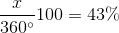
Begin by dividing over the 100

Then multiply by 360

Sector TYP occupies 43% of a circle. Find the degree measure of angle TYP.
Use the following formula and solve for x:
Begin by dividing over the 100
Then multiply by 360
← Didn't Know|Knew It →
If sector AJL covers 45% of circle J, what is the measure of sector AJL's central angle?
If sector AJL covers 45% of circle J, what is the measure of sector AJL's central angle?
Tap to reveal answer
If sector AJL covers 45% of circle J, what is the measure of sector AJL's central angle?
To find an angle measure from a percentage, simply convert the percentage to a decimal and then multiply it by 360 degrees.


So, our answer is 162 degrees.
If sector AJL covers 45% of circle J, what is the measure of sector AJL's central angle?
To find an angle measure from a percentage, simply convert the percentage to a decimal and then multiply it by 360 degrees.
So, our answer is 162 degrees.
← Didn't Know|Knew It →
Sector SOW has a central angle of  . What percentage of the circle does it cover?
Sector SOW has a central angle of
Tap to reveal answer
Sector SOW has a central angle of  . What percentage of the circle does it cover?
Recall that there is a total of 360 degrees in a circle. SOW occupies 45 of them. To find the percentage, simply do the following:

Sector SOW has a central angle of
Recall that there is a total of 360 degrees in a circle. SOW occupies 45 of them. To find the percentage, simply do the following:
← Didn't Know|Knew It →
While visiting a history museum, you see a radar display which consists of a circular screen with a highlighted wedge with an angle of  . What percentage of the circle is highlighted?
While visiting a history museum, you see a radar display which consists of a circular screen with a highlighted wedge with an angle of
Tap to reveal answer
While visiting a history museum, you see a radar display which consists of a circular screen with a highlighted wedge with an angle of  . What percentage of the circle is highlighted?
To find the percentage of a sector, simply put the degree measure of the angle over 360 and multiply by 100.

So, our answer is 18.06%
While visiting a history museum, you see a radar display which consists of a circular screen with a highlighted wedge with an angle of
To find the percentage of a sector, simply put the degree measure of the angle over 360 and multiply by 100.
So, our answer is 18.06%
← Didn't Know|Knew It →
A giant clock has a minute hand four feet long. Since noon, the tip of the minute hand has traveled  feet. What time is it now?
A giant clock has a minute hand four feet long. Since noon, the tip of the minute hand has traveled
Tap to reveal answer
The circumference of the path traveled by the tip of the minute hand over the course of one hour is:
 feet.
feet.
Since the tip of the minute hand has traveled  feet since noon, the minute hand has made
 revolutions. Therefore,
  hours have elapsed since noon, making the time 1:15 PM.
The circumference of the path traveled by the tip of the minute hand over the course of one hour is:
Since the tip of the minute hand has traveled
← Didn't Know|Knew It →

Note: Figure NOT drawn to scale
Refer to the above diagram. is a semicircle. Evaluate
  .
.
Note: Figure NOT drawn to scale
Refer to the above diagram.
Tap to reveal answer
An inscribed angle of a circle that intercepts a semicircle is a right angle; therefore,  , which intercepts the semicircle
  , is such an angle. Consequently,


Inscribed  intercepts an arc with twice its angle measure; this arc is
  , so
, so
 .
.
An inscribed angle of a circle that intercepts a semicircle is a right angle; therefore,
Inscribed
← Didn't Know|Knew It →

Figure NOT drawn to scale
Refer to the above diagram. is a semicircle. Evaluate
  given
given  .
.
Figure NOT drawn to scale
Refer to the above diagram.
Tap to reveal answer
An inscribed angle of a circle that intercepts a semicircle is a right angle; therefore, , which intercepts the semicircle  , is such an angle. Consequently,
  is a right triangle, and
  and
and  are complementary angles. Therefore,


Inscribed intercepts an arc with twice its angle measure; this arc is  , so
, so
 .
.
The major arc corresponding to this minor arc,  , has measure

An inscribed angle of a circle that intercepts a semicircle is a right angle; therefore,
Inscribed
The major arc corresponding to this minor arc,
← Didn't Know|Knew It →
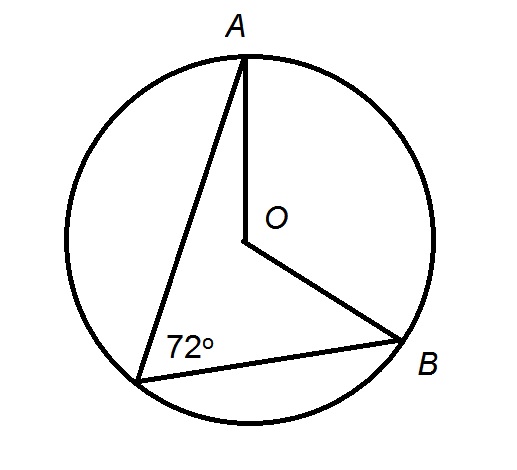
In the above diagram, radius  .
.
Calculate the length of  .
.
In the above diagram, radius
Calculate the length of
Tap to reveal answer
Inscribed  , which measures
  , intercepts an arc with twice its measure. That arc is
  , which consequently has measure
 .
.
This makes an arc which comprises

of the circle.
The circumference of a circle is  multiplied by its radius, so
 .
.
The length of is  of this, or
  .
.
Inscribed
This makes
of the circle.
The circumference of a circle is
The length of
← Didn't Know|Knew It →
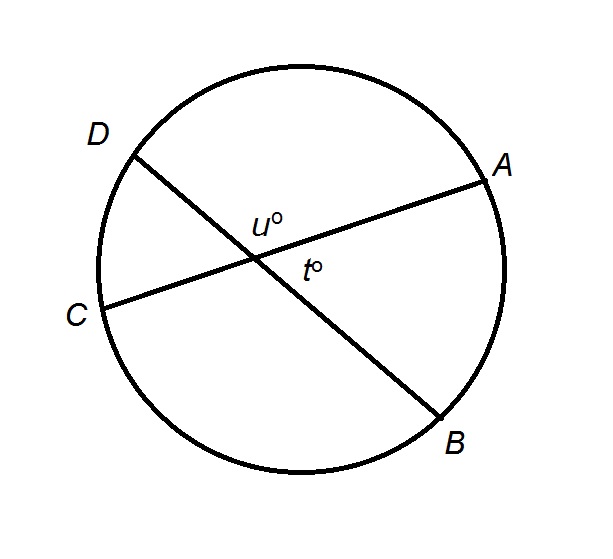
Figure NOT drawn to scale.
The circumference of the above circle is 100.  and
and  have lengths 20 and 15, respectively. Evaluate
  .
.
Figure NOT drawn to scale.
The circumference of the above circle is 100.
Tap to reveal answer
The length of  comprises
  of the circumference of the circle. Therefore, its degree measure is
 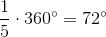 . Similarly, The length of
  comprises
  of the circumference of the circle. Therefore, its degree measure is
 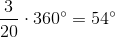 .
.
If two chords cut each other inside the circle, as  and
and  do, and one pair of vertical angles are examined, then the degree measure of each angle is half the sum of those of the arcs intercepted - that is,
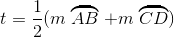
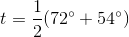


The length of
If two chords cut each other inside the circle, as
← Didn't Know|Knew It →
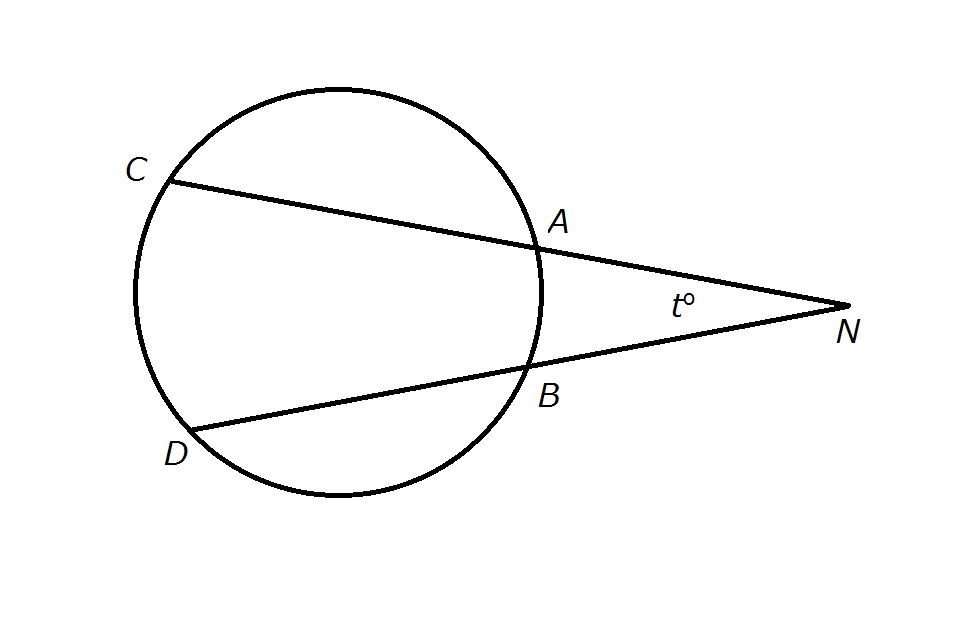
Figure NOT drawn to scale.
The circumference of the above circle is 120.  and
and  have lengths 10 and 20, respectively. Evaluate
  .
.
Figure NOT drawn to scale.
The circumference of the above circle is 120.
Tap to reveal answer
The length of  comprises
  of the circumference of the circle. Therefore, its degree measure is
 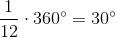 . Similarly, The length of
  comprises
  of the circumference of the circle. Therefore, its degree measure is
 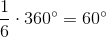 .
.
If two secants are constructed to a circle from an outside point, the degree measure of the angle the secants form is half the difference of those of the arcs intercepted - that is,
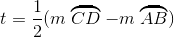
 .
.
The length of
If two secants are constructed to a circle from an outside point, the degree measure of the angle the secants form is half the difference of those of the arcs intercepted - that is,
← Didn't Know|Knew It →
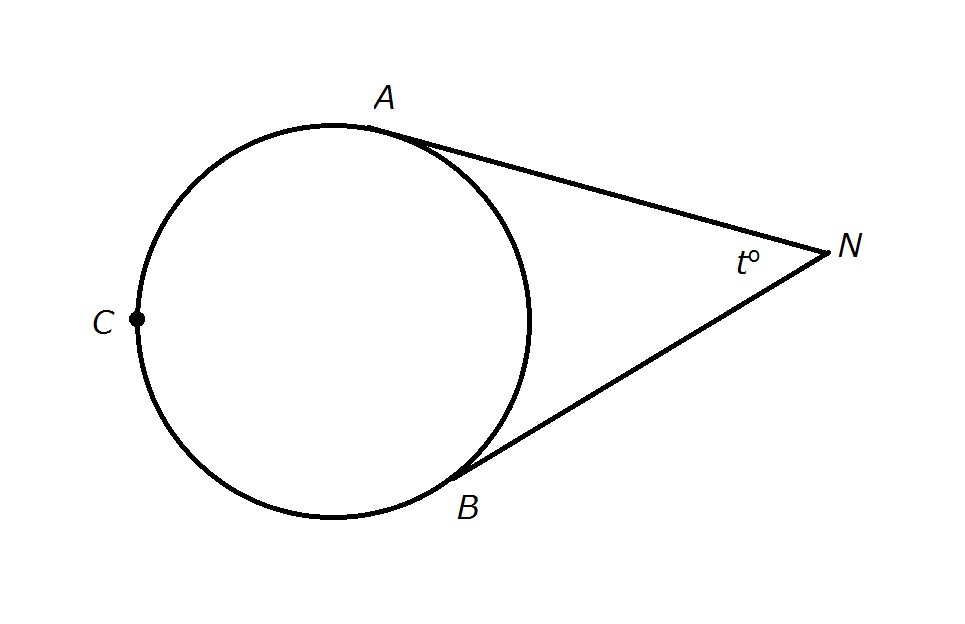
Figure NOT drawn to scale.
Refer to the above diagram.  and
and  have lengths 80 and 160, respectively. Evaluate
  .
.
Figure NOT drawn to scale.
Refer to the above diagram.
Tap to reveal answer
The circumference of the circle is the sum of the two arc lengths:

The length of  comprises
  of the circumference of the circle. Therefore, its degree measure is
 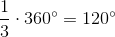 . Consequently,
  is an arc of degree measure
  .
.
The segments shown are both tangents from  to the circle. Consequently, the degree measure of the angle they form is half the difference of the angle measures of the arcs they intercept - that is,


The circumference of the circle is the sum of the two arc lengths:
The length of
The segments shown are both tangents from
← Didn't Know|Knew It →
A giant clock has a minute hand four feet long. Since noon, the tip of the minute hand has traveled feet. What time is it now?
A giant clock has a minute hand four feet long. Since noon, the tip of the minute hand has traveled
Tap to reveal answer
The circumference of the path traveled by the tip of the minute hand over the course of one hour is:
feet.
Since the tip of the minute hand has traveled feet since noon, the minute hand has made
revolutions. Therefore, hours have elapsed since noon, making the time 1:15 PM.
The circumference of the path traveled by the tip of the minute hand over the course of one hour is:
Since the tip of the minute hand has traveled
← Didn't Know|Knew It →
Note: Figure NOT drawn to scale
Refer to the above diagram. is a semicircle. Evaluate .
Note: Figure NOT drawn to scale
Refer to the above diagram.
Tap to reveal answer
An inscribed angle of a circle that intercepts a semicircle is a right angle; therefore, , which intercepts the semicircle , is such an angle. Consequently,
Inscribed intercepts an arc with twice its angle measure; this arc is , so
.
An inscribed angle of a circle that intercepts a semicircle is a right angle; therefore,
Inscribed
← Didn't Know|Knew It →
Figure NOT drawn to scale
Refer to the above diagram. is a semicircle. Evaluate given .
Figure NOT drawn to scale
Refer to the above diagram.
Tap to reveal answer
An inscribed angle of a circle that intercepts a semicircle is a right angle; therefore, , which intercepts the semicircle , is such an angle. Consequently, is a right triangle, and and are complementary angles. Therefore,
Inscribed intercepts an arc with twice its angle measure; this arc is , so
.
The major arc corresponding to this minor arc, , has measure
An inscribed angle of a circle that intercepts a semicircle is a right angle; therefore,
Inscribed
The major arc corresponding to this minor arc,
← Didn't Know|Knew It →
In the above diagram, radius .
Calculate the length of .
In the above diagram, radius
Calculate the length of
Tap to reveal answer
Inscribed , which measures , intercepts an arc with twice its measure. That arc is , which consequently has measure
.
This makes an arc which comprises
of the circle.
The circumference of a circle is multiplied by its radius, so
.
The length of is of this, or .
Inscribed
This makes
of the circle.
The circumference of a circle is
The length of
← Didn't Know|Knew It →
Figure NOT drawn to scale.
The circumference of the above circle is 100. and have lengths 20 and 15, respectively. Evaluate .
Figure NOT drawn to scale.
The circumference of the above circle is 100.
Tap to reveal answer
The length of comprises of the circumference of the circle. Therefore, its degree measure is . Similarly, The length of comprises of the circumference of the circle. Therefore, its degree measure is .
If two chords cut each other inside the circle, as and do, and one pair of vertical angles are examined, then the degree measure of each angle is half the sum of those of the arcs intercepted - that is,
The length of
If two chords cut each other inside the circle, as
← Didn't Know|Knew It →
Figure NOT drawn to scale.
The circumference of the above circle is 120. and have lengths 10 and 20, respectively. Evaluate .
Figure NOT drawn to scale.
The circumference of the above circle is 120.
Tap to reveal answer
The length of comprises of the circumference of the circle. Therefore, its degree measure is . Similarly, The length of comprises of the circumference of the circle. Therefore, its degree measure is .
If two secants are constructed to a circle from an outside point, the degree measure of the angle the secants form is half the difference of those of the arcs intercepted - that is,
.
The length of
If two secants are constructed to a circle from an outside point, the degree measure of the angle the secants form is half the difference of those of the arcs intercepted - that is,
← Didn't Know|Knew It →
Figure NOT drawn to scale.
Refer to the above diagram. and have lengths 80 and 160, respectively. Evaluate .
Figure NOT drawn to scale.
Refer to the above diagram.
Tap to reveal answer
The circumference of the circle is the sum of the two arc lengths:
The length of comprises of the circumference of the circle. Therefore, its degree measure is . Consequently, is an arc of degree measure .
The segments shown are both tangents from to the circle. Consequently, the degree measure of the angle they form is half the difference of the angle measures of the arcs they intercept - that is,
The circumference of the circle is the sum of the two arc lengths:
The length of
The segments shown are both tangents from
← Didn't Know|Knew It →
Sector TYP occupies 43% of a circle. Find the degree measure of angle TYP.
Sector TYP occupies 43% of a circle. Find the degree measure of angle TYP.
Tap to reveal answer
Sector TYP occupies 43% of a circle. Find the degree measure of angle TYP.
Use the following formula and solve for x:
Begin by dividing over the 100
Then multiply by 360
Sector TYP occupies 43% of a circle. Find the degree measure of angle TYP.
Use the following formula and solve for x:
Begin by dividing over the 100
Then multiply by 360
← Didn't Know|Knew It →
If sector AJL covers 45% of circle J, what is the measure of sector AJL's central angle?
If sector AJL covers 45% of circle J, what is the measure of sector AJL's central angle?
Tap to reveal answer
If sector AJL covers 45% of circle J, what is the measure of sector AJL's central angle?
To find an angle measure from a percentage, simply convert the percentage to a decimal and then multiply it by 360 degrees.
So, our answer is 162 degrees.
If sector AJL covers 45% of circle J, what is the measure of sector AJL's central angle?
To find an angle measure from a percentage, simply convert the percentage to a decimal and then multiply it by 360 degrees.
So, our answer is 162 degrees.
← Didn't Know|Knew It →