Plane Geometry - ISEE Upper Level Quantitative Reasoning
Card 1 of 1260

Examine the above diagram. If  , give
  in terms of
  .
.
Examine the above diagram. If
Tap to reveal answer
The two marked angles are same-side exterior angles of parallel lines, which are supplementary - that is, their measures have sum 180. We can solve for  in this equation:


The two marked angles are same-side exterior angles of parallel lines, which are supplementary - that is, their measures have sum 180. We can solve for
← Didn't Know|Knew It →

Examine the above diagram. If  , give
  in terms of
  .
.
Examine the above diagram. If
Tap to reveal answer
The two marked angles are same-side interior angles of parallel lines, which are supplementary - that is, their measures have sum 180. We can solve for  in this equation:


The two marked angles are same-side interior angles of parallel lines, which are supplementary - that is, their measures have sum 180. We can solve for
← Didn't Know|Knew It →

Examine the above diagram. Which of the following statements must be true whether or not  and
and  are parallel?
Examine the above diagram. Which of the following statements must be true whether or not
Tap to reveal answer
Four statements can be eliminated by the various parallel theorems and postulates. Congruence of alternate interior angles or corresponding angles forces the lines to be parallel, so
 and
and
 .
.
Also, if same-side interior angles or same-side exterior angles are supplementary, the lines are parallel, so
 and
and
 .
.
However,  whether or not
  since they are vertical angles, which are always congruent.
Four statements can be eliminated by the various parallel theorems and postulates. Congruence of alternate interior angles or corresponding angles forces the lines to be parallel, so
Also, if same-side interior angles or same-side exterior angles are supplementary, the lines are parallel, so
However,
← Didn't Know|Knew It →

Examine the above diagram. What is  ?
?
Examine the above diagram. What is
Tap to reveal answer
By angle addition,


By angle addition,
← Didn't Know|Knew It →
 and
and  are supplementary;
  and
and  are complementary.
 .
.
What is  ?
?
What is
Tap to reveal answer
Supplementary angles and complementary angles have measures totaling  and
and  , respectively.
 , so its supplement
  has measure

 , the complement of
  , has measure

Supplementary angles and complementary angles have measures totaling
← Didn't Know|Knew It →

Note: Figure NOT drawn to scale.
In the above figure,  and
and  . Which of the following is equal to
  ?
?
Note: Figure NOT drawn to scale.
In the above figure,
Tap to reveal answer
 and
and  form a linear pair, so their angle measures total
  . Set up and solve the following equation:


← Didn't Know|Knew It →
Two angles which form a linear pair have measures  and
and  . Which is the lesser of the measures (or the common measure) of the two angles?
Two angles which form a linear pair have measures
Tap to reveal answer
Two angles that form a linear pair are supplementary - that is, they have measures that total . Therefore, we set and solve for  in this equation:


The two angles have measure

and

 is the lesser of the two measures and is the correct choice.
Two angles that form a linear pair are supplementary - that is, they have measures that total
The two angles have measure
and
← Didn't Know|Knew It →
Two vertical angles have measures  and
and  . Which is the lesser of the measures (or the common measure) of the two angles?
Two vertical angles have measures
Tap to reveal answer
Two vertical angles - angles which share a vertex and whose union is a pair of lines - have the same measure. Therefore, we set up and solve the equation


Two vertical angles - angles which share a vertex and whose union is a pair of lines - have the same measure. Therefore, we set up and solve the equation
← Didn't Know|Knew It →
A line  intersects parallel lines
  and
and  .
.  and
and  are corresponding angles;
  and
and  are same side interior angles.


Evaluate  .
.
A line
Evaluate
Tap to reveal answer
When a transversal such as  crosses two parallel lines, two corresponding angles - angles in the same relative position to their respective lines - are congruent. Therefore,


Two same-side interior angles are supplementary - that is, their angle measures total 180 - so


We can solve this system by the substitution method as follows:


Backsolve:


 , which is the correct response.
When a transversal such as
Two same-side interior angles are supplementary - that is, their angle measures total 180 - so
We can solve this system by the substitution method as follows:
Backsolve:
← Didn't Know|Knew It →

Note: Figure NOT drawn to scale.
Refer to the above diagram. Give the measure of  .
.
Note: Figure NOT drawn to scale.
Refer to the above diagram. Give the measure of
Tap to reveal answer
The top and bottom angles, being vertical angles - angles which share a vertex and whose union is a pair of lines - have the same measure, so
 ,
,
or, simplified,


The right and bottom angles form a linear pair, so their degree measures total 180. That is,

Substitute  for
for  :
:


The left and right angles, being vertical angles, have the same measure, so, since the right angle measures  , this is also the measure of the left angle,
  .
.
The top and bottom angles, being vertical angles - angles which share a vertex and whose union is a pair of lines - have the same measure, so
or, simplified,
The right and bottom angles form a linear pair, so their degree measures total 180. That is,
Substitute
The left and right angles, being vertical angles, have the same measure, so, since the right angle measures
← Didn't Know|Knew It →
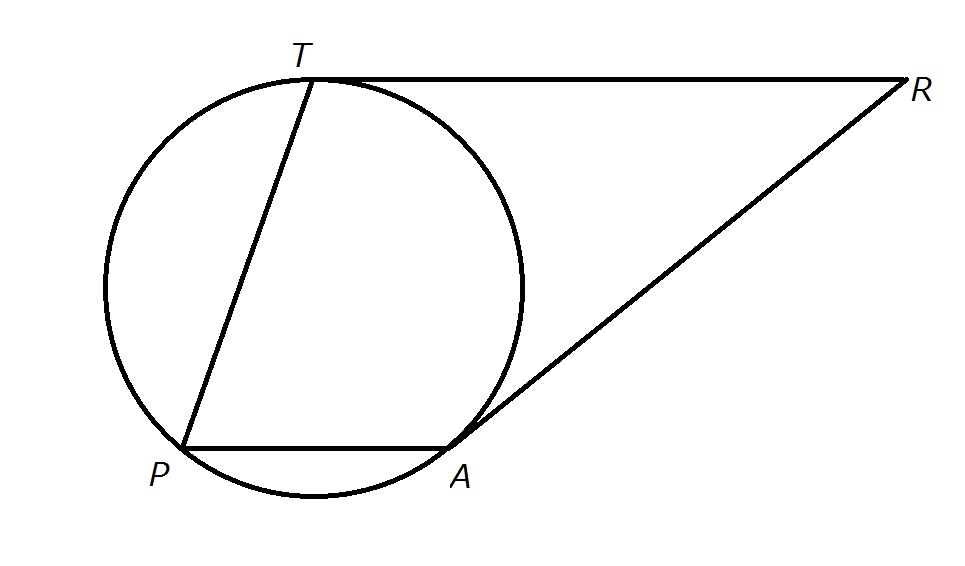
Figure NOT drawn to scale
The above figure shows Trapezoid  , with
  and
and  tangent to the circle.
  ; evaluate
  .
.
Figure NOT drawn to scale
The above figure shows Trapezoid
Tap to reveal answer
By the Same-Side Interior Angle Theorem, since  ,
,  and
and  are supplementary - that is, their degree measures total
  . Therefore,



 is an inscribed angle, so the arc it intercepts,
  , has twice its degree measure;
 .
.
The corresponding major arc,  , has as its measure

The measure of an angle formed by two tangents to a circle is equal to half the difference of those of its intercepted arcs:


Again, by the Same-Side Interior Angles Theorem,  and
and  are supplementary, so



By the Same-Side Interior Angle Theorem, since
The corresponding major arc,
The measure of an angle formed by two tangents to a circle is equal to half the difference of those of its intercepted arcs:
Again, by the Same-Side Interior Angles Theorem,
← Didn't Know|Knew It →
A right triangle has a hypotenuse of 10 and a side of 6. What is the missing side?
A right triangle has a hypotenuse of 10 and a side of 6. What is the missing side?
Tap to reveal answer
To find the missing side, use the Pythagorean Theorem  . Plug in (remember c is always the hypotenuse!) so that
  . Simplify and you get
  Subtract 36 from both sides so that you get
  Take the square root of both sides. B is 8.
To find the missing side, use the Pythagorean Theorem
← Didn't Know|Knew It →

Note: Figure NOT drawn to scale.
Refer to the above diagram.

Find the length of  .
.
Note: Figure NOT drawn to scale.
Refer to the above diagram.
Find the length of
Tap to reveal answer
First, find  .
.
Since  is an altitude of right
  to its hypotenuse,


 by the Angle-Angle Postulate, so


First, find
Since
← Didn't Know|Knew It →
Note: Figure NOT drawn to scale.
Refer to the above diagram.

Find the length of  .
.
Note: Figure NOT drawn to scale.
Refer to the above diagram.
Find the length of
Tap to reveal answer
First, find  .
.
Since  is an altitude of
  from its right angle to its hypotenuse,


 by the Angle-Angle Postulate, so


First, find
Since
← Didn't Know|Knew It →

Note: Figure NOT drawn to scale.
Refer to the above diagram. Evaluate  .
.
Note: Figure NOT drawn to scale.
Refer to the above diagram. Evaluate
Tap to reveal answer
By the Pythagorean Theorem,


By the Pythagorean Theorem,
← Didn't Know|Knew It →

Note: Figure NOT drawn to scale.
Refer to the above diagram. Which of the following quadratic equations would yield the value of  as a solution?
Note: Figure NOT drawn to scale.
Refer to the above diagram. Which of the following quadratic equations would yield the value of
Tap to reveal answer
By the Pythagorean Theorem,


By the Pythagorean Theorem,
← Didn't Know|Knew It →

Refer to the above diagram. Which of the following quadratic equations would yield the value of  as a solution?
Refer to the above diagram. Which of the following quadratic equations would yield the value of
Tap to reveal answer
By the Pythagorean Theorem,


By the Pythagorean Theorem,
← Didn't Know|Knew It →
A right triangle  with hypotenuse
  is inscribed in
  , a circle with radius 26. If
  , evaluate the length of
  .
.
A right triangle
Tap to reveal answer
The arcs intercepted by a right angle are both semicircles, so hypotenuse  shares its endpoints with two semicircles. This makes a diameter of the circle, and
  .
.
By the Pythagorean Theorem,

The arcs intercepted by a right angle are both semicircles, so hypotenuse
By the Pythagorean Theorem,
← Didn't Know|Knew It →
Sector TYP occupies 43% of a circle. Find the degree measure of angle TYP.
Sector TYP occupies 43% of a circle. Find the degree measure of angle TYP.
Tap to reveal answer
Sector TYP occupies 43% of a circle. Find the degree measure of angle TYP.
Use the following formula and solve for x:
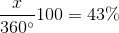
Begin by dividing over the 100

Then multiply by 360

Sector TYP occupies 43% of a circle. Find the degree measure of angle TYP.
Use the following formula and solve for x:
Begin by dividing over the 100
Then multiply by 360
← Didn't Know|Knew It →
If sector AJL covers 45% of circle J, what is the measure of sector AJL's central angle?
If sector AJL covers 45% of circle J, what is the measure of sector AJL's central angle?
Tap to reveal answer
If sector AJL covers 45% of circle J, what is the measure of sector AJL's central angle?
To find an angle measure from a percentage, simply convert the percentage to a decimal and then multiply it by 360 degrees.


So, our answer is 162 degrees.
If sector AJL covers 45% of circle J, what is the measure of sector AJL's central angle?
To find an angle measure from a percentage, simply convert the percentage to a decimal and then multiply it by 360 degrees.
So, our answer is 162 degrees.
← Didn't Know|Knew It →