How to add exponents - ISEE Upper Level Quantitative Reasoning
Card 1 of 44
Simplify the expression:

Simplify the expression:
Tap to reveal answer


← Didn't Know|Knew It →
Simplify:

Simplify:
Tap to reveal answer
In order to add exponential terms, both the base and the exponent must be the same. So we can write:


In order to add exponential terms, both the base and the exponent must be the same. So we can write:
← Didn't Know|Knew It →
Evaluate:

Evaluate:
Tap to reveal answer
Based on the zero-exponent rule we have:

That means any non-zero number raised to the zero power is equal to  . So we can write:
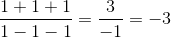
Based on the zero-exponent rule we have:
That means any non-zero number raised to the zero power is equal to
← Didn't Know|Knew It →
Which of the following is equivalent to the expression below?

Which of the following is equivalent to the expression below?
Tap to reveal answer
When exponents are multiplied by one another, and the base is the same, the exponents can be added together.
The first step is to try to create a common base.

Given that the square of 2 is for, the expression can be rewritten as:


When exponents are multiplied by one another, and the base is the same, the exponents can be added together.
The first step is to try to create a common base.
Given that the square of 2 is for, the expression can be rewritten as:
← Didn't Know|Knew It →
What is the value of the expression:

What is the value of the expression:
Tap to reveal answer
When values, having the same base, are multiplied by one another, the exponents are added together and the base stays the same.
Thus,

is equal to

When values, having the same base, are multiplied by one another, the exponents are added together and the base stays the same.
Thus,
is equal to
← Didn't Know|Knew It →
Simplify: 
Simplify:
Tap to reveal answer
When multiplying exponents, the exponents are added together. Thus, 3 and 7 are added together for a sum of 10. In this problem, the "2" becomes a coefficient in front of the x. Therefore, the correct answer is:

When multiplying exponents, the exponents are added together. Thus, 3 and 7 are added together for a sum of 10. In this problem, the "2" becomes a coefficient in front of the x. Therefore, the correct answer is:
← Didn't Know|Knew It →
Simplify the expression:

Simplify the expression:
Tap to reveal answer
To simplify this problem we need to factor out a 


We can do this because multiplying exponents is the same as adding them. Therefore,


To simplify this problem we need to factor out a
We can do this because multiplying exponents is the same as adding them. Therefore,
← Didn't Know|Knew It →
Simplify:

Simplify:
Tap to reveal answer
When multiplying exponents, the exponents are added together.

When multiplying exponents, the exponents are added together.
← Didn't Know|Knew It →
Simplify:

Simplify:
Tap to reveal answer
When multiplying exponents, the exponents are added together.

When multiplying exponents, the exponents are added together.
← Didn't Know|Knew It →
Solve: 
Solve:
Tap to reveal answer
It is not necessary to evaluate both terms and multiply.
According to the rules of exponents, when we have the same bases raised to some power that are multiplied with each other, we can add the powers.

This term can be rewritten as a fraction.
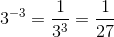
The answer is: 
It is not necessary to evaluate both terms and multiply.
According to the rules of exponents, when we have the same bases raised to some power that are multiplied with each other, we can add the powers.
This term can be rewritten as a fraction.
The answer is:
← Didn't Know|Knew It →
Simplify:

Simplify:
Tap to reveal answer
Based on the product rule for exponents in order to multiply two exponential terms with the same base, add their exponents:

So we can write:

Based on the product rule for exponents in order to multiply two exponential terms with the same base, add their exponents:
So we can write:
← Didn't Know|Knew It →
Simplify the expression:
Simplify the expression:
Tap to reveal answer
← Didn't Know|Knew It →
Simplify:
Simplify:
Tap to reveal answer
In order to add exponential terms, both the base and the exponent must be the same. So we can write:
In order to add exponential terms, both the base and the exponent must be the same. So we can write:
← Didn't Know|Knew It →
Evaluate:
Evaluate:
Tap to reveal answer
Based on the zero-exponent rule we have:
That means any non-zero number raised to the zero power is equal to . So we can write:
Based on the zero-exponent rule we have:
That means any non-zero number raised to the zero power is equal to
← Didn't Know|Knew It →
Which of the following is equivalent to the expression below?
Which of the following is equivalent to the expression below?
Tap to reveal answer
When exponents are multiplied by one another, and the base is the same, the exponents can be added together.
The first step is to try to create a common base.
Given that the square of 2 is for, the expression can be rewritten as:
When exponents are multiplied by one another, and the base is the same, the exponents can be added together.
The first step is to try to create a common base.
Given that the square of 2 is for, the expression can be rewritten as:
← Didn't Know|Knew It →
What is the value of the expression:
What is the value of the expression:
Tap to reveal answer
When values, having the same base, are multiplied by one another, the exponents are added together and the base stays the same.
Thus,
is equal to
When values, having the same base, are multiplied by one another, the exponents are added together and the base stays the same.
Thus,
is equal to
← Didn't Know|Knew It →
Simplify:
Simplify:
Tap to reveal answer
When multiplying exponents, the exponents are added together. Thus, 3 and 7 are added together for a sum of 10. In this problem, the "2" becomes a coefficient in front of the x. Therefore, the correct answer is:
When multiplying exponents, the exponents are added together. Thus, 3 and 7 are added together for a sum of 10. In this problem, the "2" becomes a coefficient in front of the x. Therefore, the correct answer is:
← Didn't Know|Knew It →
Simplify the expression:
Simplify the expression:
Tap to reveal answer
To simplify this problem we need to factor out a
We can do this because multiplying exponents is the same as adding them. Therefore,
To simplify this problem we need to factor out a
We can do this because multiplying exponents is the same as adding them. Therefore,
← Didn't Know|Knew It →
Simplify:
Simplify:
Tap to reveal answer
When multiplying exponents, the exponents are added together.
When multiplying exponents, the exponents are added together.
← Didn't Know|Knew It →
Simplify:
Simplify:
Tap to reveal answer
When multiplying exponents, the exponents are added together.
When multiplying exponents, the exponents are added together.
← Didn't Know|Knew It →