How to find the area of a square - ISEE Upper Level Quantitative Reasoning
Card 1 of 60
A square is made into a rectangle by increasing the width by 20% and decreasing the length by 20%. By what percentage has the area of the square changed?
A square is made into a rectangle by increasing the width by 20% and decreasing the length by 20%. By what percentage has the area of the square changed?
Tap to reveal answer
The area decreases by 20% of 20%, which is 4%.
The easiest way to see this is to plug in numbers for the sides of the square. If we are using percentages, it is easiest to use factors of 10 or 100. In this case we will say that the square has a side length of 10.
10% of 10 is 1, so 20% is 2. Now we can just increase one of the sides by 2, and decrease another side by 2. So our rectangle has dimensions of 12 x 8 instead of 10 x 10.
The original square had an area of 100, and the new rectangle has an area of 96. So the rectangle is 4 square units smaller, which is 4% smaller than the original square.
The area decreases by 20% of 20%, which is 4%.
The easiest way to see this is to plug in numbers for the sides of the square. If we are using percentages, it is easiest to use factors of 10 or 100. In this case we will say that the square has a side length of 10.
10% of 10 is 1, so 20% is 2. Now we can just increase one of the sides by 2, and decrease another side by 2. So our rectangle has dimensions of 12 x 8 instead of 10 x 10.
The original square had an area of 100, and the new rectangle has an area of 96. So the rectangle is 4 square units smaller, which is 4% smaller than the original square.
← Didn't Know|Knew It →
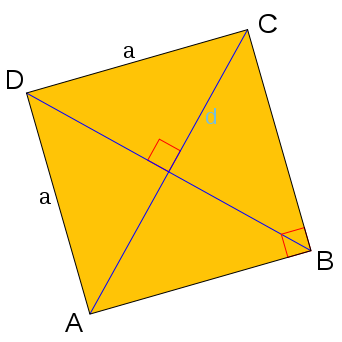
Side  shown in the diagram of square
  below is equal to 21cm. What is the area of
  ?
?
Side
Tap to reveal answer
To find the area of a quadrilateral, multiply length times width. In a square, since all sides are equal,  is both the length and width.

To find the area of a quadrilateral, multiply length times width. In a square, since all sides are equal,
← Didn't Know|Knew It →
If Amy is carpeting her living room, which meaures  feet by
  feet, how many square feet of carpet will she need?
If Amy is carpeting her living room, which meaures
Tap to reveal answer
To find the area of the floor, multiply the length of the room by the width (which is the same forumla used to find the area of a square). The equation can be written: 
Substitute  feet for
  and
and  feet for
  :
:

Amy will need  of carpet.
To find the area of the floor, multiply the length of the room by the width (which is the same forumla used to find the area of a square). The equation can be written:
Substitute
Amy will need
← Didn't Know|Knew It →
A rectangle and a square have the same perimeter. The rectangle has length  centimeters and width
  centimeters. Give the area of the square.
A rectangle and a square have the same perimeter. The rectangle has length
Tap to reveal answer
The perimeter of the rectangle is
 centimeters.
This is also the perimeter of the square, so divide this by  to get its sidelength:
 centimeters.
The area is the square of this, or  square centimeters.
The perimeter of the rectangle is
This is also the perimeter of the square, so divide this by
The area is the square of this, or
← Didn't Know|Knew It →
Four squares have sidelengths 4 inches, 8 inches, 12 inches, and 16 inches. What is the average of their areas?
Four squares have sidelengths 4 inches, 8 inches, 12 inches, and 16 inches. What is the average of their areas?
Tap to reveal answer
The areas of the four squares can be calculated by squaring their sidelengths. Add these areas, then divide by 4:
 square inches
The areas of the four squares can be calculated by squaring their sidelengths. Add these areas, then divide by 4:
← Didn't Know|Knew It →
Which of the following is equal to the area of a square with sidelength  yards?
Which of the following is equal to the area of a square with sidelength
Tap to reveal answer
Multiply the sidelength by 36 to convert from yards to inches:

Square this to get the area:
 square inches
Multiply the sidelength by 36 to convert from yards to inches:
Square this to get the area:
← Didn't Know|Knew It →
What is the area of a square in which the length of one side is equal to  ?
?
What is the area of a square in which the length of one side is equal to
Tap to reveal answer
The area of a square is equal to the product of one side multiplied by another side. Therefore, the area will be equal to:

The next step is to convert the fractions being added together to a form in which they have a common denominator. This gives us:

The area of a square is equal to the product of one side multiplied by another side. Therefore, the area will be equal to:
The next step is to convert the fractions being added together to a form in which they have a common denominator. This gives us:
← Didn't Know|Knew It →
One of the sides of a square on the coordinate plane has its endpoints at the points with coordinates  and
and  . What is the area of this square?
One of the sides of a square on the coordinate plane has its endpoints at the points with coordinates
Tap to reveal answer
The length of a segment with endpoints  and
and  can be found using the distance formula with
  ,
,  ,
,  ,
,  :
:



This is the length of one side of the square, so the area is the square of this, or 122.
The length of a segment with endpoints
This is the length of one side of the square, so the area is the square of this, or 122.
← Didn't Know|Knew It →
One of the sides of a square on the coordinate plane has its endpoint at the points with coordinates  and
and  , where
  and
and  are both positive. Give the area of the square in terms of
  and
and  .
.
One of the sides of a square on the coordinate plane has its endpoint at the points with coordinates
Tap to reveal answer
The length of a segment with endpoints  and
and  can be found using the distance formula as follows:


This is the length of one side of the square, so the area is the square of this, or  .
.
The length of a segment with endpoints
This is the length of one side of the square, so the area is the square of this, or
← Didn't Know|Knew It →
One of the vertices of a square is at the origin. The square has area 13. Which of the following could be the vertex of the square opposite that at the origin?
One of the vertices of a square is at the origin. The square has area 13. Which of the following could be the vertex of the square opposite that at the origin?
Tap to reveal answer
Since a square is a rhombus, one way to calculate the area of a square is to take half the square of the length of a diagonal. If we let  be the length of each diagonal, then


Therefore, we want to choose the point that is  units from the origin. Using the distance formula, we see that
  is such a point:


Of the other points:
 :
:


 :
:


 :
:


Since a square is a rhombus, one way to calculate the area of a square is to take half the square of the length of a diagonal. If we let
Therefore, we want to choose the point that is
Of the other points:
← Didn't Know|Knew It →
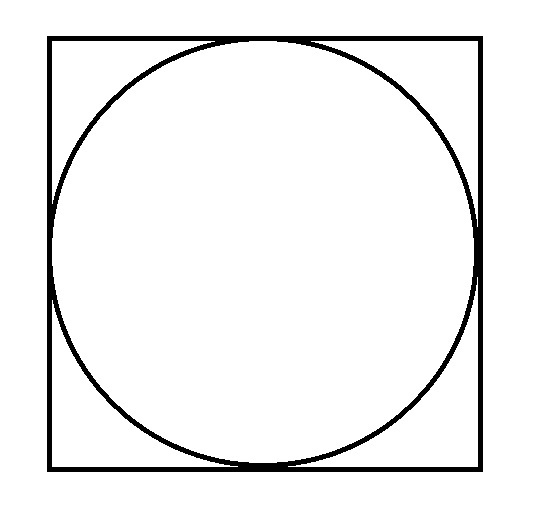
In the above diagram, the circle is inscribed inside the square. The circle has area 30. What is the area of the square?
In the above diagram, the circle is inscribed inside the square. The circle has area 30. What is the area of the square?
Tap to reveal answer

In terms of  , the area of the circle is equal to
 .
.
Each side of the square has length equal to the diameter,  , so its area is the square of this, or

Therefore, the ratio of the area of the square to that of the circle is

Therefore, the area of the circle is multiplied by this ratio to get the area of the square:


Substituting:

In terms of
Each side of the square has length equal to the diameter,
Therefore, the ratio of the area of the square to that of the circle is
Therefore, the area of the circle is multiplied by this ratio to get the area of the square:
Substituting:
← Didn't Know|Knew It →
One of your holiday gifts is wrapped in a cube-shaped box.
If one of the edges has a length of 6 inches, what is the area of one side of the box?
One of your holiday gifts is wrapped in a cube-shaped box.
If one of the edges has a length of 6 inches, what is the area of one side of the box?
Tap to reveal answer
One of your holiday gifts is wrapped in a cube-shaped box.
If one of the edges has a length of 6 inches, what is the area of one side of the box?
We are asked to find the area of one side of a cube, in other words, the area of a square.
We can find the area of a square by squaring the length of the side.

One of your holiday gifts is wrapped in a cube-shaped box.
If one of the edges has a length of 6 inches, what is the area of one side of the box?
We are asked to find the area of one side of a cube, in other words, the area of a square.
We can find the area of a square by squaring the length of the side.
← Didn't Know|Knew It →
Find the area of a square with a base of 9cm.
Find the area of a square with a base of 9cm.
Tap to reveal answer
To find the area of a square, we will use the following formula:

where l is the length and w is the width of the square.
Now, we know the base (or length) of the square is 9cm. Because it is a square, all sides are equal. Therefore, the width is also 9cm.
Knowing this, we can substitute into the formula. We get


To find the area of a square, we will use the following formula:
where l is the length and w is the width of the square.
Now, we know the base (or length) of the square is 9cm. Because it is a square, all sides are equal. Therefore, the width is also 9cm.
Knowing this, we can substitute into the formula. We get
← Didn't Know|Knew It →
While out walking, you find a strange, square-shaped piece of metal. If the side length of the piece is 26 inches, what is the area of the square?
While out walking, you find a strange, square-shaped piece of metal. If the side length of the piece is 26 inches, what is the area of the square?
Tap to reveal answer
While out walking, you find a strange, square-shaped piece of metal. If the side length of the piece is 26 inches, what is the area of the square?
To find the area of a square, simply square the side length:

So, our answer is:

While out walking, you find a strange, square-shaped piece of metal. If the side length of the piece is 26 inches, what is the area of the square?
To find the area of a square, simply square the side length:
So, our answer is:
← Didn't Know|Knew It →
What is the area of the square with a side length of  ?
?
What is the area of the square with a side length of
Tap to reveal answer
Write the formula for the area of a square.

Substitute the side into the formula.


The answer is: 
Write the formula for the area of a square.
Substitute the side into the formula.
The answer is:
← Didn't Know|Knew It →
A rectangle and a square have the same perimeter. The rectangle has length centimeters and width centimeters. Give the area of the square.
A rectangle and a square have the same perimeter. The rectangle has length
Tap to reveal answer
The perimeter of the rectangle is
centimeters.
This is also the perimeter of the square, so divide this by to get its sidelength:
centimeters.
The area is the square of this, or square centimeters.
The perimeter of the rectangle is
This is also the perimeter of the square, so divide this by
The area is the square of this, or
← Didn't Know|Knew It →
A square is made into a rectangle by increasing the width by 20% and decreasing the length by 20%. By what percentage has the area of the square changed?
A square is made into a rectangle by increasing the width by 20% and decreasing the length by 20%. By what percentage has the area of the square changed?
Tap to reveal answer
The area decreases by 20% of 20%, which is 4%.
The easiest way to see this is to plug in numbers for the sides of the square. If we are using percentages, it is easiest to use factors of 10 or 100. In this case we will say that the square has a side length of 10.
10% of 10 is 1, so 20% is 2. Now we can just increase one of the sides by 2, and decrease another side by 2. So our rectangle has dimensions of 12 x 8 instead of 10 x 10.
The original square had an area of 100, and the new rectangle has an area of 96. So the rectangle is 4 square units smaller, which is 4% smaller than the original square.
The area decreases by 20% of 20%, which is 4%.
The easiest way to see this is to plug in numbers for the sides of the square. If we are using percentages, it is easiest to use factors of 10 or 100. In this case we will say that the square has a side length of 10.
10% of 10 is 1, so 20% is 2. Now we can just increase one of the sides by 2, and decrease another side by 2. So our rectangle has dimensions of 12 x 8 instead of 10 x 10.
The original square had an area of 100, and the new rectangle has an area of 96. So the rectangle is 4 square units smaller, which is 4% smaller than the original square.
← Didn't Know|Knew It →
Side shown in the diagram of square below is equal to 21cm. What is the area of ?
Side
Tap to reveal answer
To find the area of a quadrilateral, multiply length times width. In a square, since all sides are equal, is both the length and width.
To find the area of a quadrilateral, multiply length times width. In a square, since all sides are equal,
← Didn't Know|Knew It →
If Amy is carpeting her living room, which meaures feet by feet, how many square feet of carpet will she need?
If Amy is carpeting her living room, which meaures
Tap to reveal answer
To find the area of the floor, multiply the length of the room by the width (which is the same forumla used to find the area of a square). The equation can be written:
Substitute feet for and feet for :
Amy will need of carpet.
To find the area of the floor, multiply the length of the room by the width (which is the same forumla used to find the area of a square). The equation can be written:
Substitute
Amy will need
← Didn't Know|Knew It →
Four squares have sidelengths 4 inches, 8 inches, 12 inches, and 16 inches. What is the average of their areas?
Four squares have sidelengths 4 inches, 8 inches, 12 inches, and 16 inches. What is the average of their areas?
Tap to reveal answer
The areas of the four squares can be calculated by squaring their sidelengths. Add these areas, then divide by 4:
square inches
The areas of the four squares can be calculated by squaring their sidelengths. Add these areas, then divide by 4:
← Didn't Know|Knew It →