How to find the length of the diagonal of a kite - ISEE Upper Level Quantitative Reasoning
Card 1 of 4
A kite has the area of  . One of the diagonals of the kite has length
  . Give the length of the other diagonal of the kite.
A kite has the area of
Tap to reveal answer
The area of a kite is half the product of the diagonals, i.e.
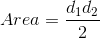 ,
,
where  and
and  are the lengths of the diagonals.

The area of a kite is half the product of the diagonals, i.e.
where
← Didn't Know|Knew It →
A kite has the area of . One of the diagonals of the kite has length . Give the length of the other diagonal of the kite.
A kite has the area of
Tap to reveal answer
The area of a kite is half the product of the diagonals, i.e.
,
where and are the lengths of the diagonals.
The area of a kite is half the product of the diagonals, i.e.
where
← Didn't Know|Knew It →
A kite has the area of . One of the diagonals of the kite has length . Give the length of the other diagonal of the kite.
A kite has the area of
Tap to reveal answer
The area of a kite is half the product of the diagonals, i.e.
,
where and are the lengths of the diagonals.
The area of a kite is half the product of the diagonals, i.e.
where
← Didn't Know|Knew It →
A kite has the area of . One of the diagonals of the kite has length . Give the length of the other diagonal of the kite.
A kite has the area of
Tap to reveal answer
The area of a kite is half the product of the diagonals, i.e.
,
where and are the lengths of the diagonals.
The area of a kite is half the product of the diagonals, i.e.
where
← Didn't Know|Knew It →