How to find the length of the side of an acute / obtuse isosceles triangle - ISEE Upper Level Quantitative Reasoning
Card 1 of 8
Two sides of an isosceles triangle have lengths 3 feet and 4 feet. Which of the following could be the length of the third side?
Two sides of an isosceles triangle have lengths 3 feet and 4 feet. Which of the following could be the length of the third side?
Tap to reveal answer
An isosceles triangle, by definition, has two sides of equal length. Having the third side measure either 3 feet or 4 feet would make the triangle meet this criterion.
3 feet is equal to  inches, and 4 feet is equal to
  inches. We choose 36 inches, since that, but not 48 inches, is a choice.
An isosceles triangle, by definition, has two sides of equal length. Having the third side measure either 3 feet or 4 feet would make the triangle meet this criterion.
3 feet is equal to
← Didn't Know|Knew It →
The triangles are similar. Solve for  .
.
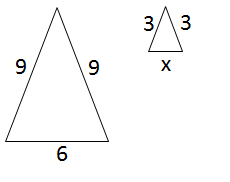
The triangles are similar. Solve for
Tap to reveal answer
Because the triangles are similar, proportions can be used to solve for the length of the side:

Cross-multiply:


Because the triangles are similar, proportions can be used to solve for the length of the side:
Cross-multiply:
← Didn't Know|Knew It →
Two sides of an isosceles triangle have lengths 3 feet and 4 feet. Which of the following could be the length of the third side?
Two sides of an isosceles triangle have lengths 3 feet and 4 feet. Which of the following could be the length of the third side?
Tap to reveal answer
An isosceles triangle, by definition, has two sides of equal length. Having the third side measure either 3 feet or 4 feet would make the triangle meet this criterion.
3 feet is equal to inches, and 4 feet is equal to inches. We choose 36 inches, since that, but not 48 inches, is a choice.
An isosceles triangle, by definition, has two sides of equal length. Having the third side measure either 3 feet or 4 feet would make the triangle meet this criterion.
3 feet is equal to
← Didn't Know|Knew It →
The triangles are similar. Solve for .
The triangles are similar. Solve for
Tap to reveal answer
Because the triangles are similar, proportions can be used to solve for the length of the side:
Cross-multiply:
Because the triangles are similar, proportions can be used to solve for the length of the side:
Cross-multiply:
← Didn't Know|Knew It →
Two sides of an isosceles triangle have lengths 3 feet and 4 feet. Which of the following could be the length of the third side?
Two sides of an isosceles triangle have lengths 3 feet and 4 feet. Which of the following could be the length of the third side?
Tap to reveal answer
An isosceles triangle, by definition, has two sides of equal length. Having the third side measure either 3 feet or 4 feet would make the triangle meet this criterion.
3 feet is equal to inches, and 4 feet is equal to inches. We choose 36 inches, since that, but not 48 inches, is a choice.
An isosceles triangle, by definition, has two sides of equal length. Having the third side measure either 3 feet or 4 feet would make the triangle meet this criterion.
3 feet is equal to
← Didn't Know|Knew It →
The triangles are similar. Solve for .
The triangles are similar. Solve for
Tap to reveal answer
Because the triangles are similar, proportions can be used to solve for the length of the side:
Cross-multiply:
Because the triangles are similar, proportions can be used to solve for the length of the side:
Cross-multiply:
← Didn't Know|Knew It →
Two sides of an isosceles triangle have lengths 3 feet and 4 feet. Which of the following could be the length of the third side?
Two sides of an isosceles triangle have lengths 3 feet and 4 feet. Which of the following could be the length of the third side?
Tap to reveal answer
An isosceles triangle, by definition, has two sides of equal length. Having the third side measure either 3 feet or 4 feet would make the triangle meet this criterion.
3 feet is equal to inches, and 4 feet is equal to inches. We choose 36 inches, since that, but not 48 inches, is a choice.
An isosceles triangle, by definition, has two sides of equal length. Having the third side measure either 3 feet or 4 feet would make the triangle meet this criterion.
3 feet is equal to
← Didn't Know|Knew It →
The triangles are similar. Solve for .
The triangles are similar. Solve for
Tap to reveal answer
Because the triangles are similar, proportions can be used to solve for the length of the side:
Cross-multiply:
Because the triangles are similar, proportions can be used to solve for the length of the side:
Cross-multiply:
← Didn't Know|Knew It →