Finding Derivatives - Math
Card 1 of 252
Find the derivative of the following function:
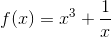
Find the derivative of the following function:
Tap to reveal answer
Since this function is a polynomial, we take the derivative of each term separately.
From the power rule, the derivative of

is simply

We can rewrite  as
as

and using the power rule again, we get a derivative of
 or
or 
So the answer is
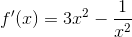
Since this function is a polynomial, we take the derivative of each term separately.
From the power rule, the derivative of
is simply
We can rewrite
and using the power rule again, we get a derivative of
So the answer is
← Didn't Know|Knew It →
Which of the following best represents  ?
?
Which of the following best represents
Tap to reveal answer
The question is just asking for the Quotient Rule formula.
Recall the Quotient Rule is the bottom function times the derivative of the top minus the top function times the derivative of the bottom all divided by the bottom function squared.
Given,
the bottom function is  and the top function is
  . This makes the bottom derivative
  and the top derivative
  .
.
Substituting these into the Quotient Rule formula resulting in the following.

The question is just asking for the Quotient Rule formula.
Recall the Quotient Rule is the bottom function times the derivative of the top minus the top function times the derivative of the bottom all divided by the bottom function squared.
Given,
the bottom function is
Substituting these into the Quotient Rule formula resulting in the following.
← Didn't Know|Knew It →
What is 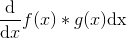
What is
Tap to reveal answer
The chain rule is "first times the derivative of the second plus second times derivative of the first".
In this case, that means  .
.
The chain rule is "first times the derivative of the second plus second times derivative of the first".
In this case, that means
← Didn't Know|Knew It →
What is the first derivative of  ?
?
What is the first derivative of
Tap to reveal answer
Since we're adding terms, we take the derivative of each part separately. For  , we can use the power rule, which states that we multiply the variable by the current exponent and then lower the exponent by one. For sine, we use our trigonometric derivative rules.
Remember, 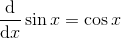 .
.


Since we're adding terms, we take the derivative of each part separately. For
Remember,
← Didn't Know|Knew It →
What is the second derivative of  ?
?
What is the second derivative of
Tap to reveal answer
To find the second derivative, we need to start by finding the first one.
Since we're adding terms, we take the derivative of each part separately. For  , we can use the power rule, which states that we multiply the variable by the current exponent and then lower the exponent by one. For sine, we use our trigonometric derivative rules.
Remember, 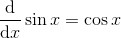 .
.


Now we repeat the process, but using  as our equation.
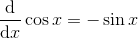


To find the second derivative, we need to start by finding the first one.
Since we're adding terms, we take the derivative of each part separately. For
Remember,
Now we repeat the process, but using
← Didn't Know|Knew It →
An ellipse is represented by the following equation:

What is the slope of the curve at the point (3,2)?
An ellipse is represented by the following equation:
What is the slope of the curve at the point (3,2)?
Tap to reveal answer
It would be difficult to differentiate this equation by isolating  . Luckily, we don't have to. Use
  to represent the derivative of
  with respect to
  and follow the chain rule.
(Remember,  is the derivative of
  with respect to
  , although it usually doesn't get written out because it is equal to 1. We'll write it out this time so you can see how implicit differentiation works.)




Now we need to isolate  by first putting all of these terms on the same side:


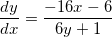
This is the equation for the derivative at any point on the curve. By substituting in (3, 2) from the original question, we can find the slope at that particular point:

It would be difficult to differentiate this equation by isolating
(Remember,
Now we need to isolate
This is the equation for the derivative at any point on the curve. By substituting in (3, 2) from the original question, we can find the slope at that particular point:
← Didn't Know|Knew It →
If  , what is
  ?
?
If
Tap to reveal answer
For this problem, we can use the power rule. The power rule states that we multiply each variable by its current exponent and then lower that exponent by one.

Simplify.

Anything to the zero power is one, so  .
.
Therefore,  .
.
For this problem, we can use the power rule. The power rule states that we multiply each variable by its current exponent and then lower that exponent by one.
Simplify.
Anything to the zero power is one, so
Therefore,
← Didn't Know|Knew It →
Find the derivative of the following function:

Find the derivative of the following function:
Tap to reveal answer
We use the power rule on each term of the function.
The first term

becomes
 .
.
The second term

becomes
 .
.
The final term, 7, is a constant, so its derivative is simply zero.
We use the power rule on each term of the function.
The first term
becomes
The second term
becomes
The final term, 7, is a constant, so its derivative is simply zero.
← Didn't Know|Knew It →
Give the average rate of change of the function  on the interval
  .
.
Give the average rate of change of the function
Tap to reveal answer
The average rate of change of  on interval
  is
is

Substitute:

The average rate of change of
Substitute:
← Didn't Know|Knew It →
What is the derivative of  ?
?
What is the derivative of
Tap to reveal answer
To get  , we can use the power rule.
Since the exponent of the  is
is  , as
, as  , we lower the exponent by one and then multiply the coefficient by that original exponent:


Anything to the  power is
  .
.


To get
Since the exponent of the
Anything to the
← Didn't Know|Knew It →
What is the derivative of  ?
?
What is the derivative of
Tap to reveal answer
To solve this problem, we can use the power rule. That means we lower the exponent of the variable by one and multiply the variable by that original exponent.


Remember that anything to the zero power is one.


To solve this problem, we can use the power rule. That means we lower the exponent of the variable by one and multiply the variable by that original exponent.
Remember that anything to the zero power is one.
← Didn't Know|Knew It →
What is the derivative of  ?
?
What is the derivative of
Tap to reveal answer
To solve this problem, we can use the power rule. That means we lower the exponent of the variable by one and multiply the variable by that original exponent.
We're going to treat  as
as  , as anything to the zero power is one.
That means this problem will look like this:

Notice that  , as anything times zero is zero.


Remember, anything to the zero power is one.


To solve this problem, we can use the power rule. That means we lower the exponent of the variable by one and multiply the variable by that original exponent.
We're going to treat
That means this problem will look like this:
Notice that
Remember, anything to the zero power is one.
← Didn't Know|Knew It →
What is the derivative of  ?
?
What is the derivative of
Tap to reveal answer
To solve this problem, we can use the power rule. That means we lower the exponent of the variable by one and multiply the variable by that original exponent.
We're going to treat  as
as  , as anything to the zero power is one.

Notice that  , as anything times zero is zero.


To solve this problem, we can use the power rule. That means we lower the exponent of the variable by one and multiply the variable by that original exponent.
We're going to treat
Notice that
← Didn't Know|Knew It →

Tap to reveal answer
To solve this equation, we can use the power rule. To use the power rule, we lower the exponent on the variable and multiply by that exponent.
We're going to treat  as
as  since anything to the zero power is one.
 "$\frac{\mathrm{d}$ }{\mathrm{d} $x}(6x^2$$+8)=(2*6x^{2-1}$$)+(0*8x^{0-1}$)")
Notice that  since anything times zero is zero.


To solve this equation, we can use the power rule. To use the power rule, we lower the exponent on the variable and multiply by that exponent.
We're going to treat
Notice that
← Didn't Know|Knew It →
What is the derivative of  ?
?
What is the derivative of
Tap to reveal answer
To solve this equation, we can use the power rule. To use the power rule, we lower the exponent on the variable and multiply by that exponent.
We're going to treat  as
as  since anything to the zero power is one.

Notice that  since anything times zero is zero.
That leaves us with  .
.
Simplify.


As stated earlier, anything to the zero power is one, leaving us with:

To solve this equation, we can use the power rule. To use the power rule, we lower the exponent on the variable and multiply by that exponent.
We're going to treat
Notice that
That leaves us with
Simplify.
As stated earlier, anything to the zero power is one, leaving us with:
← Didn't Know|Knew It →
What is the derivative of  ?
?
What is the derivative of
Tap to reveal answer
To solve this equation, we can use the power rule. To use the power rule, we lower the exponent on the variable and multiply by that exponent.
We're going to treat  as
as  since anything to the zero power is one.
 "$\frac{\mathrm{d}$ }{\mathrm{d} $x}(12x^2$$+13x+4)=(2*12x^{2-1}$$)+(1*13x^{1-1}$$)+(0*4x^{0-1}$)")
Notice that  since anything times zero is zero.


Just like it was mentioned earlier, anything to the zero power is one.


To solve this equation, we can use the power rule. To use the power rule, we lower the exponent on the variable and multiply by that exponent.
We're going to treat
Notice that
Just like it was mentioned earlier, anything to the zero power is one.
← Didn't Know|Knew It →
What is the derivative of  ?
?
What is the derivative of
Tap to reveal answer
To take the derivative of this equation, we can use the power rule. The power rule says that we lower the exponent of each variable by one and multiply that number by the original exponent.

Simplify.

Remember that anything to the zero power is equal to one.


To take the derivative of this equation, we can use the power rule. The power rule says that we lower the exponent of each variable by one and multiply that number by the original exponent.
Simplify.
Remember that anything to the zero power is equal to one.
← Didn't Know|Knew It →
What is the derivative of  ?
?
What is the derivative of
Tap to reveal answer
To take the derivative of this equation, we can use the power rule. The power rule says that we lower the exponent of each variable by one and multiply that number by the original exponent.
We are going to treat  as
as  since anything to the zero power is one.

Notice that  since anything times zero is zero.

Simplify.

As stated before, anything to the zero power is one.


To take the derivative of this equation, we can use the power rule. The power rule says that we lower the exponent of each variable by one and multiply that number by the original exponent.
We are going to treat
Notice that
Simplify.
As stated before, anything to the zero power is one.
← Didn't Know|Knew It →
What is the derivative of  ?
?
What is the derivative of
Tap to reveal answer
To find the first derivative, we can use the power rule. We lower the exponent on all the variables by one and multiply by the original variable.


Anything to the zero power is one.


To find the first derivative, we can use the power rule. We lower the exponent on all the variables by one and multiply by the original variable.
Anything to the zero power is one.
← Didn't Know|Knew It →
What is the derivative of  ?
?
What is the derivative of
Tap to reveal answer
To find the first derivative, we can use the power rule. We lower the exponent on all the variables by one and multiply by the original variable.
We're going to treat  as
as  since anything to the zero power is one.
For this problem that would look like this:

Notice that  since anything times zero is zero.


To find the first derivative, we can use the power rule. We lower the exponent on all the variables by one and multiply by the original variable.
We're going to treat
For this problem that would look like this:
Notice that
← Didn't Know|Knew It →