Linear Functions - Math
Card 1 of 408
Write  in slope-intercept form.
Write
Tap to reveal answer
Slope-intercept form is  .
.


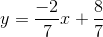
Slope-intercept form is
← Didn't Know|Knew It →
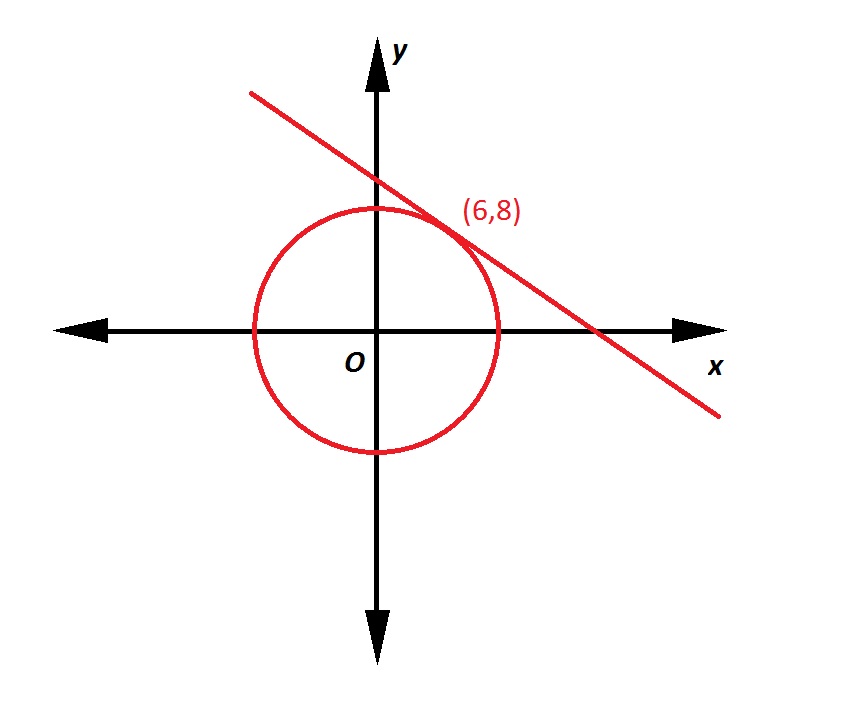
Note: Figure NOT drawn to scale.
Refer to the above figure. The circle has its center at the origin; the line is tangent to the circle at the point indicated. What is the equation of the line in slope-intercept form?
Note: Figure NOT drawn to scale.
Refer to the above figure. The circle has its center at the origin; the line is tangent to the circle at the point indicated. What is the equation of the line in slope-intercept form?
Tap to reveal answer
A line tangent to a circle at a given point is perpendicular to the radius from the center to that point. That radius, which has endpoints  , has slope
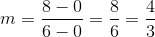 .
.
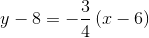
The line, being perpendicular to this radius, will have slope equal to the opposite of the reciprocal of that of the radius. This slope will be  . Since it includes point
  , we can use the point-slope form of the line to find its equation:

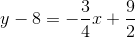

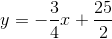
A line tangent to a circle at a given point is perpendicular to the radius from the center to that point. That radius, which has endpoints
The line, being perpendicular to this radius, will have slope equal to the opposite of the reciprocal of that of the radius. This slope will be
← Didn't Know|Knew It →
Solve:


Solve:
Tap to reveal answer
Use substution to solve this problem:
 becomes
  and then is substituted into the second equation. Then solve for
  :
:
 , so
, so  and
and  to give the solution
  .
.
Use substution to solve this problem:
← Didn't Know|Knew It →
Solve for the  - and
- and  - intercepts:

Solve for the
Tap to reveal answer
To solve for the  -intercept, set
  to zero and solve for
  :
:




To solve for the  -intercept, set
  to zero and solve for
  :
:




To solve for the
To solve for the
← Didn't Know|Knew It →
Solve:
Solve:
Tap to reveal answer
Use substution to solve this problem:
becomes and then is substituted into the second equation. Then solve for :
, so and to give the solution .
Use substution to solve this problem:
← Didn't Know|Knew It →
Solve for the - and - intercepts:
Solve for the
Tap to reveal answer
To solve for the -intercept, set to zero and solve for :
To solve for the -intercept, set to zero and solve for :
To solve for the
To solve for the
← Didn't Know|Knew It →
Which line would never intersect a line with the slope  ?
?
Which line would never intersect a line with the slope
Tap to reveal answer
This question is very simple once you realize that a line that will never intersect another line must have the same slope (parallel lines will never intersect). Therefore you must look for the choice that has a slope of  . Each answer can be converted to the form
  or by knowing that in the equation
  , the slope of the line is simply
  . In the correct answer,
  , the slope would be
  , which simplfies to
  .
.
*Note* the y-intercept is irrelevant to finding the correct answer.
This question is very simple once you realize that a line that will never intersect another line must have the same slope (parallel lines will never intersect). Therefore you must look for the choice that has a slope of
*Note* the y-intercept is irrelevant to finding the correct answer.
← Didn't Know|Knew It →
What is the equation of the line that intersects the point  and
and  ?
?
What is the equation of the line that intersects the point
Tap to reveal answer
We are only given the points the line intersects. This can be used to find the slope of the line, knowing that slope is rise/run, or change in  /change in
  or by the formula,
 .
.
By substituting, we get
 for the slope.
To find the  intercept, we can use the equation
  , where
  --->
--->  .
.
Since both given points are on the line, either can be used to solve for  :
:
 -->
--> 
 -->
--> 
We are only given the points the line intersects. This can be used to find the slope of the line, knowing that slope is rise/run, or change in
By substituting, we get
To find the
Since both given points are on the line, either can be used to solve for
← Didn't Know|Knew It →
Which line is perpendicular to the line  ?
?
Which line is perpendicular to the line
Tap to reveal answer
Lines that are perpendicular have negative reciprocal slopes. Therefore, the line perpendicular to  must have a slope of
  . Knowing that the slope of
  is
is  , only
  has a slope of
  .
.
Lines that are perpendicular have negative reciprocal slopes. Therefore, the line perpendicular to
← Didn't Know|Knew It →
Write the equation from the augmented matrix.


Write the equation from the augmented matrix.
Tap to reveal answer
Do the first row first and use x and y to represent your variable.


Do the first row first and use x and y to represent your variable.
← Didn't Know|Knew It →
Solve for  in the equation.

Solve for
Tap to reveal answer
Solve for x by isolating the variable.


Solve for x by isolating the variable.
← Didn't Know|Knew It →
If the equation  was shifted left three units and up one unit, what is the new equation of the line?
If the equation
Tap to reveal answer
If the equation shifts left three units, the  term will become
  .
.
The equation shifting up one unit will change the y-intercept of the equation.
Rewrite the equation and distribute to simplify.

The correct equation is: 
If the equation shifts left three units, the
The equation shifting up one unit will change the y-intercept of the equation.
Rewrite the equation and distribute to simplify.
The correct equation is:
← Didn't Know|Knew It →
Write the equation of a line that is parallel and two points lower than the line  .
.
Write the equation of a line that is parallel and two points lower than the line
Tap to reveal answer
Straight-line equations may be written in the slope-intercept form:  .
.
In this form,  equals the slope of the line and
  corresponds to the y-intercept.
The given line has a slope of  and a y-intercept of positive
  . A line that is parallel to another has the same slope. Therefore, the slope of the new line will have to be
  .
.

In order to shift a line down, you must change the y-intercept. Since we are moving the line down by  the y-intercept should be
  because
  .
.

If we plug those values into the slope-intercept equation, then we have the answer:  .
.
Straight-line equations may be written in the slope-intercept form:
In this form,
The given line has a slope of
In order to shift a line down, you must change the y-intercept. Since we are moving the line down by
If we plug those values into the slope-intercept equation, then we have the answer:
← Didn't Know|Knew It →
Given the equation  , which of the following lines are steeper?
Given the equation
Tap to reveal answer
Considering that slope (m) is defined as rise over run, you can look that the fractional slopes and determine which are steeper or more flat. For example,  is equivalent to up one and over 8 while
  is equivalent to up one and over 10. As you can see the slope of the second line "runs" horizontally more than does the first slope and is therefore flatter. Based on this fact one can conclude that the larger the the slope, the steeper the line. So select the largest slope and this is the steepest line. In our case it is
  because
  is steeper (larger) than
  (flatter and a smaller number).
Considering that slope (m) is defined as rise over run, you can look that the fractional slopes and determine which are steeper or more flat. For example,
← Didn't Know|Knew It →
The equation  is shifted eight units downward. Write the new equation.
The equation
Tap to reveal answer
Rewrite the equation in slope-intercept format,  .
.
Subtract two on both sides.

If the equation shifts eight units down, this means that the y-intercept,  , would also subtracted eight units.
The correct answer is: 
Rewrite the equation in slope-intercept format,
Subtract two on both sides.
If the equation shifts eight units down, this means that the y-intercept,
The correct answer is:
← Didn't Know|Knew It →
Which of the following describes the transformation of the function  from its parent function
  ?
?
Which of the following describes the transformation of the function
Tap to reveal answer
The only differences among the answer choices is the translation. The translation of a function is determined by  , which represents a horizontal translation h units to the right and k units up. In this case, h = 3 and k = 0, which indicates a translation 3 units to the right.
The only differences among the answer choices is the translation. The translation of a function is determined by
← Didn't Know|Knew It →
If the line  is shifted up two units, and left three units, what is the new equation?
If the line
Tap to reveal answer
Vertical shifts will change the y-intercept. Shifting the equation up two units will add two to the y-intercept.

The equation becomes: 
Shifting the equation left three units means that the inner term  will become
  .
.
Replace the term.
The equation becomes: 
Simplify this equation by distribution.
The answer is: 
Vertical shifts will change the y-intercept. Shifting the equation up two units will add two to the y-intercept.
The equation becomes:
Shifting the equation left three units means that the inner term
Replace the term.
The equation becomes:
Simplify this equation by distribution.
The answer is:
← Didn't Know|Knew It →
Suppose  is shifted left two units. What is the new equation in slope-intercept form?
Suppose
Tap to reveal answer
Rewrite the given standard form equation in slope-intercept format: 
Subtract  from both sides.


Divide by two on both sides.

Simplify both sides.

If this equation is shifted left two units, the  will be replaced with
  .
.
Rewrite the equation and simplify.


The answer is: 
Rewrite the given standard form equation in slope-intercept format:
Subtract
Divide by two on both sides.
Simplify both sides.
If this equation is shifted left two units, the
Rewrite the equation and simplify.
The answer is:
← Didn't Know|Knew It →
Shift  left four units. Write the new equation.
Shift
Tap to reveal answer
Simplify the equation given by distributing the integer through the binomial and combine like-terms. This will put the equation in slope intercept form.


Since this equation is shifted left four units, replace  with
with  .
.

Simplify this equation.

The new equation after the shift is: 
Simplify the equation given by distributing the integer through the binomial and combine like-terms. This will put the equation in slope intercept form.
Since this equation is shifted left four units, replace
Simplify this equation.
The new equation after the shift is:
← Didn't Know|Knew It →
If the line  is shifted up four units, what is the new equation?
If the line
Tap to reveal answer
Rewrite the given equation,  , in standard form to slope intercept form,
  .
.
Subtract  from both sides.


Divide by two on both sides.

Simplify the equation.

The vertical shift by four units will shift the y-intercept up four units. Add four to the equation.

The answer is: 
Rewrite the given equation,
Subtract
Divide by two on both sides.
Simplify the equation.
The vertical shift by four units will shift the y-intercept up four units. Add four to the equation.
The answer is:
← Didn't Know|Knew It →