Polynomials - Math
Card 1 of 116
Factor the polynomial if the expression is equal to zero when  .
.

Factor the polynomial if the expression is equal to zero when
Tap to reveal answer
Knowing the zeroes makes it relatively easy to factor the polynomial.
The expression  fits the description of the zeroes.
Now we need to check the answer.


We are able to get back to the original expression, meaning that the answer is  .
.
Knowing the zeroes makes it relatively easy to factor the polynomial.
The expression
Now we need to check the answer.
We are able to get back to the original expression, meaning that the answer is
← Didn't Know|Knew It →
A polyomial with leading term  has 5 and 7 as roots; 7 is a double root. What is this polynomial?
A polyomial with leading term
Tap to reveal answer
Since 5 is a single root and 7 is a double root, and the degree of the polynomial is 3, the polynomial is  . To put this in expanded form:






Since 5 is a single root and 7 is a double root, and the degree of the polynomial is 3, the polynomial is
← Didn't Know|Knew It →
A polyomial with leading term  has 6 as a triple root. What is this polynomial?
A polyomial with leading term
Tap to reveal answer
Since 6 is a triple root, and the degree of the polynomial is 3, the polynomial is  , which we can expland using the cube of a binomial pattern.


Since 6 is a triple root, and the degree of the polynomial is 3, the polynomial is
← Didn't Know|Knew It →
What are the solutions to  ?
?
What are the solutions to
Tap to reveal answer
When we are looking for the solutions of a quadratic, or the zeroes, we are looking for the values of  such that the output will be zero. Thus, we first factor the equation.

Then, we are looking for the values where each of these factors are equal to zero.
 implies
and  implies
Thus, these are our solutions.
When we are looking for the solutions of a quadratic, or the zeroes, we are looking for the values of
Then, we are looking for the values where each of these factors are equal to zero.
and
Thus, these are our solutions.
← Didn't Know|Knew It →
Simplify the following polynomial function:

Simplify the following polynomial function:
Tap to reveal answer
First, multiply the outside term with each term within the parentheses:


Rearranging the polynomial into fractional form, we get:

First, multiply the outside term with each term within the parentheses:
Rearranging the polynomial into fractional form, we get:
← Didn't Know|Knew It →
Simplify the following polynomial:
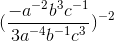
Simplify the following polynomial:
Tap to reveal answer
To simplify the polynomial, begin by combining like terms:
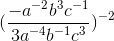

To simplify the polynomial, begin by combining like terms:
← Didn't Know|Knew It →
Find the zeros of the following polynomial:

Find the zeros of the following polynomial:
Tap to reveal answer
First, we need to find all the possible rational roots of the polynomial using the Rational Roots Theorem:

Since the leading coefficient is just 1, we have the following possible (rational) roots to try:
±1, ±2, ±3, ±4, ±6, ±12, ±24
When we substitute one of these numbers for  , we're hoping that the equation ends up equaling zero. Let's see if
  is a zero:



Since the function equals zero when  is
is  , one of the factors of the polynomial is
  . This doesn't help us find the other factors, however. We can use synthetic substitution as a shorter way than long division to factor the equation.



Now we can factor the function this way:
(x%5E%7B3%7D-5x%5E%7B2%7D-2x+24) $"f(x)=(x+1)(x^{3}$$-5x^{2}$-2x+24)")
We repeat this process, using the Rational Roots Theorem with the second term to find a possible zero. Let's try  :
:


When we factor using synthetic substitution for  , we get the following result:

Using our quadratic factoring rules, we can factor completely:

Thus, the zeroes of  are
are 
First, we need to find all the possible rational roots of the polynomial using the Rational Roots Theorem:
Since the leading coefficient is just 1, we have the following possible (rational) roots to try:
±1, ±2, ±3, ±4, ±6, ±12, ±24
When we substitute one of these numbers for
Since the function equals zero when
Now we can factor the function this way:
(x%5E%7B3%7D-5x%5E%7B2%7D-2x+24) $"f(x)=(x+1)(x^{3}$$-5x^{2}$-2x+24)")
We repeat this process, using the Rational Roots Theorem with the second term to find a possible zero. Let's try
When we factor using synthetic substitution for
Using our quadratic factoring rules, we can factor completely:
Thus, the zeroes of
← Didn't Know|Knew It →
Simplify the following polynomial function:
Simplify the following polynomial function:
Tap to reveal answer
First, multiply the outside term with each term within the parentheses:
Rearranging the polynomial into fractional form, we get:
First, multiply the outside term with each term within the parentheses:
Rearranging the polynomial into fractional form, we get:
← Didn't Know|Knew It →
Simplify the following polynomial:
Simplify the following polynomial:
Tap to reveal answer
To simplify the polynomial, begin by combining like terms:
To simplify the polynomial, begin by combining like terms:
← Didn't Know|Knew It →
Factor the polynomial if the expression is equal to zero when .
Factor the polynomial if the expression is equal to zero when
Tap to reveal answer
Knowing the zeroes makes it relatively easy to factor the polynomial.
The expression fits the description of the zeroes.
Now we need to check the answer.
We are able to get back to the original expression, meaning that the answer is .
Knowing the zeroes makes it relatively easy to factor the polynomial.
The expression
Now we need to check the answer.
We are able to get back to the original expression, meaning that the answer is
← Didn't Know|Knew It →
A polyomial with leading term has 5 and 7 as roots; 7 is a double root. What is this polynomial?
A polyomial with leading term
Tap to reveal answer
Since 5 is a single root and 7 is a double root, and the degree of the polynomial is 3, the polynomial is . To put this in expanded form:
Since 5 is a single root and 7 is a double root, and the degree of the polynomial is 3, the polynomial is
← Didn't Know|Knew It →
A polyomial with leading term has 6 as a triple root. What is this polynomial?
A polyomial with leading term
Tap to reveal answer
Since 6 is a triple root, and the degree of the polynomial is 3, the polynomial is , which we can expland using the cube of a binomial pattern.
Since 6 is a triple root, and the degree of the polynomial is 3, the polynomial is
← Didn't Know|Knew It →
What are the solutions to ?
What are the solutions to
Tap to reveal answer
When we are looking for the solutions of a quadratic, or the zeroes, we are looking for the values of such that the output will be zero. Thus, we first factor the equation.
Then, we are looking for the values where each of these factors are equal to zero.
implies
and implies
Thus, these are our solutions.
When we are looking for the solutions of a quadratic, or the zeroes, we are looking for the values of
Then, we are looking for the values where each of these factors are equal to zero.
and
Thus, these are our solutions.
← Didn't Know|Knew It →
Find the zeros of the following polynomial:
Find the zeros of the following polynomial:
Tap to reveal answer
First, we need to find all the possible rational roots of the polynomial using the Rational Roots Theorem:
Since the leading coefficient is just 1, we have the following possible (rational) roots to try:
±1, ±2, ±3, ±4, ±6, ±12, ±24
When we substitute one of these numbers for , we're hoping that the equation ends up equaling zero. Let's see if is a zero:
Since the function equals zero when is , one of the factors of the polynomial is . This doesn't help us find the other factors, however. We can use synthetic substitution as a shorter way than long division to factor the equation.
Now we can factor the function this way:
(x%5E%7B3%7D-5x%5E%7B2%7D-2x+24) $"f(x)=(x+1)(x^{3}$$-5x^{2}$-2x+24)")
We repeat this process, using the Rational Roots Theorem with the second term to find a possible zero. Let's try :
When we factor using synthetic substitution for , we get the following result:
Using our quadratic factoring rules, we can factor completely:
Thus, the zeroes of are
First, we need to find all the possible rational roots of the polynomial using the Rational Roots Theorem:
Since the leading coefficient is just 1, we have the following possible (rational) roots to try:
±1, ±2, ±3, ±4, ±6, ±12, ±24
When we substitute one of these numbers for
Since the function equals zero when
Now we can factor the function this way:
(x%5E%7B3%7D-5x%5E%7B2%7D-2x+24) $"f(x)=(x+1)(x^{3}$$-5x^{2}$-2x+24)")
We repeat this process, using the Rational Roots Theorem with the second term to find a possible zero. Let's try
When we factor using synthetic substitution for
Using our quadratic factoring rules, we can factor completely:
Thus, the zeroes of
← Didn't Know|Knew It →
Factor the polynomial if the expression is equal to zero when .
Factor the polynomial if the expression is equal to zero when
Tap to reveal answer
Knowing the zeroes makes it relatively easy to factor the polynomial.
The expression fits the description of the zeroes.
Now we need to check the answer.
We are able to get back to the original expression, meaning that the answer is .
Knowing the zeroes makes it relatively easy to factor the polynomial.
The expression
Now we need to check the answer.
We are able to get back to the original expression, meaning that the answer is
← Didn't Know|Knew It →
A polyomial with leading term has 5 and 7 as roots; 7 is a double root. What is this polynomial?
A polyomial with leading term
Tap to reveal answer
Since 5 is a single root and 7 is a double root, and the degree of the polynomial is 3, the polynomial is . To put this in expanded form:
Since 5 is a single root and 7 is a double root, and the degree of the polynomial is 3, the polynomial is
← Didn't Know|Knew It →
A polyomial with leading term has 6 as a triple root. What is this polynomial?
A polyomial with leading term
Tap to reveal answer
Since 6 is a triple root, and the degree of the polynomial is 3, the polynomial is , which we can expland using the cube of a binomial pattern.
Since 6 is a triple root, and the degree of the polynomial is 3, the polynomial is
← Didn't Know|Knew It →
What are the solutions to ?
What are the solutions to
Tap to reveal answer
When we are looking for the solutions of a quadratic, or the zeroes, we are looking for the values of such that the output will be zero. Thus, we first factor the equation.
Then, we are looking for the values where each of these factors are equal to zero.
implies
and implies
Thus, these are our solutions.
When we are looking for the solutions of a quadratic, or the zeroes, we are looking for the values of
Then, we are looking for the values where each of these factors are equal to zero.
and
Thus, these are our solutions.
← Didn't Know|Knew It →
Simplify the following polynomial function:
Simplify the following polynomial function:
Tap to reveal answer
First, multiply the outside term with each term within the parentheses:
Rearranging the polynomial into fractional form, we get:
First, multiply the outside term with each term within the parentheses:
Rearranging the polynomial into fractional form, we get:
← Didn't Know|Knew It →
Simplify the following polynomial:
Simplify the following polynomial:
Tap to reveal answer
To simplify the polynomial, begin by combining like terms:
To simplify the polynomial, begin by combining like terms:
← Didn't Know|Knew It →