Triangles - Math
Card 1 of 4048
What is the hypotenuse of a right triangle with sides 5 and 8?
What is the hypotenuse of a right triangle with sides 5 and 8?
Tap to reveal answer
Because this is a right triangle, we can use the Pythagorean Theorem which says _a_2 + _b_2 = _c_2, or the squares of the two sides of a right triangle must equal the square of the hypotenuse. Here we have a = 5 and b = 8.
_a_2 + _b_2 = _c_2
52 + 82 = _c_2
25 + 64 = _c_2
89 = _c_2
c = √89
Because this is a right triangle, we can use the Pythagorean Theorem which says _a_2 + _b_2 = _c_2, or the squares of the two sides of a right triangle must equal the square of the hypotenuse. Here we have a = 5 and b = 8.
_a_2 + _b_2 = _c_2
52 + 82 = _c_2
25 + 64 = _c_2
89 = _c_2
c = √89
← Didn't Know|Knew It →
Which is the greater quantity?
(a) The hypotenuse of a right triangle with legs  and
and  .
.
(b) The hypotenuse of a right triangle with legs  and
and  .
.
Which is the greater quantity?
(a) The hypotenuse of a right triangle with legs
(b) The hypotenuse of a right triangle with legs
Tap to reveal answer
The hypotenuses of the triangles measure as follows:
(a) 
(b) 
 , so
, so  , making (a) the greater quantity.
The hypotenuses of the triangles measure as follows:
(a)
(b)
← Didn't Know|Knew It →
Which is the greater quantity?
(a) The hypotenuse of a  right triangle with a leg of length 20
(b) The hypotenuse of a right triangle with legs of length 19 and 21
Which is the greater quantity?
(a) The hypotenuse of a
(b) The hypotenuse of a right triangle with legs of length 19 and 21
Tap to reveal answer
The hypotenuses of the triangles measure as follows:
(a) 
(b) 
 , so
, so  , making (b) the greater quantity
The hypotenuses of the triangles measure as follows:
(a)
(b)
← Didn't Know|Knew It →
A right triangle has a leg  feet long and a hypotenuse
  feet long. Which is the greater quantity?
(a) The length of the second leg of the triangle
(b) 60 inches
A right triangle has a leg
(a) The length of the second leg of the triangle
(b) 60 inches
Tap to reveal answer
The length of the second leg can be calculated using the Pythagorean Theorem. Set  :
:

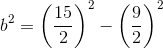
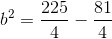


The second leg therefore measures  inches.
The length of the second leg can be calculated using the Pythagorean Theorem. Set
The second leg therefore measures
← Didn't Know|Knew It →
What is the hypotenuse of a right triangle with sides 9 inches and 12 inches?
What is the hypotenuse of a right triangle with sides 9 inches and 12 inches?
Tap to reveal answer
Since we're dealing with right triangles, we can use the Pythagorean Theorem ( ). In this formula, a and b are the sides, while c is the hypotenuse. The hypotenuse of a right triangle is the longest side and the side that is opposite the right angle. Now, we can plug into our formula, which looks like this:
  We simplify and get
  . At this point, isolate c. This means taking the square root of both sides so that your answer is 15in.
Since we're dealing with right triangles, we can use the Pythagorean Theorem (
← Didn't Know|Knew It →
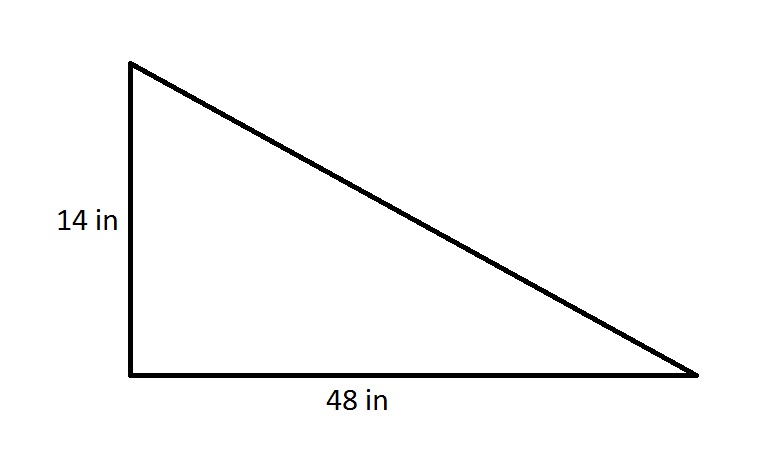
The perimeter of a regular pentagon is 75% of that of the triangle in the above diagram. Which is the greater quantity?
(A) The length of one side of the pentagon
(B) One and one-half feet
The perimeter of a regular pentagon is 75% of that of the triangle in the above diagram. Which is the greater quantity?
(A) The length of one side of the pentagon
(B) One and one-half feet
Tap to reveal answer
By the Pythagorean Theorem, the hypotenuse of the right triangle is
 inches, making its perimeter
 inches.
The pentagon in question has sides of length 75% of 112, or
 .
.
Since a pentagon has five sides of equal length, each side will have measure
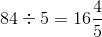 inches.
One and a half feet are equivalent to 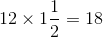 inches, so (B) is the greater quantity.
By the Pythagorean Theorem, the hypotenuse of the right triangle is
The pentagon in question has sides of length 75% of 112, or
Since a pentagon has five sides of equal length, each side will have measure
One and a half feet are equivalent to
← Didn't Know|Knew It →
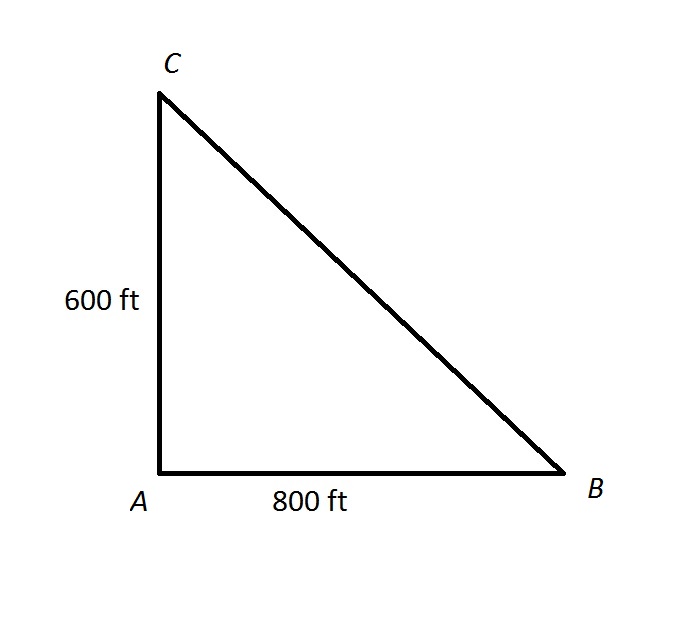
The track at Gauss High School is unusual in that it is shaped like a right triangle, as shown above.
Cary decides to get some exercise by running from point A to point B, then running half of the distance from point B to point C.
Which is the greater quantity?
(A) The distance Cary runs
(B) One-fourth of a mile
The track at Gauss High School is unusual in that it is shaped like a right triangle, as shown above.
Cary decides to get some exercise by running from point A to point B, then running half of the distance from point B to point C.
Which is the greater quantity?
(A) The distance Cary runs
(B) One-fourth of a mile
Tap to reveal answer
By the Pythagorean Theorem, the distance from B to C is


 feet
feet
Cary runs
 feet
feet
Since 5,280 feet make a mile, one-fourth of a mile is equal to
 feet.
feet.
(B) is greater
By the Pythagorean Theorem, the distance from B to C is
Cary runs
Since 5,280 feet make a mile, one-fourth of a mile is equal to
(B) is greater
← Didn't Know|Knew It →
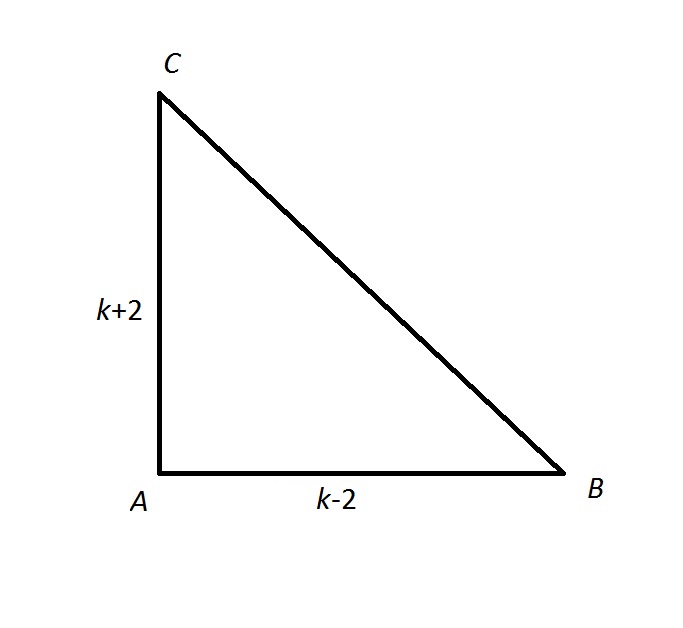
Give the length of the hypotenuse of the above right triangle in terms of  .
.
Give the length of the hypotenuse of the above right triangle in terms of
Tap to reveal answer
If we let  be the length of the hypotenuse, then by the Pythagorean theorem,



If we let
← Didn't Know|Knew It →
In Square  .
.  is the midpoint of
  ,
,  is the midpoint of
  , and
, and  is the midpoint of
  . Construct the line segments
  and
and  .
.
Which is the greater quantity?
(a) 
(b) 
In Square
Which is the greater quantity?
(a)
(b)
Tap to reveal answer
The figure referenced is below:
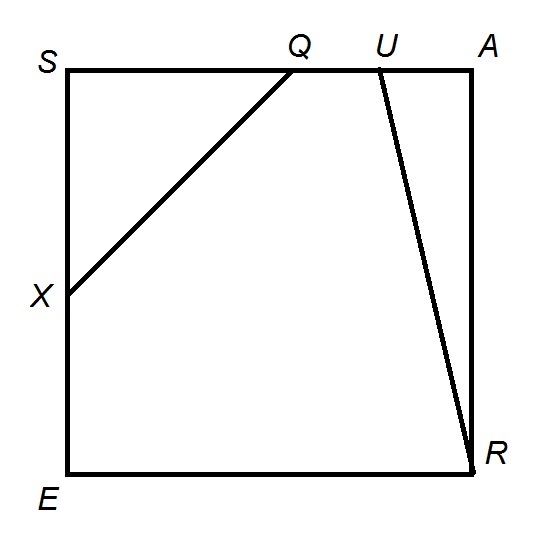
For the sake of simplicity, assume that the square has sides of length 4. The following reasoning is independent of the actual lengths, and the reason for choosing 4 will become apparent in the explanation.
 and
and  are midpoints of their respective sides, so
  , making
  the hypotenuse of a triangle with legs of length 2 and 2. Therefore,
 .
.
Also,  , and since
  is the midpoint of
  ,
,  .
.  , making
  the hypotenuse of a triangle with legs of length 1 and 4. Therefore,

 , so
, so 
The figure referenced is below:
For the sake of simplicity, assume that the square has sides of length 4. The following reasoning is independent of the actual lengths, and the reason for choosing 4 will become apparent in the explanation.
Also,
← Didn't Know|Knew It →
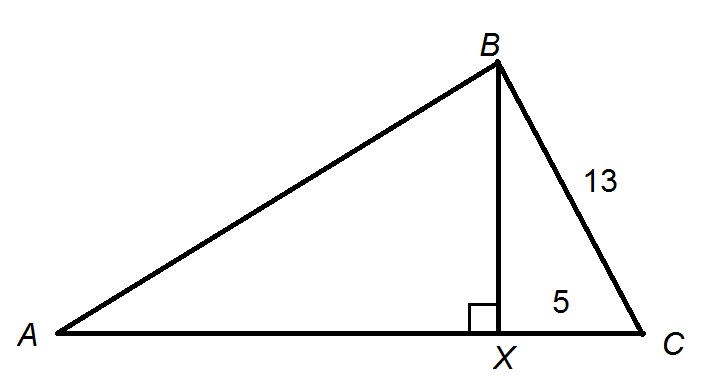
Figure NOT drawn to scale.
In the above figure,  is a right angle.
What is the length of  ?
?
Figure NOT drawn to scale.
In the above figure,
What is the length of
Tap to reveal answer
The altitude of a right triangle from the vertex of its right angle divides the triangle into two smaller triangles each similar to the larger triangle. In particular,
 .
.
Their corresponding sides are in proportion, so, setting the ratios of the hypotenuses to the short legs equal to each other,


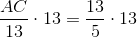
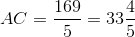
The altitude of a right triangle from the vertex of its right angle divides the triangle into two smaller triangles each similar to the larger triangle. In particular,
Their corresponding sides are in proportion, so, setting the ratios of the hypotenuses to the short legs equal to each other,
← Didn't Know|Knew It →
Figure NOT drawn to scale.
In the above figure,  is a right angle.
What is the length of  ?
?
Figure NOT drawn to scale.
In the above figure,
What is the length of
Tap to reveal answer
The altitude of a right triangle from the vertex of its right angle divides the triangle into two smaller triangles each similar to the larger triangle. In particular,
 .
.
Their corresponding sides are in proportion, so, setting the ratios of the long legs to the short legs equal to each other,

By the Pythagorean Theorem.


The proportion statement becomes


The altitude of a right triangle from the vertex of its right angle divides the triangle into two smaller triangles each similar to the larger triangle. In particular,
Their corresponding sides are in proportion, so, setting the ratios of the long legs to the short legs equal to each other,
By the Pythagorean Theorem.
The proportion statement becomes
← Didn't Know|Knew It →
Given:  with
with  ,
,  ,
,  .
.
Which is the greater quantity?
(a) 
(b) 
Given:
Which is the greater quantity?
(a)
(b)
Tap to reveal answer
The measure of the angle formed by the two shorter sides of a triangle can be determined to be acute, right, or obtuse by comparing the sum of the squares of those lengths to the square of the length of the opposite side. We compare:


 ; it follows that
  is obtuse, and has measure greater than
The measure of the angle formed by the two shorter sides of a triangle can be determined to be acute, right, or obtuse by comparing the sum of the squares of those lengths to the square of the length of the opposite side. We compare:
← Didn't Know|Knew It →
Figure NOT drawn to scale.
In the above figure, is a right angle.
What is the length of ?
Figure NOT drawn to scale.
In the above figure,
What is the length of
Tap to reveal answer
The altitude of a right triangle from the vertex of its right angle divides the triangle into two smaller triangles each similar to the larger triangle. In particular,
.
Their corresponding sides are in proportion, so, setting the ratios of the hypotenuses to the short legs equal to each other,
The altitude of a right triangle from the vertex of its right angle divides the triangle into two smaller triangles each similar to the larger triangle. In particular,
Their corresponding sides are in proportion, so, setting the ratios of the hypotenuses to the short legs equal to each other,
← Didn't Know|Knew It →
An isosceles triangle has a base of 12 cm and an area of 42 $cm^{2}$. What must be the height of this triangle?
An isosceles triangle has a base of 12 cm and an area of 42 $cm^{2}$. What must be the height of this triangle?
Tap to reveal answer
A=\frac{1}{2}$bh.
6x=42
x=7
A=\frac{1}{2}$bh.
6x=42
x=7
← Didn't Know|Knew It →
A triangle has sides of length 8, 13, and L. Which of the following cannot equal L?
A triangle has sides of length 8, 13, and L. Which of the following cannot equal L?
Tap to reveal answer
The sum of the lengths of two sides of a triangle cannot be less than the length of the third side. 8 + 4 = 12, which is less than 13.
The sum of the lengths of two sides of a triangle cannot be less than the length of the third side. 8 + 4 = 12, which is less than 13.
← Didn't Know|Knew It →
Two sides of a triangle are 20 and 32. Which of the following CANNOT be the third side of this triangle.
Two sides of a triangle are 20 and 32. Which of the following CANNOT be the third side of this triangle.
Tap to reveal answer
Please remember the Triangle Inequality Theorem, which states that the sum of any two sides of a triangle must be greater than the third side. Therefore, the correct answer is 10 because the sum of 10 and 20 would not be greater than the third side 32.
Please remember the Triangle Inequality Theorem, which states that the sum of any two sides of a triangle must be greater than the third side. Therefore, the correct answer is 10 because the sum of 10 and 20 would not be greater than the third side 32.
← Didn't Know|Knew It →
A triangle has a perimeter of 36 inches, and one side that is 12 inches long. The lengths of the other two sides have a ratio of 3:5. What is the length of the longest side of the triangle?
A triangle has a perimeter of 36 inches, and one side that is 12 inches long. The lengths of the other two sides have a ratio of 3:5. What is the length of the longest side of the triangle?
Tap to reveal answer
We know that the perimeter is 36 inches, and one side is 12. This means, the sum of the lengths of the other two sides are 24. The ratio between the two sides is 3:5, giving a total of 8 parts. We divide the remaining length, 24 inches, by 8 giving us 3. This means each part is 3. We multiply this by the ratio and get 9:15, meaning the longest side is 15 inches.
We know that the perimeter is 36 inches, and one side is 12. This means, the sum of the lengths of the other two sides are 24. The ratio between the two sides is 3:5, giving a total of 8 parts. We divide the remaining length, 24 inches, by 8 giving us 3. This means each part is 3. We multiply this by the ratio and get 9:15, meaning the longest side is 15 inches.
← Didn't Know|Knew It →
A triangle has sides of length 5, 7, and x. Which of the following can NOT be a value of x?
A triangle has sides of length 5, 7, and x. Which of the following can NOT be a value of x?
Tap to reveal answer
The sum of the lengths of any two sides of a triangle must exceed the length of the third side; therefore, 5+7 > x, which cannot happen if x = 13.
The sum of the lengths of any two sides of a triangle must exceed the length of the third side; therefore, 5+7 > x, which cannot happen if x = 13.
← Didn't Know|Knew It →
Two sides of a triangle have lengths 4 and 7. Which of the following represents the set of all possible lengths of the third side, x?
Two sides of a triangle have lengths 4 and 7. Which of the following represents the set of all possible lengths of the third side, x?
Tap to reveal answer
The set of possible lengths is: 7-4 < x < 7+4, or 3 < X < 11.
The set of possible lengths is: 7-4 < x < 7+4, or 3 < X < 11.
← Didn't Know|Knew It →
If two sides of a triangle have lengths 8 and 10, what could the length of the third side NOT be?
If two sides of a triangle have lengths 8 and 10, what could the length of the third side NOT be?
Tap to reveal answer
According to the Triangle Inequality Theorem, the sums of the lengths of any two sides of a triangle must be greater than the length of the third side. Since 10 + 8 is 18, the only length out of the answer choices that is not possible is 19.
According to the Triangle Inequality Theorem, the sums of the lengths of any two sides of a triangle must be greater than the length of the third side. Since 10 + 8 is 18, the only length out of the answer choices that is not possible is 19.
← Didn't Know|Knew It →