Squares - Math
Card 1 of 2366
The area of square R is 12 times the area of square T. If the area of square R is 48, what is the length of one side of square T?
The area of square R is 12 times the area of square T. If the area of square R is 48, what is the length of one side of square T?
Tap to reveal answer
We start by dividing the area of square R (48) by 12, to come up with the area of square T, 4. Then take the square root of the area to get the length of one side, giving us 2.
We start by dividing the area of square R (48) by 12, to come up with the area of square T, 4. Then take the square root of the area to get the length of one side, giving us 2.
← Didn't Know|Knew It →
When the side of a certain square is increased by 2 inches, the area of the resulting square is 64 sq. inches greater than the original square. What is the length of the side of the original square, in inches?
When the side of a certain square is increased by 2 inches, the area of the resulting square is 64 sq. inches greater than the original square. What is the length of the side of the original square, in inches?
Tap to reveal answer
Let x represent the length of the original square in inches. Thus the area of the original square is x2. Two inches are added to x, which is represented by x+2. The area of the resulting square is (x+2)2. We are given that the new square is 64 sq. inches greater than the original. Therefore we can write the algebraic expression:
x2 + 64 = (x+2)2
FOIL the right side of the equation.
x2 + 64 = x2 + 4x + 4
Subtract x2 from both sides and then continue with the alegbra.
64 = 4x + 4
64 = 4(x + 1)
16 = x + 1
15 = x
Therefore, the length of the original square is 15 inches.
If you plug in the answer choices, you would need to add 2 inches to the value of the answer choice and then take the difference of two squares. The choice with 15 would be correct because 172 -152 = 64.
Let x represent the length of the original square in inches. Thus the area of the original square is x2. Two inches are added to x, which is represented by x+2. The area of the resulting square is (x+2)2. We are given that the new square is 64 sq. inches greater than the original. Therefore we can write the algebraic expression:
x2 + 64 = (x+2)2
FOIL the right side of the equation.
x2 + 64 = x2 + 4x + 4
Subtract x2 from both sides and then continue with the alegbra.
64 = 4x + 4
64 = 4(x + 1)
16 = x + 1
15 = x
Therefore, the length of the original square is 15 inches.
If you plug in the answer choices, you would need to add 2 inches to the value of the answer choice and then take the difference of two squares. The choice with 15 would be correct because 172 -152 = 64.
← Didn't Know|Knew It →
If the area of a square is 25 inches squared, what is the perimeter?
If the area of a square is 25 inches squared, what is the perimeter?
Tap to reveal answer
The area of a square is equal to length times width or length squared (since length and width are equal on a square). Therefore, the length of one side is l = $$\sqrt{25in^{2}$$} or l=5 in. The perimeter of a square is the sum of the length of all 4 sides or 4 times 5 in. =20 in.
The area of a square is equal to length times width or length squared (since length and width are equal on a square). Therefore, the length of one side is l = $$\sqrt{25in^{2}$$} or l=5 in. The perimeter of a square is the sum of the length of all 4 sides or 4 times 5 in. =20 in.
← Didn't Know|Knew It →
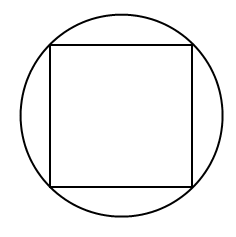
A square is inscribed inside a circle, as illustrated above. The radius of the circle is  units. If all of the square's diagonals pass through the circle's center, what is the area of the square?
A square is inscribed inside a circle, as illustrated above. The radius of the circle is
Tap to reveal answer
Given that the square's diagonals pass through the circle's center, those diagonals must each form a diameter of the circle. The circle's diameter is twice its radius, i.e.  , which is
  . Since this diameter (i.e., the square's diagonal) is the hypotenuse of a right triangle formed by two sides of the square, the length of one of the square's sides can be calculated with the Pythagorean Theorem.
  replace
  and
and  because the sides of the square must be equal in length. Since the objective is to solve for the square's area, solve for
  since one side squared will be the square's area.


 units squared
Given that the square's diagonals pass through the circle's center, those diagonals must each form a diameter of the circle. The circle's diameter is twice its radius, i.e.
← Didn't Know|Knew It →
The perimeter of a square is 48. What is the length of its diagonal?
The perimeter of a square is 48. What is the length of its diagonal?
Tap to reveal answer
Perimeter = side * 4
48 = side * 4
Side = 12
We can break up the square into two equal right triangles. The diagonal of the sqaure is then the hypotenuse of these two triangles.
Therefore, we can use the Pythagorean Theorem to solve for the diagonal:





Perimeter = side * 4
48 = side * 4
Side = 12
We can break up the square into two equal right triangles. The diagonal of the sqaure is then the hypotenuse of these two triangles.
Therefore, we can use the Pythagorean Theorem to solve for the diagonal:
← Didn't Know|Knew It →
A square lot has an area of 1,200 square meters. To the nearest meter, how far is it from one corner to the opposite corner?
A square lot has an area of 1,200 square meters. To the nearest meter, how far is it from one corner to the opposite corner?
Tap to reveal answer
A square is also a rhombus, so its area can be calculated as one half the product of its diagonals:
 ,
,
where  is the common diagonal length.
Since  ,
,  .
.


The distance between opposite corners is about 49 meters.
A square is also a rhombus, so its area can be calculated as one half the product of its diagonals:
where
Since
The distance between opposite corners is about 49 meters.
← Didn't Know|Knew It →
Find the length of the square's diagonal.

Find the length of the square's diagonal.
Tap to reveal answer
The diagonal line cuts the square into two equal triangles. Their hypotenuse is the diagonal of the square, so we can solve for the hypotenuse.
We need to use the Pythagorean Theorem:  , where a and b are the legs and c is the hypotenuse.
The two legs have lengths of 8. Plug this in and solve for c:


The diagonal line cuts the square into two equal triangles. Their hypotenuse is the diagonal of the square, so we can solve for the hypotenuse.
We need to use the Pythagorean Theorem:
The two legs have lengths of 8. Plug this in and solve for c:
← Didn't Know|Knew It →
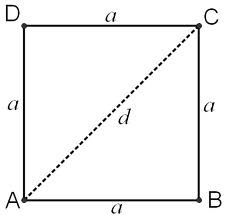
Side  in the square below has a length of 12. What is the length of the diagonal
  ?
?
Side
Tap to reveal answer
Diagonal  forms a triangle with adjacent sides
  . Since this is a square we know this is a right triangle and we can use the Pythagorean Theorem to determine the length of
  . Sides of length
  form each of the legs and
  is the hypotenuse. So the equation looks like this:

Solve for 


We can simplify this to

Diagonal
Solve for
We can simplify this to
← Didn't Know|Knew It →
A man wants to build a not-quite-regulation softball field on his property and finds that he only has enough room to make the distance between home plate and first base 44 feet. How far (nearest foot) will it be from home plate to second base, assuming he builds it to that specification?
(Note: the four bases are the vertices of a perfect square, with the bases called home plate, first base, second base, third base, in that order).
A man wants to build a not-quite-regulation softball field on his property and finds that he only has enough room to make the distance between home plate and first base 44 feet. How far (nearest foot) will it be from home plate to second base, assuming he builds it to that specification?
(Note: the four bases are the vertices of a perfect square, with the bases called home plate, first base, second base, third base, in that order).
Tap to reveal answer
The path from home plate to first base is a side of a perfect square; the path from home plate to second base is a diagonal. As two sides and a diagonal form a  triangle, the diagonal measures
  as long as a side.
The distance to second base from home is  times the distance to first base:

The path from home plate to first base is a side of a perfect square; the path from home plate to second base is a diagonal. As two sides and a diagonal form a
The distance to second base from home is
← Didn't Know|Knew It →
Find the length of the diagonal of a square that has side lengths of  cm.
cm.
Find the length of the diagonal of a square that has side lengths of
Tap to reveal answer
You can do this problem in two different ways that lead to the final answer:
1. Pythagorean Theorem
2. Special Triangles (45-45-90)
1. For the first idea, use the Pythagorean Theorem:  , where a and b are the side lengths of the square and c is the length of the diagonal.


2. If you know that ALL squares can be made into two special right triangles such that their angles are 45-45-90, then there's a formula you could use:
Let's say that your side length of the square is "a". Then the diagonal of the square (or the hypotenuse of the right triangle) will be  .
.
So using this with a=4:

You can do this problem in two different ways that lead to the final answer:
1. Pythagorean Theorem
2. Special Triangles (45-45-90)
1. For the first idea, use the Pythagorean Theorem:
2. If you know that ALL squares can be made into two special right triangles such that their angles are 45-45-90, then there's a formula you could use:
Let's say that your side length of the square is "a". Then the diagonal of the square (or the hypotenuse of the right triangle) will be
So using this with a=4:
← Didn't Know|Knew It →
The perimeter of a square is  units. How many units long is the diagonal of the square?
The perimeter of a square is
Tap to reveal answer
From the perimeter, we can find the length of each side of the square. The side lengths of a square are equal by definition therefore, the perimeter can be rewritten as,


Then we use the Pythagorean Theorme to find the diagonal, which is the hypotenuse of a right triangle with each leg being a side of the square.



From the perimeter, we can find the length of each side of the square. The side lengths of a square are equal by definition therefore, the perimeter can be rewritten as,
Then we use the Pythagorean Theorme to find the diagonal, which is the hypotenuse of a right triangle with each leg being a side of the square.
← Didn't Know|Knew It →
Find the length of the diagonal of the square with a side length of  .
.
Find the length of the diagonal of the square with a side length of
Tap to reveal answer
The diagonal of a square is also a hypotenuse of a right triangle with the side lengths as legs of the triangle.

Use the Pythagorean Theorem to find the length of the diagonal.


For the square given in the question,

The diagonal of a square is also a hypotenuse of a right triangle with the side lengths as legs of the triangle.
Use the Pythagorean Theorem to find the length of the diagonal.
For the square given in the question,
← Didn't Know|Knew It →
Find the length of the diagonal of a square with side lengths of  .
.
Find the length of the diagonal of a square with side lengths of
Tap to reveal answer
The diagonal of a square is also a hypotenuse of a right triangle with the side lengths as legs of the triangle.
Use the Pythagorean Theorem to find the length of the diagonal.


For the square given in the question,

The diagonal of a square is also a hypotenuse of a right triangle with the side lengths as legs of the triangle.
Use the Pythagorean Theorem to find the length of the diagonal.
For the square given in the question,
← Didn't Know|Knew It →
Find the length of the diagonal of a square with side lengths of  .
.
Find the length of the diagonal of a square with side lengths of
Tap to reveal answer
The diagonal of a square is also a hypotenuse of a right triangle with the side lengths as legs of the triangle.
Use the Pythagorean Theorem to find the length of the diagonal.


For the square given in the question,

The diagonal of a square is also a hypotenuse of a right triangle with the side lengths as legs of the triangle.
Use the Pythagorean Theorem to find the length of the diagonal.
For the square given in the question,
← Didn't Know|Knew It →
Find the length of the diagonal of a square with side lengths of  .
.
Find the length of the diagonal of a square with side lengths of
Tap to reveal answer
The diagonal of a square is also a hypotenuse of a right triangle with the side lengths as legs of the triangle.
Use the Pythagorean Theorem to find the length of the diagonal.


For the square given in the question,

The diagonal of a square is also a hypotenuse of a right triangle with the side lengths as legs of the triangle.
Use the Pythagorean Theorem to find the length of the diagonal.
For the square given in the question,
← Didn't Know|Knew It →
Find the length of the diagonal of a square with side lengths of  .
.
Find the length of the diagonal of a square with side lengths of
Tap to reveal answer
The diagonal of a square is also a hypotenuse of a right triangle with the side lengths as legs of the triangle.
Use the Pythagorean Theorem to find the length of the diagonal.


For the square given in the question,

The diagonal of a square is also a hypotenuse of a right triangle with the side lengths as legs of the triangle.
Use the Pythagorean Theorem to find the length of the diagonal.
For the square given in the question,
← Didn't Know|Knew It →
Find the length of the diagonal of a square with a side length of  .
.
Find the length of the diagonal of a square with a side length of
Tap to reveal answer
The diagonal of a square is also a hypotenuse of a right triangle with the side lengths as legs of the triangle.
Use the Pythagorean Theorem to find the length of the diagonal.


For the square given in the question,

The diagonal of a square is also a hypotenuse of a right triangle with the side lengths as legs of the triangle.
Use the Pythagorean Theorem to find the length of the diagonal.
For the square given in the question,
← Didn't Know|Knew It →
Find the length of the diagonal of a square that has a side length of  .
.
Find the length of the diagonal of a square that has a side length of
Tap to reveal answer
The diagonal of a square is also a hypotenuse of a right triangle with the side lengths as legs of the triangle.
Use the Pythagorean Theorem to find the length of the diagonal.


For the square given in the question,

The diagonal of a square is also a hypotenuse of a right triangle with the side lengths as legs of the triangle.
Use the Pythagorean Theorem to find the length of the diagonal.
For the square given in the question,
← Didn't Know|Knew It →
Find the length of the diagonal of a square that has a side length of  .
.
Find the length of the diagonal of a square that has a side length of
Tap to reveal answer
The diagonal of a square is also a hypotenuse of a right triangle with the side lengths as legs of the triangle.
Use the Pythagorean Theorem to find the length of the diagonal.


For the square given in the question,

The diagonal of a square is also a hypotenuse of a right triangle with the side lengths as legs of the triangle.
Use the Pythagorean Theorem to find the length of the diagonal.
For the square given in the question,
← Didn't Know|Knew It →
Find the length of the diagonal of a square with side lengths of  .
.
Find the length of the diagonal of a square with side lengths of
Tap to reveal answer
The diagonal of a square is also a hypotenuse of a right triangle with the side lengths as legs of the triangle.
Use the Pythagorean Theorem to find the length of the diagonal.


For the square given in the question,

The diagonal of a square is also a hypotenuse of a right triangle with the side lengths as legs of the triangle.
Use the Pythagorean Theorem to find the length of the diagonal.
For the square given in the question,
← Didn't Know|Knew It →