Right Triangles - Math
Card 1 of 1788
What is the hypotenuse of a right triangle with sides 5 and 8?
What is the hypotenuse of a right triangle with sides 5 and 8?
Tap to reveal answer
Because this is a right triangle, we can use the Pythagorean Theorem which says _a_2 + _b_2 = _c_2, or the squares of the two sides of a right triangle must equal the square of the hypotenuse. Here we have a = 5 and b = 8.
_a_2 + _b_2 = _c_2
52 + 82 = _c_2
25 + 64 = _c_2
89 = _c_2
c = √89
Because this is a right triangle, we can use the Pythagorean Theorem which says _a_2 + _b_2 = _c_2, or the squares of the two sides of a right triangle must equal the square of the hypotenuse. Here we have a = 5 and b = 8.
_a_2 + _b_2 = _c_2
52 + 82 = _c_2
25 + 64 = _c_2
89 = _c_2
c = √89
← Didn't Know|Knew It →
Which is the greater quantity?
(a) The hypotenuse of a right triangle with legs  and
and  .
.
(b) The hypotenuse of a right triangle with legs  and
and  .
.
Which is the greater quantity?
(a) The hypotenuse of a right triangle with legs
(b) The hypotenuse of a right triangle with legs
Tap to reveal answer
The hypotenuses of the triangles measure as follows:
(a) 
(b) 
 , so
, so  , making (a) the greater quantity.
The hypotenuses of the triangles measure as follows:
(a)
(b)
← Didn't Know|Knew It →
Which is the greater quantity?
(a) The hypotenuse of a  right triangle with a leg of length 20
(b) The hypotenuse of a right triangle with legs of length 19 and 21
Which is the greater quantity?
(a) The hypotenuse of a
(b) The hypotenuse of a right triangle with legs of length 19 and 21
Tap to reveal answer
The hypotenuses of the triangles measure as follows:
(a) 
(b) 
 , so
, so  , making (b) the greater quantity
The hypotenuses of the triangles measure as follows:
(a)
(b)
← Didn't Know|Knew It →
A right triangle has a leg  feet long and a hypotenuse
  feet long. Which is the greater quantity?
(a) The length of the second leg of the triangle
(b) 60 inches
A right triangle has a leg
(a) The length of the second leg of the triangle
(b) 60 inches
Tap to reveal answer
The length of the second leg can be calculated using the Pythagorean Theorem. Set  :
:

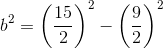
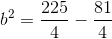


The second leg therefore measures  inches.
The length of the second leg can be calculated using the Pythagorean Theorem. Set
The second leg therefore measures
← Didn't Know|Knew It →
What is the hypotenuse of a right triangle with sides 9 inches and 12 inches?
What is the hypotenuse of a right triangle with sides 9 inches and 12 inches?
Tap to reveal answer
Since we're dealing with right triangles, we can use the Pythagorean Theorem ( ). In this formula, a and b are the sides, while c is the hypotenuse. The hypotenuse of a right triangle is the longest side and the side that is opposite the right angle. Now, we can plug into our formula, which looks like this:
  We simplify and get
  . At this point, isolate c. This means taking the square root of both sides so that your answer is 15in.
Since we're dealing with right triangles, we can use the Pythagorean Theorem (
← Didn't Know|Knew It →
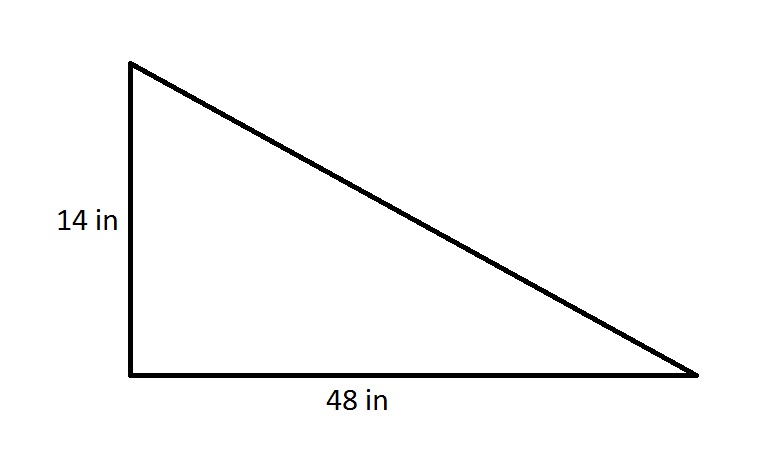
The perimeter of a regular pentagon is 75% of that of the triangle in the above diagram. Which is the greater quantity?
(A) The length of one side of the pentagon
(B) One and one-half feet
The perimeter of a regular pentagon is 75% of that of the triangle in the above diagram. Which is the greater quantity?
(A) The length of one side of the pentagon
(B) One and one-half feet
Tap to reveal answer
By the Pythagorean Theorem, the hypotenuse of the right triangle is
 inches, making its perimeter
 inches.
The pentagon in question has sides of length 75% of 112, or
 .
.
Since a pentagon has five sides of equal length, each side will have measure
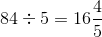 inches.
One and a half feet are equivalent to 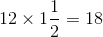 inches, so (B) is the greater quantity.
By the Pythagorean Theorem, the hypotenuse of the right triangle is
The pentagon in question has sides of length 75% of 112, or
Since a pentagon has five sides of equal length, each side will have measure
One and a half feet are equivalent to
← Didn't Know|Knew It →
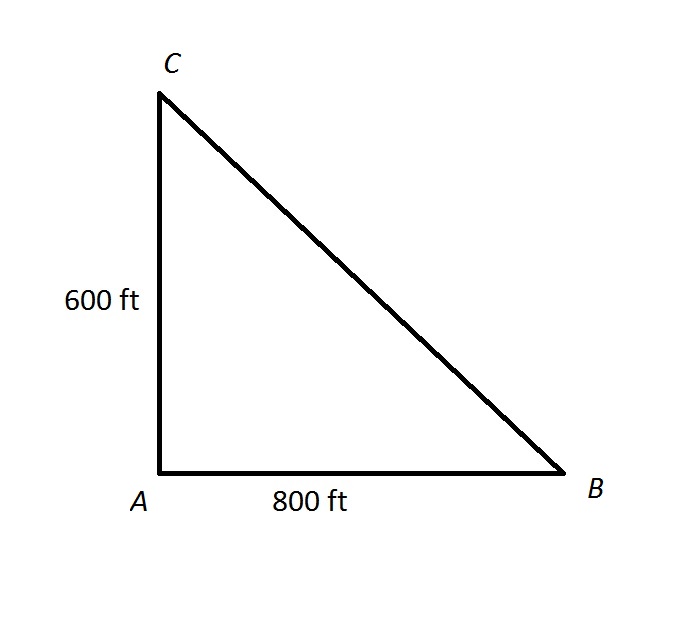
The track at Gauss High School is unusual in that it is shaped like a right triangle, as shown above.
Cary decides to get some exercise by running from point A to point B, then running half of the distance from point B to point C.
Which is the greater quantity?
(A) The distance Cary runs
(B) One-fourth of a mile
The track at Gauss High School is unusual in that it is shaped like a right triangle, as shown above.
Cary decides to get some exercise by running from point A to point B, then running half of the distance from point B to point C.
Which is the greater quantity?
(A) The distance Cary runs
(B) One-fourth of a mile
Tap to reveal answer
By the Pythagorean Theorem, the distance from B to C is


 feet
feet
Cary runs
 feet
feet
Since 5,280 feet make a mile, one-fourth of a mile is equal to
 feet.
feet.
(B) is greater
By the Pythagorean Theorem, the distance from B to C is
Cary runs
Since 5,280 feet make a mile, one-fourth of a mile is equal to
(B) is greater
← Didn't Know|Knew It →
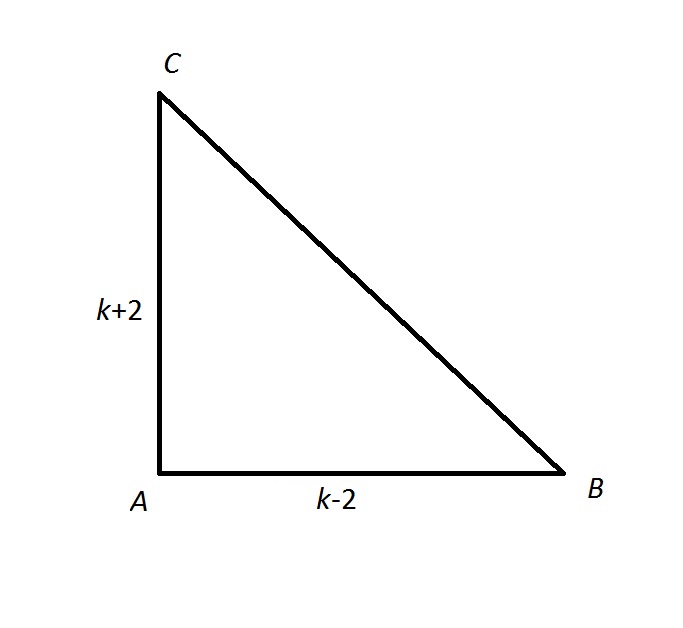
Give the length of the hypotenuse of the above right triangle in terms of  .
.
Give the length of the hypotenuse of the above right triangle in terms of
Tap to reveal answer
If we let  be the length of the hypotenuse, then by the Pythagorean theorem,



If we let
← Didn't Know|Knew It →
In Square  .
.  is the midpoint of
  ,
,  is the midpoint of
  , and
, and  is the midpoint of
  . Construct the line segments
  and
and  .
.
Which is the greater quantity?
(a) 
(b) 
In Square
Which is the greater quantity?
(a)
(b)
Tap to reveal answer
The figure referenced is below:
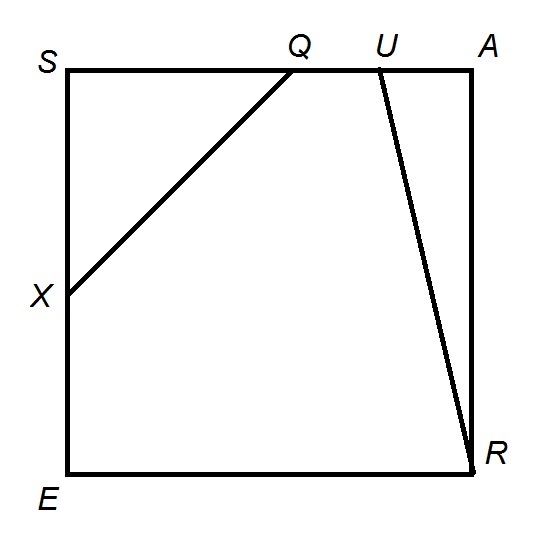
For the sake of simplicity, assume that the square has sides of length 4. The following reasoning is independent of the actual lengths, and the reason for choosing 4 will become apparent in the explanation.
 and
and  are midpoints of their respective sides, so
  , making
  the hypotenuse of a triangle with legs of length 2 and 2. Therefore,
 .
.
Also,  , and since
  is the midpoint of
  ,
,  .
.  , making
  the hypotenuse of a triangle with legs of length 1 and 4. Therefore,

 , so
, so 
The figure referenced is below:
For the sake of simplicity, assume that the square has sides of length 4. The following reasoning is independent of the actual lengths, and the reason for choosing 4 will become apparent in the explanation.
Also,
← Didn't Know|Knew It →
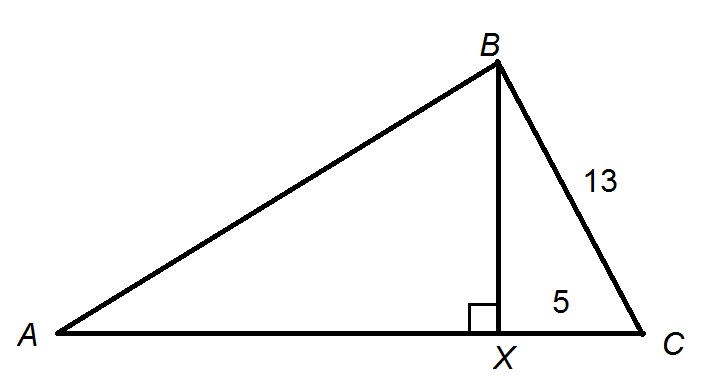
Figure NOT drawn to scale.
In the above figure,  is a right angle.
What is the length of  ?
?
Figure NOT drawn to scale.
In the above figure,
What is the length of
Tap to reveal answer
The altitude of a right triangle from the vertex of its right angle divides the triangle into two smaller triangles each similar to the larger triangle. In particular,
 .
.
Their corresponding sides are in proportion, so, setting the ratios of the hypotenuses to the short legs equal to each other,


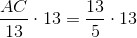
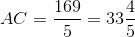
The altitude of a right triangle from the vertex of its right angle divides the triangle into two smaller triangles each similar to the larger triangle. In particular,
Their corresponding sides are in proportion, so, setting the ratios of the hypotenuses to the short legs equal to each other,
← Didn't Know|Knew It →
Figure NOT drawn to scale.
In the above figure,  is a right angle.
What is the length of  ?
?
Figure NOT drawn to scale.
In the above figure,
What is the length of
Tap to reveal answer
The altitude of a right triangle from the vertex of its right angle divides the triangle into two smaller triangles each similar to the larger triangle. In particular,
 .
.
Their corresponding sides are in proportion, so, setting the ratios of the long legs to the short legs equal to each other,

By the Pythagorean Theorem.


The proportion statement becomes


The altitude of a right triangle from the vertex of its right angle divides the triangle into two smaller triangles each similar to the larger triangle. In particular,
Their corresponding sides are in proportion, so, setting the ratios of the long legs to the short legs equal to each other,
By the Pythagorean Theorem.
The proportion statement becomes
← Didn't Know|Knew It →
Given:  with
with  ,
,  ,
,  .
.
Which is the greater quantity?
(a) 
(b) 
Given:
Which is the greater quantity?
(a)
(b)
Tap to reveal answer
The measure of the angle formed by the two shorter sides of a triangle can be determined to be acute, right, or obtuse by comparing the sum of the squares of those lengths to the square of the length of the opposite side. We compare:


 ; it follows that
  is obtuse, and has measure greater than
The measure of the angle formed by the two shorter sides of a triangle can be determined to be acute, right, or obtuse by comparing the sum of the squares of those lengths to the square of the length of the opposite side. We compare:
← Didn't Know|Knew It →
Figure NOT drawn to scale.
In the above figure, is a right angle.
What is the length of ?
Figure NOT drawn to scale.
In the above figure,
What is the length of
Tap to reveal answer
The altitude of a right triangle from the vertex of its right angle divides the triangle into two smaller triangles each similar to the larger triangle. In particular,
.
Their corresponding sides are in proportion, so, setting the ratios of the hypotenuses to the short legs equal to each other,
The altitude of a right triangle from the vertex of its right angle divides the triangle into two smaller triangles each similar to the larger triangle. In particular,
Their corresponding sides are in proportion, so, setting the ratios of the hypotenuses to the short legs equal to each other,
← Didn't Know|Knew It →

What is the perimeter of the triangle?
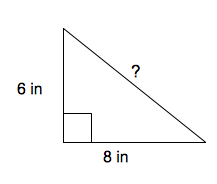
What is the perimeter of the triangle?
Tap to reveal answer
How do you find the perimeter of a right triangle?
There are three primary methods used to find the perimeter of a right triangle.
- When side lengths are given, add them together.
- Solve for a missing side using the Pythagorean theorem.
- If we know side-angle-side information, solve for the missing side using the Law of Cosines.
Method 1:
This method will show you how to calculate the perimeter of a triangle when all sides lengths are known. Consider the following figure:

If we know the lengths of sides  ,
,  , and
, and  , then we can simply add them together to find the perimeter of the triangle. It is important to note several things. First, we need to make sure that all the units given match one another. Second, when all the side lengths are known, then the perimeter formula may be used on all types of triangles (e.g. right, acute, obtuse, equilateral, isosceles, and scalene). The perimeter formula is written formally in the following format:

Method 2:
In right triangles, we can calculate the perimeter of a triangle when we are provided only two sides. We can do this by using the Pythagorean theorem. Let's first discuss right triangles in a general sense. A right triangle is a triangle that has one  angle. It is a special triangle and needs to be labeled accordingly. The legs of the triangle form the
  angle and they are labeled
  and
and  . The side of the triangle that is opposite of the
  angle and connects the two legs is known as the hypotenuse. The hypotenuse is the longest side of the triangle and is labeled as
  .
.
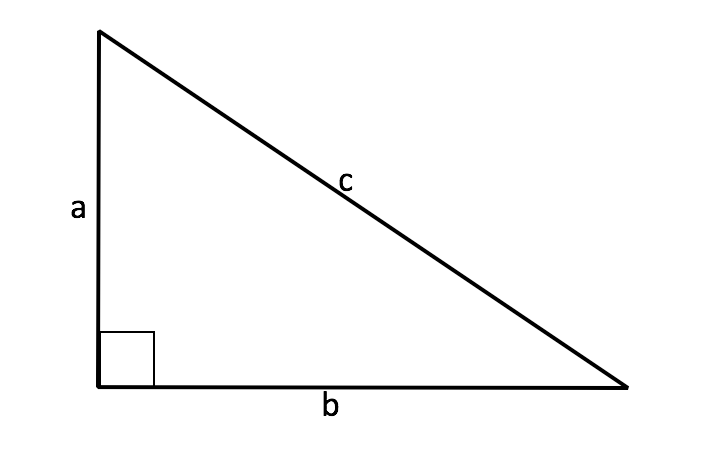
If a triangle appears in this format, then we can use the Pythagorean theorem to solve for any missing side. This formula is written in the following manner:

We can rearrange it in a number of ways to solve for each of the sides of the triangle. Let's rearrange it to solve for the hypotenuse,  .
.

Rearrange and take the square root of both sides.

Simplify.

Now, let's use the Pythagorean theorem to solve for one of the legs,  .
.

Subtract  from both sides of the equation.


Take the square root of both sides.

Simplify.

Last, let's use the Pythagorean theorem to solve for the adjacent leg,  .
.

Subtract  from both sides of the equation.


Take the square root of both sides.

Simplify.

It is important to note that we can only use the following formulas to solve for the missing side of a right triangle when two other sides are known:


After we find the missing side, we can use the perimeter formula to calculate the triangle's perimeter.
Method 3:
This method is the most complicated method and can only be used when we know two side lengths of a triangle as well as the measure of the angle that is between them. When we know side-angle-side (SAS) information, we can use the Law of Cosines to find the missing side. In order for this formula to accurately calculate the missing side we need to label the triangle in the following manner:

When the triangle is labeled in this way each side directly corresponds to the angle directly opposite of it. If we label our triangle carefully, then we can use the following formulas to find missing sides in any triangle given SAS information:


After, we calculate the right side of the equation, we need to take the square root of both sides in order to obtain the final side length of the missing side. Last, we need to use the perimeter formula to obtain the distance of the side lengths of the polygon.
Solution:
Now, that we have discussed the three methods used to calculate the perimeter of a triangle, we can use this information to solve the problem. In order to find the length of the hypotenuse, use the Pythagorean theorem:
 , where
  and
and  are the legs of the triangle, and
  is the hypotenuse.


The hypotenuse is 10 inches long.
To find the perimeter, simply add up the three side lengths:

How do you find the perimeter of a right triangle?
There are three primary methods used to find the perimeter of a right triangle.
- When side lengths are given, add them together.
- Solve for a missing side using the Pythagorean theorem.
- If we know side-angle-side information, solve for the missing side using the Law of Cosines.
Method 1:
This method will show you how to calculate the perimeter of a triangle when all sides lengths are known. Consider the following figure:
If we know the lengths of sides
Method 2:
In right triangles, we can calculate the perimeter of a triangle when we are provided only two sides. We can do this by using the Pythagorean theorem. Let's first discuss right triangles in a general sense. A right triangle is a triangle that has one
If a triangle appears in this format, then we can use the Pythagorean theorem to solve for any missing side. This formula is written in the following manner:
We can rearrange it in a number of ways to solve for each of the sides of the triangle. Let's rearrange it to solve for the hypotenuse,
Rearrange and take the square root of both sides.
Simplify.
Now, let's use the Pythagorean theorem to solve for one of the legs,
Subtract
Take the square root of both sides.
Simplify.
Last, let's use the Pythagorean theorem to solve for the adjacent leg,
Subtract
Take the square root of both sides.
Simplify.
It is important to note that we can only use the following formulas to solve for the missing side of a right triangle when two other sides are known:
After we find the missing side, we can use the perimeter formula to calculate the triangle's perimeter.
Method 3:
This method is the most complicated method and can only be used when we know two side lengths of a triangle as well as the measure of the angle that is between them. When we know side-angle-side (SAS) information, we can use the Law of Cosines to find the missing side. In order for this formula to accurately calculate the missing side we need to label the triangle in the following manner:
When the triangle is labeled in this way each side directly corresponds to the angle directly opposite of it. If we label our triangle carefully, then we can use the following formulas to find missing sides in any triangle given SAS information:
After, we calculate the right side of the equation, we need to take the square root of both sides in order to obtain the final side length of the missing side. Last, we need to use the perimeter formula to obtain the distance of the side lengths of the polygon.
Solution:
Now, that we have discussed the three methods used to calculate the perimeter of a triangle, we can use this information to solve the problem. In order to find the length of the hypotenuse, use the Pythagorean theorem:
The hypotenuse is 10 inches long.
To find the perimeter, simply add up the three side lengths:
← Didn't Know|Knew It →
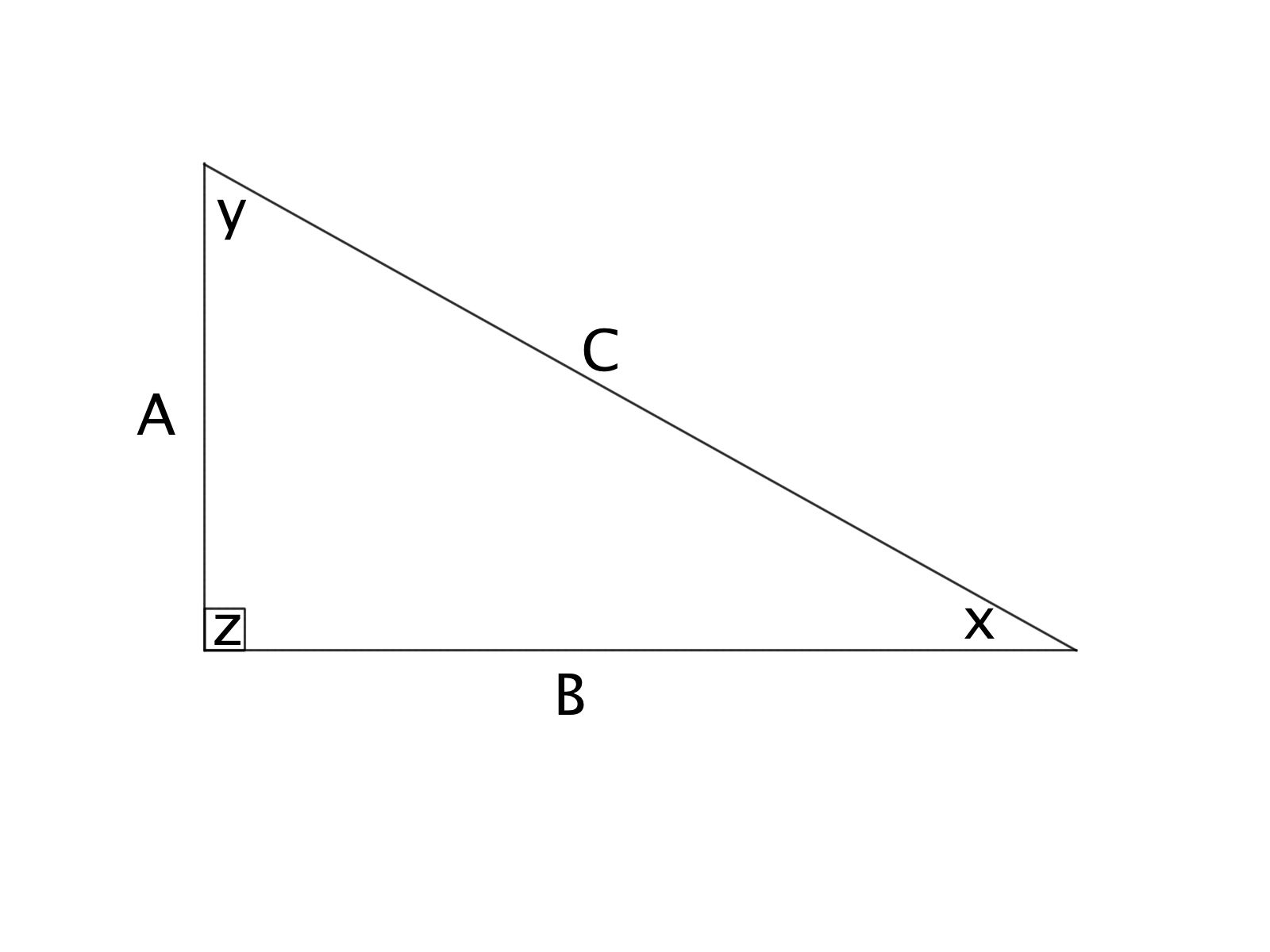
Given:


What is the perimeter of the right triangle?
Given:
What is the perimeter of the right triangle?
Tap to reveal answer
How do you find the perimeter of a right triangle?
There are three primary methods used to find the perimeter of a right triangle.
- When side lengths are given, add them together.
- Solve for a missing side using the Pythagorean theorem.
- If we know side-angle-side information, solve for the missing side using the Law of Cosines.
Method 1:
This method will show you how to calculate the perimeter of a triangle when all sides lengths are known. Consider the following figure:
If we know the lengths of sides , , and , then we can simply add them together to find the perimeter of the triangle. It is important to note several things. First, we need to make sure that all the units given match one another. Second, when all the side lengths are known, then the perimeter formula may be used on all types of triangles (e.g. right, acute, obtuse, equilateral, isosceles, and scalene). The perimeter formula is written formally in the following format:
Method 2:
In right triangles, we can calculate the perimeter of a triangle when we are provided only two sides. We can do this by using the Pythagorean theorem. Let's first discuss right triangles in a general sense. A right triangle is a triangle that has one angle. It is a special triangle and needs to be labeled accordingly. The legs of the triangle form the angle and they are labeled and . The side of the triangle that is opposite of the angle and connects the two legs is known as the hypotenuse. The hypotenuse is the longest side of the triangle and is labeled as .
If a triangle appears in this format, then we can use the Pythagorean theorem to solve for any missing side. This formula is written in the following manner:
We can rearrange it in a number of ways to solve for each of the sides of the triangle. Let's rearrange it to solve for the hypotenuse, .
Rearrange and take the square root of both sides.
Simplify.
Now, let's use the Pythagorean theorem to solve for one of the legs, .
Subtract from both sides of the equation.
Take the square root of both sides.
Simplify.
Last, let's use the Pythagorean theorem to solve for the adjacent leg, .
Subtract from both sides of the equation.
Take the square root of both sides.
Simplify.
It is important to note that we can only use the following formulas to solve for the missing side of a right triangle when two other sides are known:
After we find the missing side, we can use the perimeter formula to calculate the triangle's perimeter.
Method 3:
This method is the most complicated method and can only be used when we know two side lengths of a triangle as well as the measure of the angle that is between them. When we know side-angle-side (SAS) information, we can use the Law of Cosines to find the missing side. In order for this formula to accurately calculate the missing side we need to label the triangle in the following manner:
When the triangle is labeled in this way each side directly corresponds to the angle directly opposite of it. If we label our triangle carefully, then we can use the following formulas to find missing sides in any triangle given SAS information:
After, we calculate the right side of the equation, we need to take the square root of both sides in order to obtain the final side length of the missing side. Last, we need to use the perimeter formula to obtain the distance of the side lengths of the polygon.
Solution:
Now, that we have discussed the three methods used to calculate the perimeter of a triangle, we can use this information to solve the problem.
First, we must determine the length of side B. To do this, we use the Pythagorean theorem, which shows that:

Through substitution, we know that:


Once we know the length of side B, we can find the perimeter by adding the lengths of each side:

Since the problem is given with the unit "inches" we know that the answer is  ; converting this to feet gives us the correct answer:

How do you find the perimeter of a right triangle?
There are three primary methods used to find the perimeter of a right triangle.
- When side lengths are given, add them together.
- Solve for a missing side using the Pythagorean theorem.
- If we know side-angle-side information, solve for the missing side using the Law of Cosines.
Method 1:
This method will show you how to calculate the perimeter of a triangle when all sides lengths are known. Consider the following figure:
If we know the lengths of sides
Method 2:
In right triangles, we can calculate the perimeter of a triangle when we are provided only two sides. We can do this by using the Pythagorean theorem. Let's first discuss right triangles in a general sense. A right triangle is a triangle that has one
If a triangle appears in this format, then we can use the Pythagorean theorem to solve for any missing side. This formula is written in the following manner:
We can rearrange it in a number of ways to solve for each of the sides of the triangle. Let's rearrange it to solve for the hypotenuse,
Rearrange and take the square root of both sides.
Simplify.
Now, let's use the Pythagorean theorem to solve for one of the legs,
Subtract
Take the square root of both sides.
Simplify.
Last, let's use the Pythagorean theorem to solve for the adjacent leg,
Subtract
Take the square root of both sides.
Simplify.
It is important to note that we can only use the following formulas to solve for the missing side of a right triangle when two other sides are known:
After we find the missing side, we can use the perimeter formula to calculate the triangle's perimeter.
Method 3:
This method is the most complicated method and can only be used when we know two side lengths of a triangle as well as the measure of the angle that is between them. When we know side-angle-side (SAS) information, we can use the Law of Cosines to find the missing side. In order for this formula to accurately calculate the missing side we need to label the triangle in the following manner:
When the triangle is labeled in this way each side directly corresponds to the angle directly opposite of it. If we label our triangle carefully, then we can use the following formulas to find missing sides in any triangle given SAS information:
After, we calculate the right side of the equation, we need to take the square root of both sides in order to obtain the final side length of the missing side. Last, we need to use the perimeter formula to obtain the distance of the side lengths of the polygon.
Solution:
Now, that we have discussed the three methods used to calculate the perimeter of a triangle, we can use this information to solve the problem.
First, we must determine the length of side B. To do this, we use the Pythagorean theorem, which shows that:
Through substitution, we know that:
Once we know the length of side B, we can find the perimeter by adding the lengths of each side:
Since the problem is given with the unit "inches" we know that the answer is
← Didn't Know|Knew It →
Find the perimeter of this right triangle.

Find the perimeter of this right triangle.
Tap to reveal answer
How do you find the perimeter of a right triangle?
There are three primary methods used to find the perimeter of a right triangle.
- When side lengths are given, add them together.
- Solve for a missing side using the Pythagorean theorem.
- If we know side-angle-side information, solve for the missing side using the Law of Cosines.
Method 1:
This method will show you how to calculate the perimeter of a triangle when all sides lengths are known. Consider the following figure:
If we know the lengths of sides , , and , then we can simply add them together to find the perimeter of the triangle. It is important to note several things. First, we need to make sure that all the units given match one another. Second, when all the side lengths are known, then the perimeter formula may be used on all types of triangles (e.g. right, acute, obtuse, equilateral, isosceles, and scalene). The perimeter formula is written formally in the following format:
Method 2:
In right triangles, we can calculate the perimeter of a triangle when we are provided only two sides. We can do this by using the Pythagorean theorem. Let's first discuss right triangles in a general sense. A right triangle is a triangle that has one angle. It is a special triangle and needs to be labeled accordingly. The legs of the triangle form the angle and they are labeled and . The side of the triangle that is opposite of the angle and connects the two legs is known as the hypotenuse. The hypotenuse is the longest side of the triangle and is labeled as .
If a triangle appears in this format, then we can use the Pythagorean theorem to solve for any missing side. This formula is written in the following manner:
We can rearrange it in a number of ways to solve for each of the sides of the triangle. Let's rearrange it to solve for the hypotenuse, .
Rearrange and take the square root of both sides.
Simplify.
Now, let's use the Pythagorean theorem to solve for one of the legs, .
Subtract from both sides of the equation.
Take the square root of both sides.
Simplify.
Last, let's use the Pythagorean theorem to solve for the adjacent leg, .
Subtract from both sides of the equation.
Take the square root of both sides.
Simplify.
It is important to note that we can only use the following formulas to solve for the missing side of a right triangle when two other sides are known:
After we find the missing side, we can use the perimeter formula to calculate the triangle's perimeter.
Method 3:
This method is the most complicated method and can only be used when we know two side lengths of a triangle as well as the measure of the angle that is between them. When we know side-angle-side (SAS) information, we can use the Law of Cosines to find the missing side. In order for this formula to accurately calculate the missing side we need to label the triangle in the following manner:
When the triangle is labeled in this way each side directly corresponds to the angle directly opposite of it. If we label our triangle carefully, then we can use the following formulas to find missing sides in any triangle given SAS information:
After, we calculate the right side of the equation, we need to take the square root of both sides in order to obtain the final side length of the missing side. Last, we need to use the perimeter formula to obtain the distance of the side lengths of the polygon.
Solution:
Now, that we have discussed the three methods used to calculate the perimeter of a triangle, we can use this information to solve the problem.
Before we can find the perimeter of this triangle, we need to find the length of side 'b'. Use the Pythagorean theorem and substitute.


Knowing that c=11 and a=9, we can find b.

Now that we know what b is, we can find the perimeter using this formula:

Basically, it is just adding the length of all sides.

How do you find the perimeter of a right triangle?
There are three primary methods used to find the perimeter of a right triangle.
- When side lengths are given, add them together.
- Solve for a missing side using the Pythagorean theorem.
- If we know side-angle-side information, solve for the missing side using the Law of Cosines.
Method 1:
This method will show you how to calculate the perimeter of a triangle when all sides lengths are known. Consider the following figure:
If we know the lengths of sides
Method 2:
In right triangles, we can calculate the perimeter of a triangle when we are provided only two sides. We can do this by using the Pythagorean theorem. Let's first discuss right triangles in a general sense. A right triangle is a triangle that has one
If a triangle appears in this format, then we can use the Pythagorean theorem to solve for any missing side. This formula is written in the following manner:
We can rearrange it in a number of ways to solve for each of the sides of the triangle. Let's rearrange it to solve for the hypotenuse,
Rearrange and take the square root of both sides.
Simplify.
Now, let's use the Pythagorean theorem to solve for one of the legs,
Subtract
Take the square root of both sides.
Simplify.
Last, let's use the Pythagorean theorem to solve for the adjacent leg,
Subtract
Take the square root of both sides.
Simplify.
It is important to note that we can only use the following formulas to solve for the missing side of a right triangle when two other sides are known:
After we find the missing side, we can use the perimeter formula to calculate the triangle's perimeter.
Method 3:
This method is the most complicated method and can only be used when we know two side lengths of a triangle as well as the measure of the angle that is between them. When we know side-angle-side (SAS) information, we can use the Law of Cosines to find the missing side. In order for this formula to accurately calculate the missing side we need to label the triangle in the following manner:
When the triangle is labeled in this way each side directly corresponds to the angle directly opposite of it. If we label our triangle carefully, then we can use the following formulas to find missing sides in any triangle given SAS information:
After, we calculate the right side of the equation, we need to take the square root of both sides in order to obtain the final side length of the missing side. Last, we need to use the perimeter formula to obtain the distance of the side lengths of the polygon.
Solution:
Now, that we have discussed the three methods used to calculate the perimeter of a triangle, we can use this information to solve the problem.
Before we can find the perimeter of this triangle, we need to find the length of side 'b'. Use the Pythagorean theorem and substitute.
Knowing that c=11 and a=9, we can find b.
Now that we know what b is, we can find the perimeter using this formula:
Basically, it is just adding the length of all sides.
← Didn't Know|Knew It →
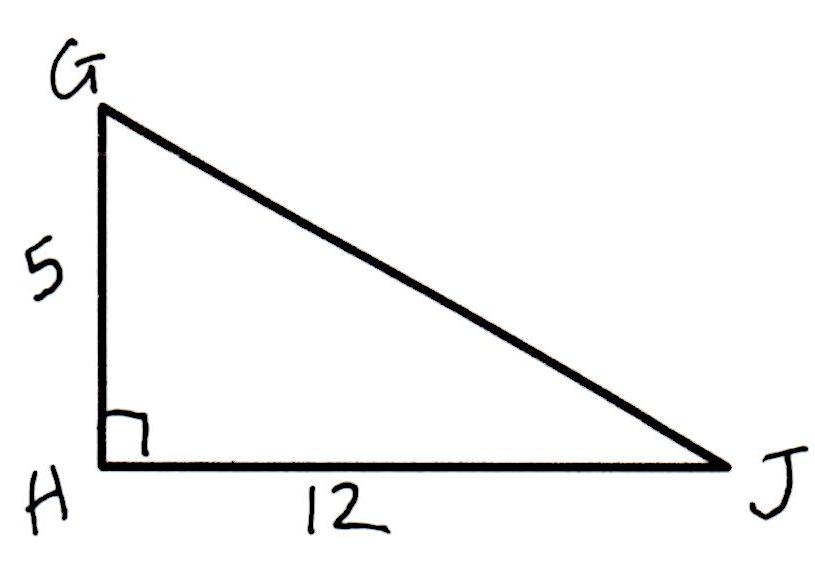

Tap to reveal answer
How do you find the perimeter of a right triangle?
There are three primary methods used to find the perimeter of a right triangle.
- When side lengths are given, add them together.
- Solve for a missing side using the Pythagorean theorem.
- If we know side-angle-side information, solve for the missing side using the Law of Cosines.
Method 1:
This method will show you how to calculate the perimeter of a triangle when all sides lengths are known. Consider the following figure:
If we know the lengths of sides , , and , then we can simply add them together to find the perimeter of the triangle. It is important to note several things. First, we need to make sure that all the units given match one another. Second, when all the side lengths are known, then the perimeter formula may be used on all types of triangles (e.g. right, acute, obtuse, equilateral, isosceles, and scalene). The perimeter formula is written formally in the following format:
Method 2:
In right triangles, we can calculate the perimeter of a triangle when we are provided only two sides. We can do this by using the Pythagorean theorem. Let's first discuss right triangles in a general sense. A right triangle is a triangle that has one angle. It is a special triangle and needs to be labeled accordingly. The legs of the triangle form the angle and they are labeled and . The side of the triangle that is opposite of the angle and connects the two legs is known as the hypotenuse. The hypotenuse is the longest side of the triangle and is labeled as .
If a triangle appears in this format, then we can use the Pythagorean theorem to solve for any missing side. This formula is written in the following manner:
We can rearrange it in a number of ways to solve for each of the sides of the triangle. Let's rearrange it to solve for the hypotenuse, .
Rearrange and take the square root of both sides.
Simplify.
Now, let's use the Pythagorean theorem to solve for one of the legs, .
Subtract from both sides of the equation.
Take the square root of both sides.
Simplify.
Last, let's use the Pythagorean theorem to solve for the adjacent leg, .
Subtract from both sides of the equation.
Take the square root of both sides.
Simplify.
It is important to note that we can only use the following formulas to solve for the missing side of a right triangle when two other sides are known:
After we find the missing side, we can use the perimeter formula to calculate the triangle's perimeter.
Method 3:
This method is the most complicated method and can only be used when we know two side lengths of a triangle as well as the measure of the angle that is between them. When we know side-angle-side (SAS) information, we can use the Law of Cosines to find the missing side. In order for this formula to accurately calculate the missing side we need to label the triangle in the following manner:
When the triangle is labeled in this way each side directly corresponds to the angle directly opposite of it. If we label our triangle carefully, then we can use the following formulas to find missing sides in any triangle given SAS information:
After, we calculate the right side of the equation, we need to take the square root of both sides in order to obtain the final side length of the missing side. Last, we need to use the perimeter formula to obtain the distance of the side lengths of the polygon.
Solution:
Now, that we have discussed the three methods used to calculate the perimeter of a triangle, we can use this information to solve the problem.
In order to calculate the perimeter we need to find the length of the hypotenuse using the Pythagorean theorem.
Rearrange.
Substitute in known values.


Now that we have found the missing side, we can substitute the values into the perimeter formula and solve.


How do you find the perimeter of a right triangle?
There are three primary methods used to find the perimeter of a right triangle.
- When side lengths are given, add them together.
- Solve for a missing side using the Pythagorean theorem.
- If we know side-angle-side information, solve for the missing side using the Law of Cosines.
Method 1:
This method will show you how to calculate the perimeter of a triangle when all sides lengths are known. Consider the following figure:
If we know the lengths of sides
Method 2:
In right triangles, we can calculate the perimeter of a triangle when we are provided only two sides. We can do this by using the Pythagorean theorem. Let's first discuss right triangles in a general sense. A right triangle is a triangle that has one
If a triangle appears in this format, then we can use the Pythagorean theorem to solve for any missing side. This formula is written in the following manner:
We can rearrange it in a number of ways to solve for each of the sides of the triangle. Let's rearrange it to solve for the hypotenuse,
Rearrange and take the square root of both sides.
Simplify.
Now, let's use the Pythagorean theorem to solve for one of the legs,
Subtract
Take the square root of both sides.
Simplify.
Last, let's use the Pythagorean theorem to solve for the adjacent leg,
Subtract
Take the square root of both sides.
Simplify.
It is important to note that we can only use the following formulas to solve for the missing side of a right triangle when two other sides are known:
After we find the missing side, we can use the perimeter formula to calculate the triangle's perimeter.
Method 3:
This method is the most complicated method and can only be used when we know two side lengths of a triangle as well as the measure of the angle that is between them. When we know side-angle-side (SAS) information, we can use the Law of Cosines to find the missing side. In order for this formula to accurately calculate the missing side we need to label the triangle in the following manner:
When the triangle is labeled in this way each side directly corresponds to the angle directly opposite of it. If we label our triangle carefully, then we can use the following formulas to find missing sides in any triangle given SAS information:
After, we calculate the right side of the equation, we need to take the square root of both sides in order to obtain the final side length of the missing side. Last, we need to use the perimeter formula to obtain the distance of the side lengths of the polygon.
Solution:
Now, that we have discussed the three methods used to calculate the perimeter of a triangle, we can use this information to solve the problem.
In order to calculate the perimeter we need to find the length of the hypotenuse using the Pythagorean theorem.
Rearrange.
Substitute in known values.
Now that we have found the missing side, we can substitute the values into the perimeter formula and solve.
← Didn't Know|Knew It →
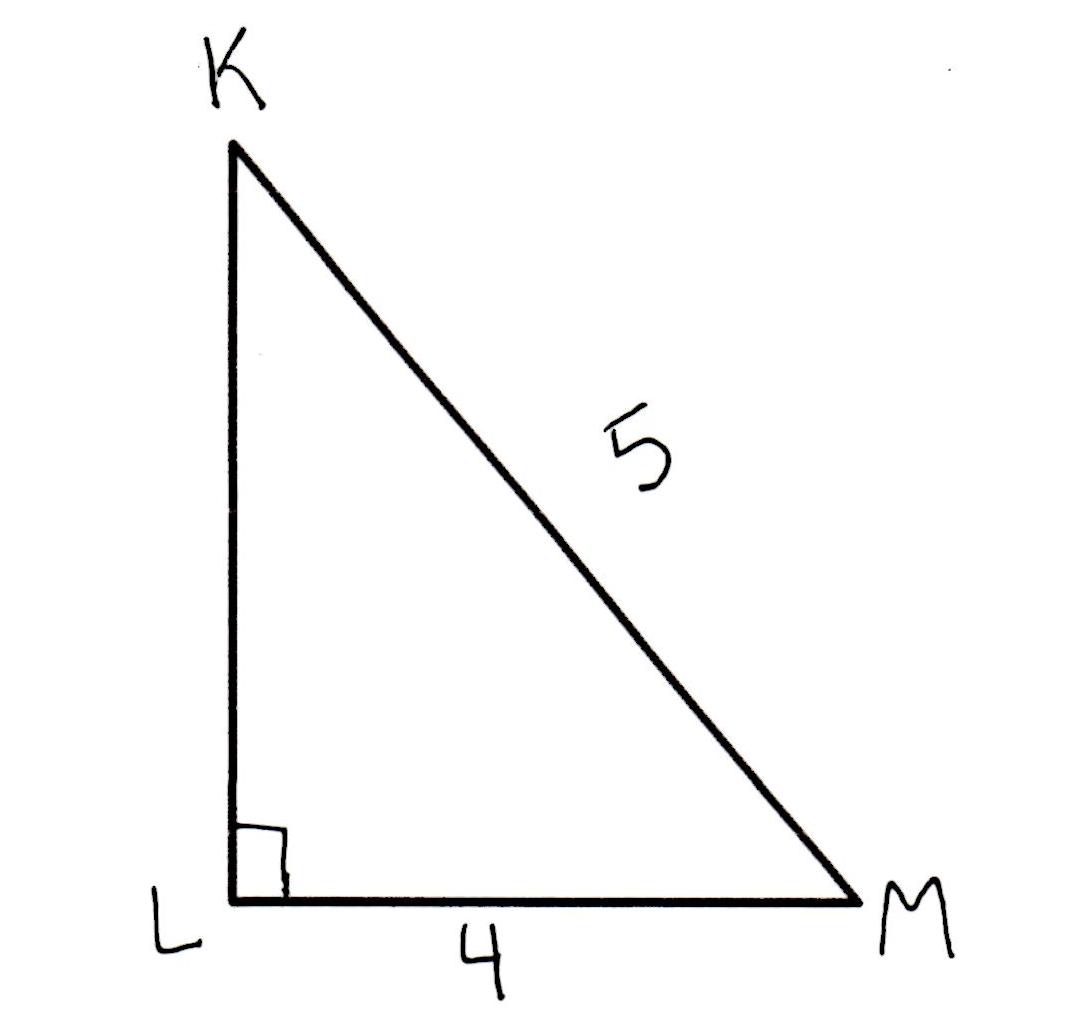

Tap to reveal answer
How do you find the perimeter of a right triangle?
There are three primary methods used to find the perimeter of a right triangle.
- When side lengths are given, add them together.
- Solve for a missing side using the Pythagorean theorem.
- If we know side-angle-side information, solve for the missing side using the Law of Cosines.
Method 1:
This method will show you how to calculate the perimeter of a triangle when all sides lengths are known. Consider the following figure:
If we know the lengths of sides , , and , then we can simply add them together to find the perimeter of the triangle. It is important to note several things. First, we need to make sure that all the units given match one another. Second, when all the side lengths are known, then the perimeter formula may be used on all types of triangles (e.g. right, acute, obtuse, equilateral, isosceles, and scalene). The perimeter formula is written formally in the following format:
Method 2:
In right triangles, we can calculate the perimeter of a triangle when we are provided only two sides. We can do this by using the Pythagorean theorem. Let's first discuss right triangles in a general sense. A right triangle is a triangle that has one angle. It is a special triangle and needs to be labeled accordingly. The legs of the triangle form the angle and they are labeled and . The side of the triangle that is opposite of the angle and connects the two legs is known as the hypotenuse. The hypotenuse is the longest side of the triangle and is labeled as .
If a triangle appears in this format, then we can use the Pythagorean theorem to solve for any missing side. This formula is written in the following manner:
We can rearrange it in a number of ways to solve for each of the sides of the triangle. Let's rearrange it to solve for the hypotenuse, .
Rearrange and take the square root of both sides.
Simplify.
Now, let's use the Pythagorean theorem to solve for one of the legs, .
Subtract from both sides of the equation.
Take the square root of both sides.
Simplify.
Last, let's use the Pythagorean theorem to solve for the adjacent leg, .
Subtract from both sides of the equation.
Take the square root of both sides.
Simplify.
It is important to note that we can only use the following formulas to solve for the missing side of a right triangle when two other sides are known:
After we find the missing side, we can use the perimeter formula to calculate the triangle's perimeter.
Method 3:
This method is the most complicated method and can only be used when we know two side lengths of a triangle as well as the measure of the angle that is between them. When we know side-angle-side (SAS) information, we can use the Law of Cosines to find the missing side. In order for this formula to accurately calculate the missing side we need to label the triangle in the following manner:
When the triangle is labeled in this way each side directly corresponds to the angle directly opposite of it. If we label our triangle carefully, then we can use the following formulas to find missing sides in any triangle given SAS information:
After, we calculate the right side of the equation, we need to take the square root of both sides in order to obtain the final side length of the missing side. Last, we need to use the perimeter formula to obtain the distance of the side lengths of the polygon.
Solution:
Now, that we have discussed the three methods used to calculate the perimeter of a triangle, we can use this information to solve the problem.
In order to calculate the perimeter we need to find the length of the hypotenuse using the Pythagorean theorem.
Rearrange.
Substitute in known values.


Now that we have found the missing side, we can substitute the values into the perimeter formula and solve.


How do you find the perimeter of a right triangle?
There are three primary methods used to find the perimeter of a right triangle.
- When side lengths are given, add them together.
- Solve for a missing side using the Pythagorean theorem.
- If we know side-angle-side information, solve for the missing side using the Law of Cosines.
Method 1:
This method will show you how to calculate the perimeter of a triangle when all sides lengths are known. Consider the following figure:
If we know the lengths of sides
Method 2:
In right triangles, we can calculate the perimeter of a triangle when we are provided only two sides. We can do this by using the Pythagorean theorem. Let's first discuss right triangles in a general sense. A right triangle is a triangle that has one
If a triangle appears in this format, then we can use the Pythagorean theorem to solve for any missing side. This formula is written in the following manner:
We can rearrange it in a number of ways to solve for each of the sides of the triangle. Let's rearrange it to solve for the hypotenuse,
Rearrange and take the square root of both sides.
Simplify.
Now, let's use the Pythagorean theorem to solve for one of the legs,
Subtract
Take the square root of both sides.
Simplify.
Last, let's use the Pythagorean theorem to solve for the adjacent leg,
Subtract
Take the square root of both sides.
Simplify.
It is important to note that we can only use the following formulas to solve for the missing side of a right triangle when two other sides are known:
After we find the missing side, we can use the perimeter formula to calculate the triangle's perimeter.
Method 3:
This method is the most complicated method and can only be used when we know two side lengths of a triangle as well as the measure of the angle that is between them. When we know side-angle-side (SAS) information, we can use the Law of Cosines to find the missing side. In order for this formula to accurately calculate the missing side we need to label the triangle in the following manner:
When the triangle is labeled in this way each side directly corresponds to the angle directly opposite of it. If we label our triangle carefully, then we can use the following formulas to find missing sides in any triangle given SAS information:
After, we calculate the right side of the equation, we need to take the square root of both sides in order to obtain the final side length of the missing side. Last, we need to use the perimeter formula to obtain the distance of the side lengths of the polygon.
Solution:
Now, that we have discussed the three methods used to calculate the perimeter of a triangle, we can use this information to solve the problem.
In order to calculate the perimeter we need to find the length of the hypotenuse using the Pythagorean theorem.
Rearrange.
Substitute in known values.
Now that we have found the missing side, we can substitute the values into the perimeter formula and solve.
← Didn't Know|Knew It →
In the figure below, right triangle  has a hypotenuse of 6. If
  and
and  , find the perimeter of the triangle
  .
.

In the figure below, right triangle
Tap to reveal answer
How do you find the perimeter of a right triangle?
There are three primary methods used to find the perimeter of a right triangle.
- When side lengths are given, add them together.
- Solve for a missing side using the Pythagorean theorem.
- If we know side-angle-side information, solve for the missing side using the Law of Cosines.
Method 1:
This method will show you how to calculate the perimeter of a triangle when all sides lengths are known. Consider the following figure:
If we know the lengths of sides , , and , then we can simply add them together to find the perimeter of the triangle. It is important to note several things. First, we need to make sure that all the units given match one another. Second, when all the side lengths are known, then the perimeter formula may be used on all types of triangles (e.g. right, acute, obtuse, equilateral, isosceles, and scalene). The perimeter formula is written formally in the following format:
Method 2:
In right triangles, we can calculate the perimeter of a triangle when we are provided only two sides. We can do this by using the Pythagorean theorem. Let's first discuss right triangles in a general sense. A right triangle is a triangle that has one angle. It is a special triangle and needs to be labeled accordingly. The legs of the triangle form the angle and they are labeled and . The side of the triangle that is opposite of the angle and connects the two legs is known as the hypotenuse. The hypotenuse is the longest side of the triangle and is labeled as .
If a triangle appears in this format, then we can use the Pythagorean theorem to solve for any missing side. This formula is written in the following manner:
We can rearrange it in a number of ways to solve for each of the sides of the triangle. Let's rearrange it to solve for the hypotenuse, .
Rearrange and take the square root of both sides.
Simplify.
Now, let's use the Pythagorean theorem to solve for one of the legs, .
Subtract from both sides of the equation.
Take the square root of both sides.
Simplify.
Last, let's use the Pythagorean theorem to solve for the adjacent leg, .
Subtract from both sides of the equation.
Take the square root of both sides.
Simplify.
It is important to note that we can only use the following formulas to solve for the missing side of a right triangle when two other sides are known:
After we find the missing side, we can use the perimeter formula to calculate the triangle's perimeter.
Method 3:
This method is the most complicated method and can only be used when we know two side lengths of a triangle as well as the measure of the angle that is between them. When we know side-angle-side (SAS) information, we can use the Law of Cosines to find the missing side. In order for this formula to accurately calculate the missing side we need to label the triangle in the following manner:
When the triangle is labeled in this way each side directly corresponds to the angle directly opposite of it. If we label our triangle carefully, then we can use the following formulas to find missing sides in any triangle given SAS information:
After, we calculate the right side of the equation, we need to take the square root of both sides in order to obtain the final side length of the missing side. Last, we need to use the perimeter formula to obtain the distance of the side lengths of the polygon.
Solution:
Now, that we have discussed the three methods used to calculate the perimeter of a triangle, we can use this information to solve the problem.
First, we need to use the Pythagorean theorem to solve for  .
.


Because we are dealing with a triangle, the only valid solution is  because we can't have negative values.
After you have found  , plug it in to find the perimeter. Remember to simplify all square roots!


How do you find the perimeter of a right triangle?
There are three primary methods used to find the perimeter of a right triangle.
- When side lengths are given, add them together.
- Solve for a missing side using the Pythagorean theorem.
- If we know side-angle-side information, solve for the missing side using the Law of Cosines.
Method 1:
This method will show you how to calculate the perimeter of a triangle when all sides lengths are known. Consider the following figure:
If we know the lengths of sides
Method 2:
In right triangles, we can calculate the perimeter of a triangle when we are provided only two sides. We can do this by using the Pythagorean theorem. Let's first discuss right triangles in a general sense. A right triangle is a triangle that has one
If a triangle appears in this format, then we can use the Pythagorean theorem to solve for any missing side. This formula is written in the following manner:
We can rearrange it in a number of ways to solve for each of the sides of the triangle. Let's rearrange it to solve for the hypotenuse,
Rearrange and take the square root of both sides.
Simplify.
Now, let's use the Pythagorean theorem to solve for one of the legs,
Subtract
Take the square root of both sides.
Simplify.
Last, let's use the Pythagorean theorem to solve for the adjacent leg,
Subtract
Take the square root of both sides.
Simplify.
It is important to note that we can only use the following formulas to solve for the missing side of a right triangle when two other sides are known:
After we find the missing side, we can use the perimeter formula to calculate the triangle's perimeter.
Method 3:
This method is the most complicated method and can only be used when we know two side lengths of a triangle as well as the measure of the angle that is between them. When we know side-angle-side (SAS) information, we can use the Law of Cosines to find the missing side. In order for this formula to accurately calculate the missing side we need to label the triangle in the following manner:
When the triangle is labeled in this way each side directly corresponds to the angle directly opposite of it. If we label our triangle carefully, then we can use the following formulas to find missing sides in any triangle given SAS information:
After, we calculate the right side of the equation, we need to take the square root of both sides in order to obtain the final side length of the missing side. Last, we need to use the perimeter formula to obtain the distance of the side lengths of the polygon.
Solution:
Now, that we have discussed the three methods used to calculate the perimeter of a triangle, we can use this information to solve the problem.
First, we need to use the Pythagorean theorem to solve for
Because we are dealing with a triangle, the only valid solution is
After you have found
← Didn't Know|Knew It →
Find the perimeter of the triangle below.

Find the perimeter of the triangle below.
Tap to reveal answer
How do you find the perimeter of a right triangle?
There are three primary methods used to find the perimeter of a right triangle.
- When side lengths are given, add them together.
- Solve for a missing side using the Pythagorean theorem.
- If we know side-angle-side information, solve for the missing side using the Law of Cosines.
Method 1:
This method will show you how to calculate the perimeter of a triangle when all sides lengths are known. Consider the following figure:
If we know the lengths of sides , , and , then we can simply add them together to find the perimeter of the triangle. It is important to note several things. First, we need to make sure that all the units given match one another. Second, when all the side lengths are known, then the perimeter formula may be used on all types of triangles (e.g. right, acute, obtuse, equilateral, isosceles, and scalene). The perimeter formula is written formally in the following format:
Method 2:
In right triangles, we can calculate the perimeter of a triangle when we are provided only two sides. We can do this by using the Pythagorean theorem. Let's first discuss right triangles in a general sense. A right triangle is a triangle that has one angle. It is a special triangle and needs to be labeled accordingly. The legs of the triangle form the angle and they are labeled and . The side of the triangle that is opposite of the angle and connects the two legs is known as the hypotenuse. The hypotenuse is the longest side of the triangle and is labeled as .
If a triangle appears in this format, then we can use the Pythagorean theorem to solve for any missing side. This formula is written in the following manner:
We can rearrange it in a number of ways to solve for each of the sides of the triangle. Let's rearrange it to solve for the hypotenuse, .
Rearrange and take the square root of both sides.
Simplify.
Now, let's use the Pythagorean theorem to solve for one of the legs, .
Subtract from both sides of the equation.
Take the square root of both sides.
Simplify.
Last, let's use the Pythagorean theorem to solve for the adjacent leg, .
Subtract from both sides of the equation.
Take the square root of both sides.
Simplify.
It is important to note that we can only use the following formulas to solve for the missing side of a right triangle when two other sides are known:
After we find the missing side, we can use the perimeter formula to calculate the triangle's perimeter.
Method 3:
This method is the most complicated method and can only be used when we know two side lengths of a triangle as well as the measure of the angle that is between them. When we know side-angle-side (SAS) information, we can use the Law of Cosines to find the missing side. In order for this formula to accurately calculate the missing side we need to label the triangle in the following manner:
When the triangle is labeled in this way each side directly corresponds to the angle directly opposite of it. If we label our triangle carefully, then we can use the following formulas to find missing sides in any triangle given SAS information:
After, we calculate the right side of the equation, we need to take the square root of both sides in order to obtain the final side length of the missing side. Last, we need to use the perimeter formula to obtain the distance of the side lengths of the polygon.
Solution:
Now, that we have discussed the three methods used to calculate the perimeter of a triangle, we can use this information to solve the problem. The perimeter of a triangle is simply the sum of its three sides. Our problem is that we only know two of the sides. The key for us is the fact that we have a right triangle (as indicated by the little box in the one angle). Knowing two sides of a right triangle and needing the third is a classic case for using the Pythagorean theorem. In simple (sort of), the Pythagorean theorem says that sum of the squares of the lengths of the legs of a right triangle is equal to the square of the length of its hypotenuse.
Every right triangle has three sides and a right angle. The side across from the right angle (also the longest) is called the hypotenuse. The other two sides are each called legs. That means in our triangle, the side with length 17 is the hypotenuse, while the one with length 8 and the one we need to find are each legs.
What the Pythagorean theorem tells us is that if we square the lengths of our two legs and add those two numbers together, we get the same number as when we square the length of our hypotenuse. Since we don't know the length of our second leg, we can identify it with the variable  .
.
This allows us to create the following algebraic equation:

which simplified becomes

To solve this equation, we first need to get the variable by itself, which can be done by subtracting 64 from both sides, giving us

From here, we simply take the square root of both sides.

Technically,  would also be a square root of 225, but since a side of a triangle can only have a positive length, we'll stick with 15 as our answer.
But we aren't done yet. We now know the length of our missing side, but we still need to add the three side lengths together to find the perimeter.

Our answer is 40.
How do you find the perimeter of a right triangle?
There are three primary methods used to find the perimeter of a right triangle.
- When side lengths are given, add them together.
- Solve for a missing side using the Pythagorean theorem.
- If we know side-angle-side information, solve for the missing side using the Law of Cosines.
Method 1:
This method will show you how to calculate the perimeter of a triangle when all sides lengths are known. Consider the following figure:
If we know the lengths of sides
Method 2:
In right triangles, we can calculate the perimeter of a triangle when we are provided only two sides. We can do this by using the Pythagorean theorem. Let's first discuss right triangles in a general sense. A right triangle is a triangle that has one
If a triangle appears in this format, then we can use the Pythagorean theorem to solve for any missing side. This formula is written in the following manner:
We can rearrange it in a number of ways to solve for each of the sides of the triangle. Let's rearrange it to solve for the hypotenuse,
Rearrange and take the square root of both sides.
Simplify.
Now, let's use the Pythagorean theorem to solve for one of the legs,
Subtract
Take the square root of both sides.
Simplify.
Last, let's use the Pythagorean theorem to solve for the adjacent leg,
Subtract
Take the square root of both sides.
Simplify.
It is important to note that we can only use the following formulas to solve for the missing side of a right triangle when two other sides are known:
After we find the missing side, we can use the perimeter formula to calculate the triangle's perimeter.
Method 3:
This method is the most complicated method and can only be used when we know two side lengths of a triangle as well as the measure of the angle that is between them. When we know side-angle-side (SAS) information, we can use the Law of Cosines to find the missing side. In order for this formula to accurately calculate the missing side we need to label the triangle in the following manner:
When the triangle is labeled in this way each side directly corresponds to the angle directly opposite of it. If we label our triangle carefully, then we can use the following formulas to find missing sides in any triangle given SAS information:
After, we calculate the right side of the equation, we need to take the square root of both sides in order to obtain the final side length of the missing side. Last, we need to use the perimeter formula to obtain the distance of the side lengths of the polygon.
Solution:
Now, that we have discussed the three methods used to calculate the perimeter of a triangle, we can use this information to solve the problem. The perimeter of a triangle is simply the sum of its three sides. Our problem is that we only know two of the sides. The key for us is the fact that we have a right triangle (as indicated by the little box in the one angle). Knowing two sides of a right triangle and needing the third is a classic case for using the Pythagorean theorem. In simple (sort of), the Pythagorean theorem says that sum of the squares of the lengths of the legs of a right triangle is equal to the square of the length of its hypotenuse.
Every right triangle has three sides and a right angle. The side across from the right angle (also the longest) is called the hypotenuse. The other two sides are each called legs. That means in our triangle, the side with length 17 is the hypotenuse, while the one with length 8 and the one we need to find are each legs.
What the Pythagorean theorem tells us is that if we square the lengths of our two legs and add those two numbers together, we get the same number as when we square the length of our hypotenuse. Since we don't know the length of our second leg, we can identify it with the variable
This allows us to create the following algebraic equation:
which simplified becomes
To solve this equation, we first need to get the variable by itself, which can be done by subtracting 64 from both sides, giving us
From here, we simply take the square root of both sides.
Technically,
But we aren't done yet. We now know the length of our missing side, but we still need to add the three side lengths together to find the perimeter.
Our answer is 40.
← Didn't Know|Knew It →