Triangles - Math
Card 1 of 276
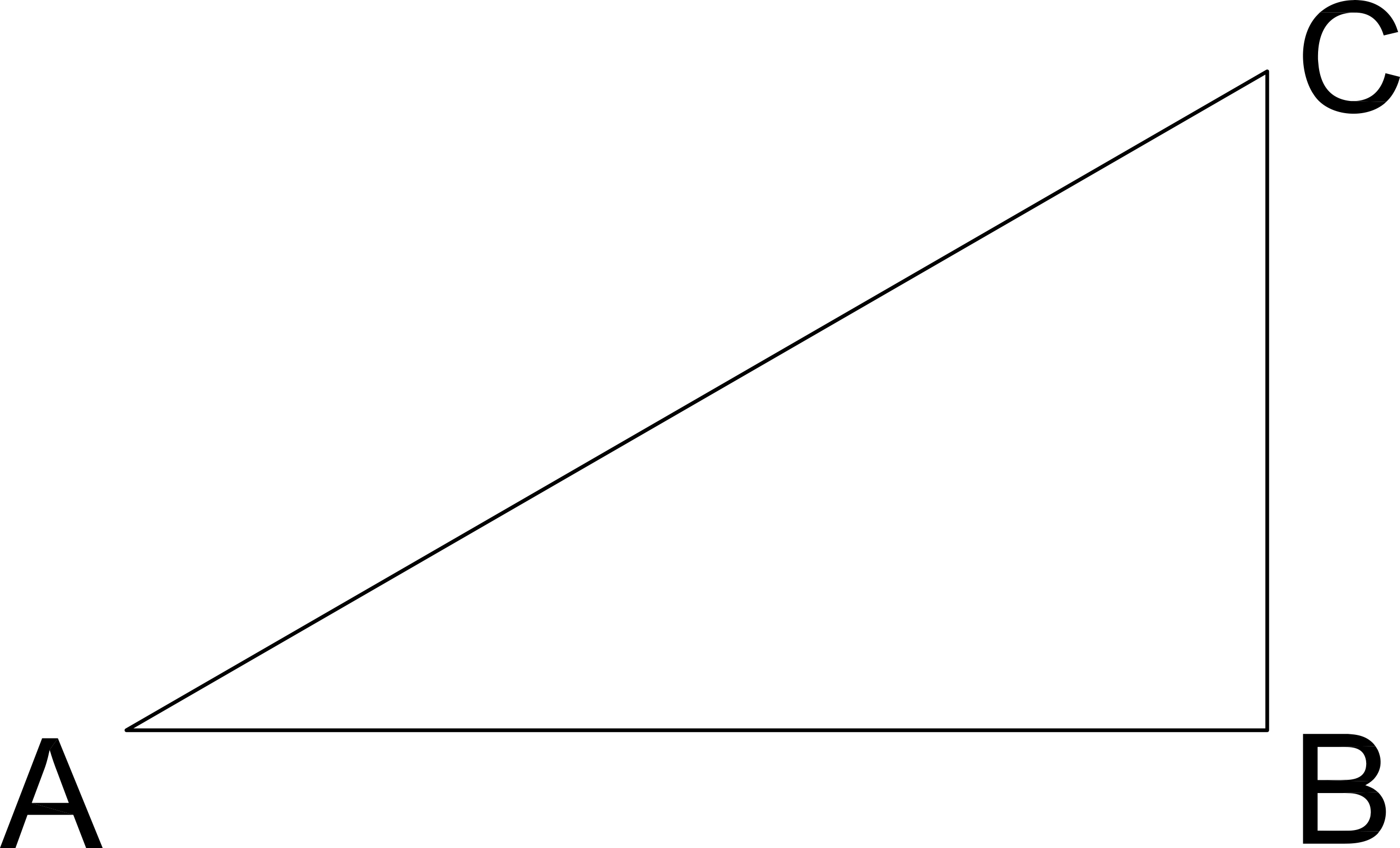
What is the length of CB?
What is the length of CB?
Tap to reveal answer


← Didn't Know|Knew It →
If  equals
  and
and  is
is  , how long is
  ?
?
If
Tap to reveal answer
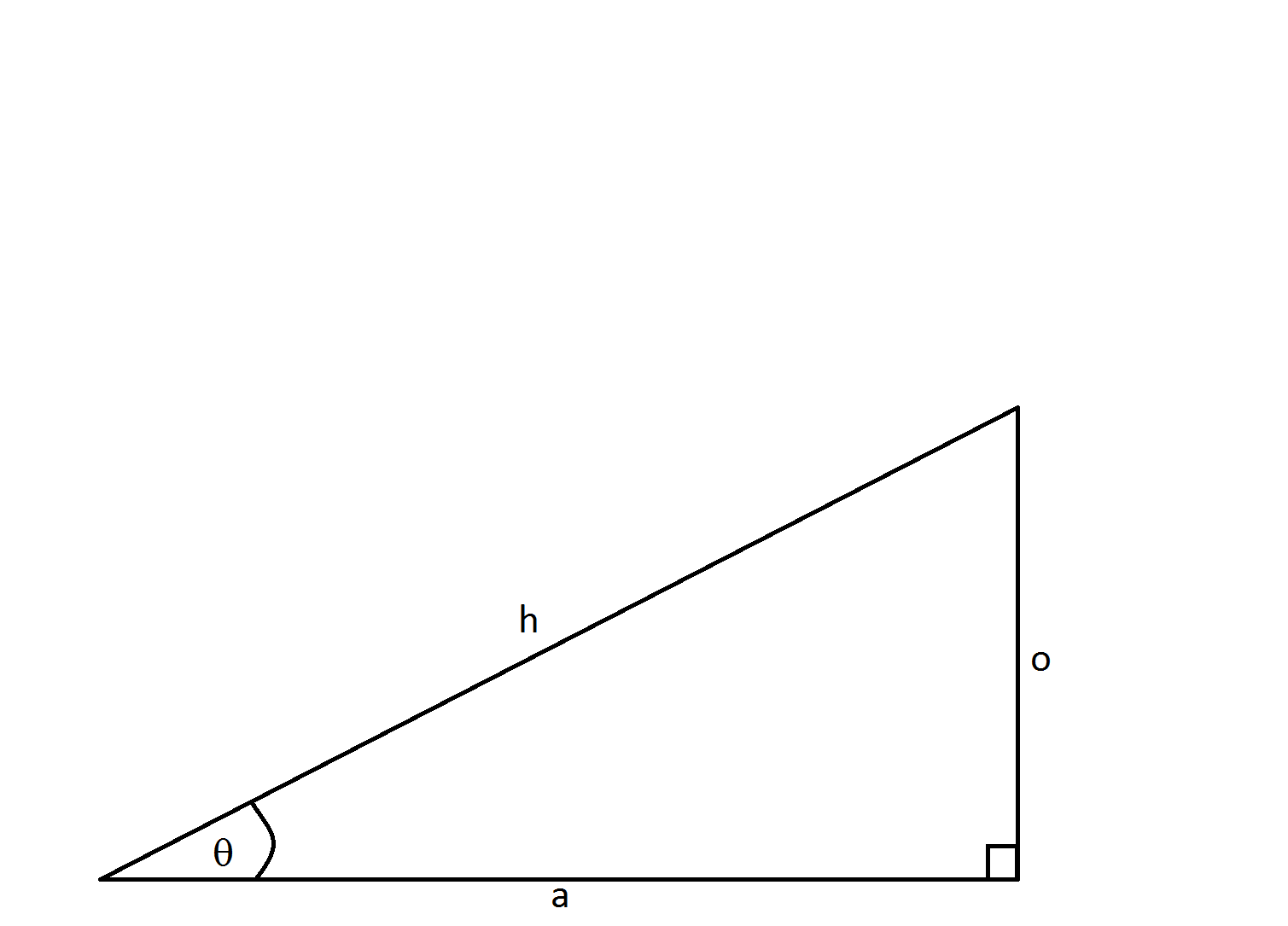
This problem can be easily solved using trig identities. We are given the hypotenuse  and
and  . We can then calculate side
  using the
  .
.
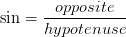
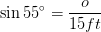
Rearrange to solve for  .
.


If you calculated the side to equal  then you utilized the
  function rather than the
  .
.
This problem can be easily solved using trig identities. We are given the hypotenuse
Rearrange to solve for
If you calculated the side to equal
← Didn't Know|Knew It →
Solve for  .
.
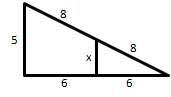
(Figure not drawn to scale).
Solve for
(Figure not drawn to scale).
Tap to reveal answer
The side-angle-side (SAS) postulate can be used to determine that the triangles are similar. Both triangles share the angle farthest to the right. In the smaller triangle, the upper edge has a length of  , and in the larger triangle is has a length of
  . In the smaller triangle, the bottom edge has a length of
  , and in the larger triangle is has a length of
  . We can test for comparison.

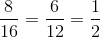
The statement is true, so the triangles must be similar.
We can use this ratio to solve for the missing side length.

To simplify, we will only use the lower edge and left edge comparison.

Cross multiply.

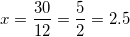
The side-angle-side (SAS) postulate can be used to determine that the triangles are similar. Both triangles share the angle farthest to the right. In the smaller triangle, the upper edge has a length of
The statement is true, so the triangles must be similar.
We can use this ratio to solve for the missing side length.
To simplify, we will only use the lower edge and left edge comparison.
Cross multiply.
← Didn't Know|Knew It →
Solve for  .
.
(Figure not drawn to scale).
Solve for
(Figure not drawn to scale).
Tap to reveal answer
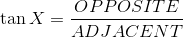
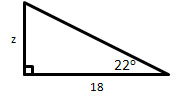
We can solve using the trigonometric definition of tangent.

We are given the angle and the adjacent side.
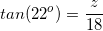
We can find  with a calculator.



We can solve using the trigonometric definition of tangent.
We are given the angle and the adjacent side.
We can find
← Didn't Know|Knew It →
A triangle has sides of length 12, 17, and 22. Of the measures of the three interior angles, which is the greatest of the three?
A triangle has sides of length 12, 17, and 22. Of the measures of the three interior angles, which is the greatest of the three?
Tap to reveal answer
We can apply the Law of Cosines to find the measure of this angle, which we will call :

The widest angle will be opposite the side of length 22, so we will set:
 ,
,  ,
, 



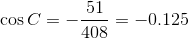

We can apply the Law of Cosines to find the measure of this angle, which we will call :
The widest angle will be opposite the side of length 22, so we will set:
← Didn't Know|Knew It →
In  ,
,  ,
,  , and
, and  . To the nearest tenth, what is
  ?
?
In
Tap to reveal answer
By the Law of Cosines:

or, equivalently,

Substitute:



By the Law of Cosines:
or, equivalently,
Substitute:
← Didn't Know|Knew It →
In  ,
,  ,
,  , and
, and  . To the nearest tenth, what is
  ?
?
In
Tap to reveal answer
By the Triangle Inequality, this triangle can exist, since  .
.
By the Law of Cosines:

Substitute the sidelengths and solve for  :
:






By the Triangle Inequality, this triangle can exist, since
By the Law of Cosines:
Substitute the sidelengths and solve for
← Didn't Know|Knew It →
What is the length of CB?
What is the length of CB?
Tap to reveal answer
← Didn't Know|Knew It →
If equals and is , how long is ?
If
Tap to reveal answer
This problem can be easily solved using trig identities. We are given the hypotenuse and . We can then calculate side using the .
Rearrange to solve for .
If you calculated the side to equal then you utilized the function rather than the .
This problem can be easily solved using trig identities. We are given the hypotenuse
Rearrange to solve for
If you calculated the side to equal
← Didn't Know|Knew It →
Solve for .
(Figure not drawn to scale).
Solve for
(Figure not drawn to scale).
Tap to reveal answer
The side-angle-side (SAS) postulate can be used to determine that the triangles are similar. Both triangles share the angle farthest to the right. In the smaller triangle, the upper edge has a length of , and in the larger triangle is has a length of . In the smaller triangle, the bottom edge has a length of , and in the larger triangle is has a length of . We can test for comparison.
The statement is true, so the triangles must be similar.
We can use this ratio to solve for the missing side length.
To simplify, we will only use the lower edge and left edge comparison.
Cross multiply.
The side-angle-side (SAS) postulate can be used to determine that the triangles are similar. Both triangles share the angle farthest to the right. In the smaller triangle, the upper edge has a length of
The statement is true, so the triangles must be similar.
We can use this ratio to solve for the missing side length.
To simplify, we will only use the lower edge and left edge comparison.
Cross multiply.
← Didn't Know|Knew It →
Solve for .
(Figure not drawn to scale).
Solve for
(Figure not drawn to scale).
Tap to reveal answer
We can solve using the trigonometric definition of tangent.
We are given the angle and the adjacent side.
We can find with a calculator.
We can solve using the trigonometric definition of tangent.
We are given the angle and the adjacent side.
We can find
← Didn't Know|Knew It →
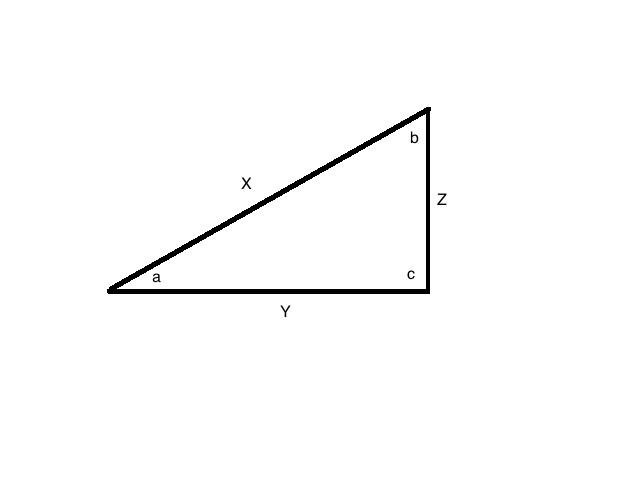
In this figure, angle  and side
  . If angle
  , what is the length of side
  ?
?
In this figure, angle
Tap to reveal answer
For this problem, use the law of sines:
 .
.
In this case, we have values that we can plug in:


Cross multiply:

Multiply both sides by  :
:

For this problem, use the law of sines:
In this case, we have values that we can plug in:
Cross multiply:
Multiply both sides by
← Didn't Know|Knew It →
In this figure  and
and  . If
. If  , what is
  ?
?
In this figure
Tap to reveal answer
For this problem, use the law of sines:
 .
.
In this case, we have values that we can plug in:


For this problem, use the law of sines:
In this case, we have values that we can plug in:
← Didn't Know|Knew It →
In this figure, angle  . If side
  and
and  , what is the value of angle
  ?
?
In this figure, angle
Tap to reveal answer
For this problem, use the law of sines:
%7D "$\frac{\text{side opposite }$a}{\sin(a)}=\frac{\text{side opposite }$b}{\sin(b)}=\frac{\text{side opposite }$c}{\sin(c)}") .
.
In this case, we have values that we can plug in:


For this problem, use the law of sines:
In this case, we have values that we can plug in:
← Didn't Know|Knew It →
In this figure, if angle  , side
  , and side
  , what is the value of angle
  ?
?
(NOTE: Figure not necessarily drawn to scale.)
In this figure, if angle
(NOTE: Figure not necessarily drawn to scale.)
Tap to reveal answer
First, observe that this figure is clearly not drawn to scale. Now, we can solve using the law of sines:
 .
.
In this case, we have values that we can plug in:


First, observe that this figure is clearly not drawn to scale. Now, we can solve using the law of sines:
In this case, we have values that we can plug in:
← Didn't Know|Knew It →
In  ,
,  ,
,  , and
, and  . To the nearest tenth, what is
  ?
?
In
Tap to reveal answer
Since we are given  and want to find
  , we apply the Law of Sines, which states, in part,

 and
and

Substitute in the above equation:

Cross-multiply and solve for  :
:


Since we are given
Substitute in the above equation:
Cross-multiply and solve for
← Didn't Know|Knew It →
In  ,
,  ,
,  , and
, and  . To the nearest tenth, what is
  ?
?
In
Tap to reveal answer
Since we are given  ,
,  , and
, and  , and want to find
  , we apply the Law of Sines, which states, in part,
 .
.
Substitute and solve for  :
:


Take the inverse sine of 0.6355:

There are two angles between  and
and  that have any given positive sine other than 1 - we get the other by subtracting the previous result from
  :
:

This, however, is impossible, since this would result in the sum of the triangle measures being greater than  . This leaves
  as the only possible answer.
Since we are given
Substitute and solve for
Take the inverse sine of 0.6355:
There are two angles between
This, however, is impossible, since this would result in the sum of the triangle measures being greater than
← Didn't Know|Knew It →

Note: Figure NOT drawn to scale.
Refer to the above diagram. Evaluate  .
.
Note: Figure NOT drawn to scale.
Refer to the above diagram. Evaluate
Tap to reveal answer
The altitude perpendicular to the hypotenuse of a right triangle divides that triangle into two smaller triangles similar to each other and the large triangle. Therefore, the sides are in proportion. The hypotenuse of the triangle is equal to

Therefore, we can set up, and solve for  in, a proportion statement involving the shorter side and hypotenuse of the large triangle and the larger of the two smaller triangles:


This is not one of the choices.
The altitude perpendicular to the hypotenuse of a right triangle divides that triangle into two smaller triangles similar to each other and the large triangle. Therefore, the sides are in proportion. The hypotenuse of the triangle is equal to
Therefore, we can set up, and solve for
This is not one of the choices.
← Didn't Know|Knew It →
What is the length of the diagonals of trapezoid  ? Assume the figure is an isoceles trapezoid.

What is the length of the diagonals of trapezoid
Tap to reveal answer
To find the length of the diagonal, we need to use the Pythagorean Theorem. Therefore, we need to sketch the following triangle within trapezoid  :
:

We know that the base of the triangle has length  . By subtracting the top of the trapezoid from the bottom of the trapezoid, we get:

Dividing by two, we have the length of each additional side on the bottom of the trapezoid:

Adding these two values together, we get  .
.
The formula for the length of diagonal  uses the Pythagoreon Theorem:
 , where
  is the point between
  and
and  representing the base of the triangle.
Plugging in our values, we get:


To find the length of the diagonal, we need to use the Pythagorean Theorem. Therefore, we need to sketch the following triangle within trapezoid
We know that the base of the triangle has length
Dividing by two, we have the length of each additional side on the bottom of the trapezoid:
Adding these two values together, we get
The formula for the length of diagonal
Plugging in our values, we get:
← Didn't Know|Knew It →
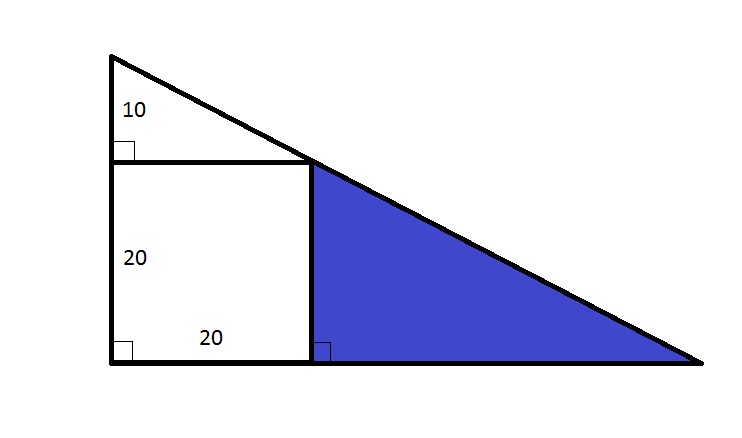
Note: Figure NOT drawn to scale.
Refer to the above diagram. Evaluate the length of the hypotenuse of the blue triangle.
Note: Figure NOT drawn to scale.
Refer to the above diagram. Evaluate the length of the hypotenuse of the blue triangle.
Tap to reveal answer
The inscribed rectangle is a 20 by 20 square. Since opposite sides of the square are parallel, the corresponding angles of the two smaller right triangles are congruent; therefore, the two triangles are similar and, by definition, their sides are in proportion.
The small top triangle has legs 10 and 20. Therefore, the length of its hypotenuse can be determined using the Pythagorean Theorem:

The small top triangle has short leg 10 and hypotenuse  . The blue triangle has short leg 20 and unknown hypotenuse
  , where
  can be calculated with the proportion statement


The inscribed rectangle is a 20 by 20 square. Since opposite sides of the square are parallel, the corresponding angles of the two smaller right triangles are congruent; therefore, the two triangles are similar and, by definition, their sides are in proportion.
The small top triangle has legs 10 and 20. Therefore, the length of its hypotenuse can be determined using the Pythagorean Theorem:
The small top triangle has short leg 10 and hypotenuse
← Didn't Know|Knew It →