Trigonometric Identities - Math
Card 1 of 48

Tap to reveal answer


← Didn't Know|Knew It →
What is the  of
of  ?
?
What is the
Tap to reveal answer
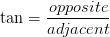
When working with basic trigonometric identities, it's easiest to remember the mnemonic:  .
.
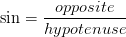
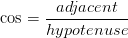 ,
,
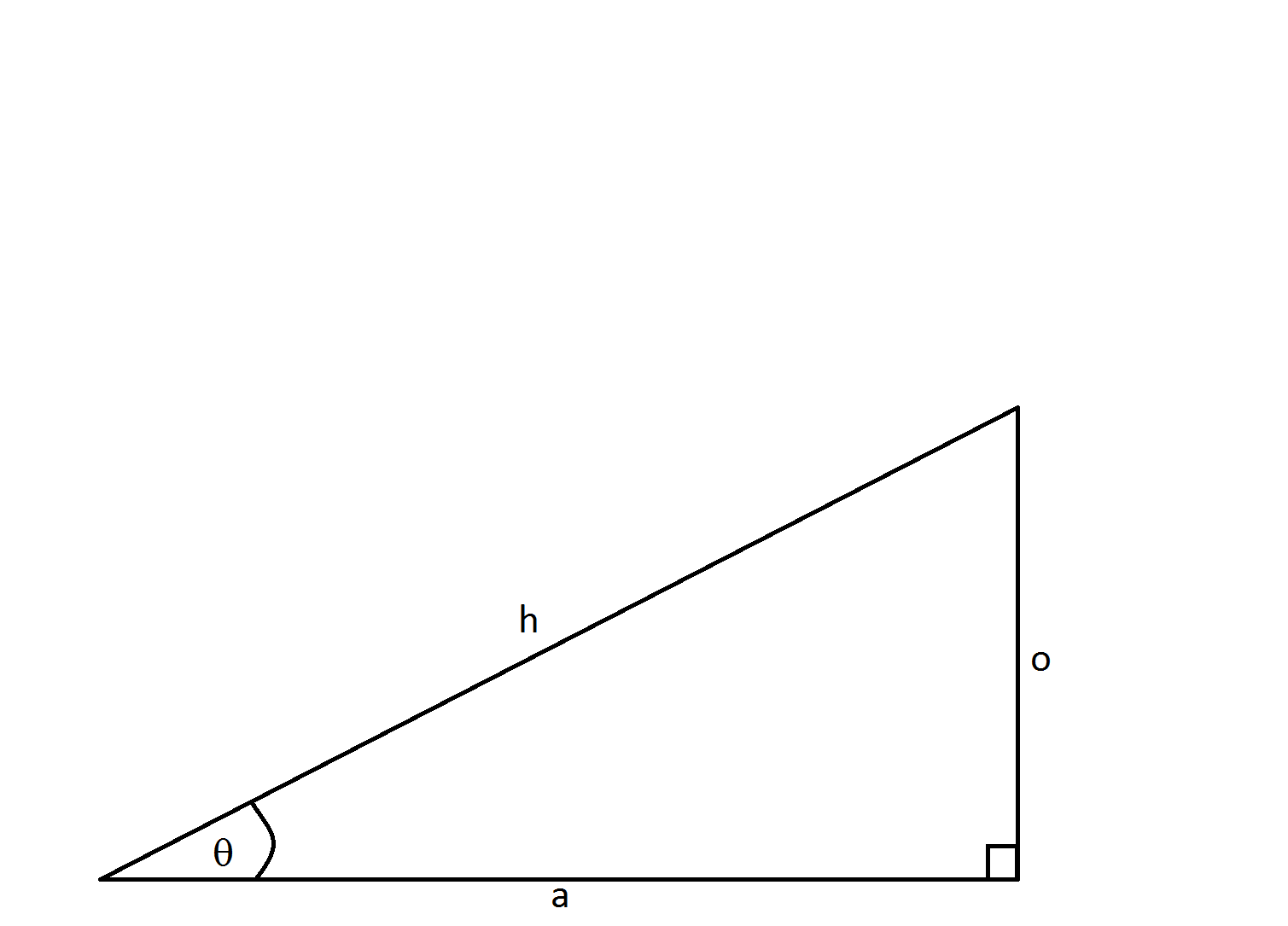
When one names the right triangle, the opposite side is opposite to the angle, the adjacent side is next to the angle, and the hypotenuse spans the two legs of the right angle.
When working with basic trigonometric identities, it's easiest to remember the mnemonic:
When one names the right triangle, the opposite side is opposite to the angle, the adjacent side is next to the angle, and the hypotenuse spans the two legs of the right angle.
← Didn't Know|Knew It →
What is the  of
of  ?
?
What is the
Tap to reveal answer
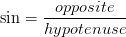
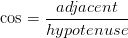
When working with basic trigonometric identities, it's easiest to remember the mnemonic:  .
.
 ,
,
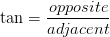
When one names the right triangle, the opposite side is opposite to the angle, the adjacent side is next to the angle, and the hypotenuse spans the two legs of the right angle.
When working with basic trigonometric identities, it's easiest to remember the mnemonic:
When one names the right triangle, the opposite side is opposite to the angle, the adjacent side is next to the angle, and the hypotenuse spans the two legs of the right angle.
← Didn't Know|Knew It →
What is the  of
of  ?
?
What is the
Tap to reveal answer
When working with basic trigonometric identities, it's easiest to remember the mnemonic:  .
.
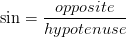
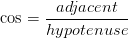
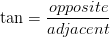
When one names the right triangle, the opposite side is opposite to the angle, the adjacent side is next to the angle, and the hypotenuse spans the two legs of the right angle.
When working with basic trigonometric identities, it's easiest to remember the mnemonic:
When one names the right triangle, the opposite side is opposite to the angle, the adjacent side is next to the angle, and the hypotenuse spans the two legs of the right angle.
← Didn't Know|Knew It →
Simplify  .
.
Simplify
Tap to reveal answer
Simplifying trionometric expressions or identities often involves a little trial and error, so it's hard to come up with a strategy that works every time. A lot of times you have to try multiple strategies and see which one helps.
Often, if you have any form of 

 or
or  in an expression, it helps to rewrite it in terms of sine and cosine. In this problem, we can use the identities
  and
and  .
.

 .
.
This doesn't seem to help a whole lot. However, we should recognize that  because of the Pythagorean identity
  .
.

We can cancel the  terms in the numerator and denominator.
 .
.
Simplifying trionometric expressions or identities often involves a little trial and error, so it's hard to come up with a strategy that works every time. A lot of times you have to try multiple strategies and see which one helps.
Often, if you have any form of
This doesn't seem to help a whole lot. However, we should recognize that
We can cancel the
← Didn't Know|Knew It →
Tap to reveal answer
← Didn't Know|Knew It →
What is the of ?
What is the
Tap to reveal answer
When working with basic trigonometric identities, it's easiest to remember the mnemonic: .
,
When one names the right triangle, the opposite side is opposite to the angle, the adjacent side is next to the angle, and the hypotenuse spans the two legs of the right angle.
When working with basic trigonometric identities, it's easiest to remember the mnemonic:
When one names the right triangle, the opposite side is opposite to the angle, the adjacent side is next to the angle, and the hypotenuse spans the two legs of the right angle.
← Didn't Know|Knew It →
What is the of ?
What is the
Tap to reveal answer
When working with basic trigonometric identities, it's easiest to remember the mnemonic: .
,
When one names the right triangle, the opposite side is opposite to the angle, the adjacent side is next to the angle, and the hypotenuse spans the two legs of the right angle.
When working with basic trigonometric identities, it's easiest to remember the mnemonic:
When one names the right triangle, the opposite side is opposite to the angle, the adjacent side is next to the angle, and the hypotenuse spans the two legs of the right angle.
← Didn't Know|Knew It →
What is the of ?
What is the
Tap to reveal answer
When working with basic trigonometric identities, it's easiest to remember the mnemonic: .
When one names the right triangle, the opposite side is opposite to the angle, the adjacent side is next to the angle, and the hypotenuse spans the two legs of the right angle.
When working with basic trigonometric identities, it's easiest to remember the mnemonic:
When one names the right triangle, the opposite side is opposite to the angle, the adjacent side is next to the angle, and the hypotenuse spans the two legs of the right angle.
← Didn't Know|Knew It →
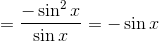
Simplify .
Simplify
Tap to reveal answer
Simplifying trionometric expressions or identities often involves a little trial and error, so it's hard to come up with a strategy that works every time. A lot of times you have to try multiple strategies and see which one helps.
Often, if you have any form of or in an expression, it helps to rewrite it in terms of sine and cosine. In this problem, we can use the identities and .
.
This doesn't seem to help a whole lot. However, we should recognize that because of the Pythagorean identity .
We can cancel the terms in the numerator and denominator.
.
Simplifying trionometric expressions or identities often involves a little trial and error, so it's hard to come up with a strategy that works every time. A lot of times you have to try multiple strategies and see which one helps.
Often, if you have any form of
This doesn't seem to help a whole lot. However, we should recognize that
We can cancel the
← Didn't Know|Knew It →
Simplify

Simplify
Tap to reveal answer
 . Thus:
← Didn't Know|Knew It →
Simplify
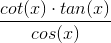
Simplify
Tap to reveal answer

and
 .
.
and
← Didn't Know|Knew It →
Simplify  .
.
Simplify
Tap to reveal answer
Remember that  . We can rearrange this to simplify our given equation:

Remember that
← Didn't Know|Knew It →
Simplify:

Simplify:
Tap to reveal answer
Whenever you see a trigonometric function squared, start looking for a Pythagorean identity.
The two identities used in this problem are  and
and  .
.
Substitute and solve.



Whenever you see a trigonometric function squared, start looking for a Pythagorean identity.
The two identities used in this problem are
Substitute and solve.
← Didn't Know|Knew It →
Simplify
Simplify
Tap to reveal answer
. Thus:
← Didn't Know|Knew It →
Simplify
Simplify
Tap to reveal answer
and
.
and
← Didn't Know|Knew It →
Simplify .
Simplify
Tap to reveal answer
Remember that . We can rearrange this to simplify our given equation:
Remember that
← Didn't Know|Knew It →
Simplify:
Simplify:
Tap to reveal answer
Whenever you see a trigonometric function squared, start looking for a Pythagorean identity.
The two identities used in this problem are and .
Substitute and solve.
Whenever you see a trigonometric function squared, start looking for a Pythagorean identity.
The two identities used in this problem are
Substitute and solve.
← Didn't Know|Knew It →
Factor and simplify  .
.
Factor and simplify
Tap to reveal answer
To reduce  , factor the numerator:
Notice that we can cancel out a  .
.
This leaves us with  .
.
To reduce
Notice that we can cancel out a
This leaves us with
← Didn't Know|Knew It →
Simplify  .
.
Simplify
Tap to reveal answer
To simplify  , break them into their SOHCAHTOA parts:
 .
.
Notice that the opposite's cancel out, leaving  .
.
To simplify
Notice that the opposite's cancel out, leaving
← Didn't Know|Knew It →