Understanding Secant, Cosecant, and Cotangent - Math
Card 1 of 8
An angle has a cosine of  . What will its cosecant be?
An angle has a cosine of
Tap to reveal answer
The problem tells us that the cosine of the angle will be  . Cosine is the adjacent over the hypotenuse. From here we can use the Pythaogrean theorem:





Now we know our opposite, adjacent, and hypotenuse.
The cosecant is 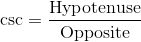 .
.
From here we can plug in our given values.

The problem tells us that the cosine of the angle will be
Now we know our opposite, adjacent, and hypotenuse.
The cosecant is
From here we can plug in our given values.
← Didn't Know|Knew It →
Which of these is equal to  for angle
  ?
?
Which of these is equal to
Tap to reveal answer
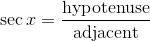 , as it is the inverse of the
  function. This is therefore the answer.
← Didn't Know|Knew It →
An angle has a cosine of . What will its cosecant be?
An angle has a cosine of
Tap to reveal answer
The problem tells us that the cosine of the angle will be . Cosine is the adjacent over the hypotenuse. From here we can use the Pythaogrean theorem:
Now we know our opposite, adjacent, and hypotenuse.
The cosecant is .
From here we can plug in our given values.
The problem tells us that the cosine of the angle will be
Now we know our opposite, adjacent, and hypotenuse.
The cosecant is
From here we can plug in our given values.
← Didn't Know|Knew It →
Which of these is equal to for angle ?
Which of these is equal to
Tap to reveal answer
, as it is the inverse of the function. This is therefore the answer.
← Didn't Know|Knew It →
An angle has a cosine of . What will its cosecant be?
An angle has a cosine of
Tap to reveal answer
The problem tells us that the cosine of the angle will be . Cosine is the adjacent over the hypotenuse. From here we can use the Pythaogrean theorem:
Now we know our opposite, adjacent, and hypotenuse.
The cosecant is .
From here we can plug in our given values.
The problem tells us that the cosine of the angle will be
Now we know our opposite, adjacent, and hypotenuse.
The cosecant is
From here we can plug in our given values.
← Didn't Know|Knew It →
Which of these is equal to for angle ?
Which of these is equal to
Tap to reveal answer
, as it is the inverse of the function. This is therefore the answer.
← Didn't Know|Knew It →
An angle has a cosine of . What will its cosecant be?
An angle has a cosine of
Tap to reveal answer
The problem tells us that the cosine of the angle will be . Cosine is the adjacent over the hypotenuse. From here we can use the Pythaogrean theorem:
Now we know our opposite, adjacent, and hypotenuse.
The cosecant is .
From here we can plug in our given values.
The problem tells us that the cosine of the angle will be
Now we know our opposite, adjacent, and hypotenuse.
The cosecant is
From here we can plug in our given values.
← Didn't Know|Knew It →
Which of these is equal to for angle ?
Which of these is equal to
Tap to reveal answer
, as it is the inverse of the function. This is therefore the answer.
← Didn't Know|Knew It →