Carbonyl Reactions - Organic Chemistry
Card 1 of 44
What is a product when propyl-butanoate undergoes saponification?
What is a product when propyl-butanoate undergoes saponification?
Tap to reveal answer
When naming esters, the root word in the name describes the carbon chain that carries the carbonyl. Saponification describes the breaking up of an ester. This yields an alcohol and a carboxylic acid. The chain with the carbonyl is butyl, so the carboxylic acid will be butanoic acid. That means the side with the alcohol will be propanol.
When naming esters, the root word in the name describes the carbon chain that carries the carbonyl. Saponification describes the breaking up of an ester. This yields an alcohol and a carboxylic acid. The chain with the carbonyl is butyl, so the carboxylic acid will be butanoic acid. That means the side with the alcohol will be propanol.
← Didn't Know|Knew It →
Which of the following best summarizes the haloform reaction?
Which of the following best summarizes the haloform reaction?
Tap to reveal answer
The haloform reaction requires a carbonyl with a terminal alpha carbon. A hydrogen gets abstracted, and the enolate is formed. A halogen attacks the alpha carbon, and the ketone is reformed. This occurs three more times until the carbon has bonds to three halogens. Then the carbon leaves, forming a carbanion, and the base attacks the carbonyl carbon. An ester is formed.
The haloform reaction requires a carbonyl with a terminal alpha carbon. A hydrogen gets abstracted, and the enolate is formed. A halogen attacks the alpha carbon, and the ketone is reformed. This occurs three more times until the carbon has bonds to three halogens. Then the carbon leaves, forming a carbanion, and the base attacks the carbonyl carbon. An ester is formed.
← Didn't Know|Knew It →
What is the product of the following reaction?

What is the product of the following reaction?
Tap to reveal answer
The reaction uses a Grignard reagent's nucleophilic carbon to attack the carbon in carbon dioxide. Following treatment with water the resulting molecule (a carboxylate anion, of the form  ) the carboxylate oxygen will be protonated, and the result is a carboxylic acid. Thus, the resulting molecule is a benzene ring with a carboxyl group attached (this is also known as benzoic acid).
The reaction uses a Grignard reagent's nucleophilic carbon to attack the carbon in carbon dioxide. Following treatment with water the resulting molecule (a carboxylate anion, of the form
← Didn't Know|Knew It →
What is a product when propyl-butanoate undergoes saponification?
What is a product when propyl-butanoate undergoes saponification?
Tap to reveal answer
When naming esters, the root word in the name describes the carbon chain that carries the carbonyl. Saponification describes the breaking up of an ester. This yields an alcohol and a carboxylic acid. The chain with the carbonyl is butyl, so the carboxylic acid will be butanoic acid. That means the side with the alcohol will be propanol.
When naming esters, the root word in the name describes the carbon chain that carries the carbonyl. Saponification describes the breaking up of an ester. This yields an alcohol and a carboxylic acid. The chain with the carbonyl is butyl, so the carboxylic acid will be butanoic acid. That means the side with the alcohol will be propanol.
← Didn't Know|Knew It →

What is the product of this reaction?
What is the product of this reaction?
Tap to reveal answer
This is a classic esterification reaction. Esterfication occurs when a carboxylic acid and an alcohol are reacted together. Only one answer choice is an ester.
This is a classic esterification reaction. Esterfication occurs when a carboxylic acid and an alcohol are reacted together. Only one answer choice is an ester.
← Didn't Know|Knew It →
What is the product of the following reaction?
What is the product of the following reaction?
Tap to reveal answer
The reaction uses a Grignard reagent's nucleophilic carbon to attack the carbon in carbon dioxide. Following treatment with water the resulting molecule (a carboxylate anion, of the form ) the carboxylate oxygen will be protonated, and the result is a carboxylic acid. Thus, the resulting molecule is a benzene ring with a carboxyl group attached (this is also known as benzoic acid).
The reaction uses a Grignard reagent's nucleophilic carbon to attack the carbon in carbon dioxide. Following treatment with water the resulting molecule (a carboxylate anion, of the form
← Didn't Know|Knew It →
What is the product of this reaction?
What is the product of this reaction?
Tap to reveal answer
This is a classic esterification reaction. Esterfication occurs when a carboxylic acid and an alcohol are reacted together. Only one answer choice is an ester.
This is a classic esterification reaction. Esterfication occurs when a carboxylic acid and an alcohol are reacted together. Only one answer choice is an ester.
← Didn't Know|Knew It →
What is the product of the following reaction?
What is the product of the following reaction?
Tap to reveal answer
The reaction uses a Grignard reagent's nucleophilic carbon to attack the carbon in carbon dioxide. Following treatment with water the resulting molecule (a carboxylate anion, of the form ) the carboxylate oxygen will be protonated, and the result is a carboxylic acid. Thus, the resulting molecule is a benzene ring with a carboxyl group attached (this is also known as benzoic acid).
The reaction uses a Grignard reagent's nucleophilic carbon to attack the carbon in carbon dioxide. Following treatment with water the resulting molecule (a carboxylate anion, of the form
← Didn't Know|Knew It →
Which of the following results in a single ketone product following acid catalyzed hydration?
Which of the following results in a single ketone product following acid catalyzed hydration?
Tap to reveal answer
During acid catalyzed hydration, a hydroxy group replaces one of the bonds in the triple bond and a double bond is formed. This is called an enol. The enol naturally turns into a ketone in a process called tautomerization. The hydroxy group can attach to either carbon across the double bond, and naming is done so that substituents have the lowest numbers. Only on 5-decyne will result in a single product, as no matter which carbon the hydroxy group bonds to, it is still on carbon 5. Thus, the only final product is 5-decone.
The other answer options will still react, but will form multiple products due to lack of symmetry.
During acid catalyzed hydration, a hydroxy group replaces one of the bonds in the triple bond and a double bond is formed. This is called an enol. The enol naturally turns into a ketone in a process called tautomerization. The hydroxy group can attach to either carbon across the double bond, and naming is done so that substituents have the lowest numbers. Only on 5-decyne will result in a single product, as no matter which carbon the hydroxy group bonds to, it is still on carbon 5. Thus, the only final product is 5-decone.
The other answer options will still react, but will form multiple products due to lack of symmetry.
← Didn't Know|Knew It →
What is the product of the reaction shown?

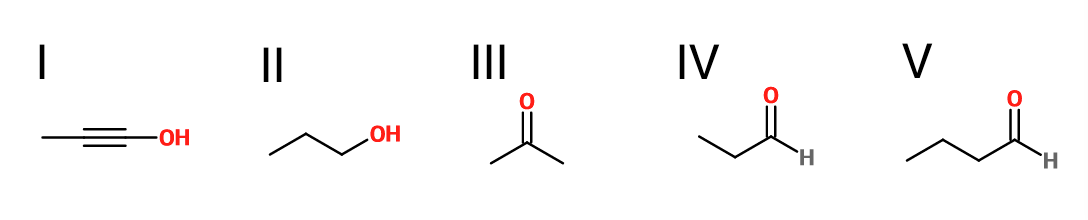
What is the product of the reaction shown?
Tap to reveal answer
First step: bromination across the double bond
Second step: double dehydrohalogenation and removal of terminal alkyne hydrogen
Third step: neutralization of the molecule
Fourth/fifth step: hydroboration/oxidation, followed by keto/enol tautomerization
First step: bromination across the double bond
Second step: double dehydrohalogenation and removal of terminal alkyne hydrogen
Third step: neutralization of the molecule
Fourth/fifth step: hydroboration/oxidation, followed by keto/enol tautomerization
← Didn't Know|Knew It →
Which of the following results in a single ketone product following acid catalyzed hydration?
Which of the following results in a single ketone product following acid catalyzed hydration?
Tap to reveal answer
During acid catalyzed hydration, a hydroxy group replaces one of the bonds in the triple bond and a double bond is formed. This is called an enol. The enol naturally turns into a ketone in a process called tautomerization. The hydroxy group can attach to either carbon across the double bond, and naming is done so that substituents have the lowest numbers. Only on 5-decyne will result in a single product, as no matter which carbon the hydroxy group bonds to, it is still on carbon 5. Thus, the only final product is 5-decone.
The other answer options will still react, but will form multiple products due to lack of symmetry.
During acid catalyzed hydration, a hydroxy group replaces one of the bonds in the triple bond and a double bond is formed. This is called an enol. The enol naturally turns into a ketone in a process called tautomerization. The hydroxy group can attach to either carbon across the double bond, and naming is done so that substituents have the lowest numbers. Only on 5-decyne will result in a single product, as no matter which carbon the hydroxy group bonds to, it is still on carbon 5. Thus, the only final product is 5-decone.
The other answer options will still react, but will form multiple products due to lack of symmetry.
← Didn't Know|Knew It →
What is the product of the reaction shown?
What is the product of the reaction shown?
Tap to reveal answer
First step: bromination across the double bond
Second step: double dehydrohalogenation and removal of terminal alkyne hydrogen
Third step: neutralization of the molecule
Fourth/fifth step: hydroboration/oxidation, followed by keto/enol tautomerization
First step: bromination across the double bond
Second step: double dehydrohalogenation and removal of terminal alkyne hydrogen
Third step: neutralization of the molecule
Fourth/fifth step: hydroboration/oxidation, followed by keto/enol tautomerization
← Didn't Know|Knew It →
What is the final organic product of the reaction shown?


What is the final organic product of the reaction shown?
Tap to reveal answer
First step: esterification
Second step: reduction
Third step: neutralization
Fourth step: oxidation to aldehyde
Fifth step: alkene metathesis
First step: esterification
Second step: reduction
Third step: neutralization
Fourth step: oxidation to aldehyde
Fifth step: alkene metathesis
← Didn't Know|Knew It →
All of the following are characteristics of a Wittig reaction except .
All of the following are characteristics of a Wittig reaction except .
Tap to reveal answer
The Wittig reaction involves the reaction of a phosphonium ylide (generated by treating a phosphonium salt with a strong base) with a ketone or aldehyde.

The reaction proceeds through a phosphaoxetane (4-membered ring containing both phosphorus and oxygen) intermediate to generate a new compound containing a carbon-carbon double bond, plus a phosphine oxide byproduct. It does not form trans double bonds exclusively; sometimes, a mixture of cis and trans isomers are obtained, and sometimes the cis isomer is the predominant product.
The Wittig reaction involves the reaction of a phosphonium ylide (generated by treating a phosphonium salt with a strong base) with a ketone or aldehyde.
The reaction proceeds through a phosphaoxetane (4-membered ring containing both phosphorus and oxygen) intermediate to generate a new compound containing a carbon-carbon double bond, plus a phosphine oxide byproduct. It does not form trans double bonds exclusively; sometimes, a mixture of cis and trans isomers are obtained, and sometimes the cis isomer is the predominant product.
← Didn't Know|Knew It →
What is the product of the following reaction?
What is the product of the following reaction?
Tap to reveal answer
The reaction uses a Grignard reagent's nucleophilic carbon to attack the carbon in carbon dioxide. Following treatment with water the resulting molecule (a carboxylate anion, of the form ) the carboxylate oxygen will be protonated, and the result is a carboxylic acid. Thus, the resulting molecule is a benzene ring with a carboxyl group attached (this is also known as benzoic acid).
The reaction uses a Grignard reagent's nucleophilic carbon to attack the carbon in carbon dioxide. Following treatment with water the resulting molecule (a carboxylate anion, of the form
← Didn't Know|Knew It →
What is the product of this reaction?
What is the product of this reaction?
Tap to reveal answer
This is a classic esterification reaction. Esterfication occurs when a carboxylic acid and an alcohol are reacted together. Only one answer choice is an ester.
This is a classic esterification reaction. Esterfication occurs when a carboxylic acid and an alcohol are reacted together. Only one answer choice is an ester.
← Didn't Know|Knew It →
Which of the following best summarizes a Claisan condensation?
Which of the following best summarizes a Claisan condensation?
Tap to reveal answer
The most acidic hydrogen of the ester gets abstracted and the enolate form of the compound is attained. The electrons from the carbon-carbon double bond attack the carbonyl carbon of the other ester. Deesterfication occurs in this same step. The final product has one ketone and one ester.
The most acidic hydrogen of the ester gets abstracted and the enolate form of the compound is attained. The electrons from the carbon-carbon double bond attack the carbonyl carbon of the other ester. Deesterfication occurs in this same step. The final product has one ketone and one ester.
← Didn't Know|Knew It →
What is the product of this reaction?
What is the product of this reaction?
Tap to reveal answer
This is a classic esterification reaction. Esterfication occurs when a carboxylic acid and an alcohol are reacted together. Only one answer choice is an ester.
This is a classic esterification reaction. Esterfication occurs when a carboxylic acid and an alcohol are reacted together. Only one answer choice is an ester.
← Didn't Know|Knew It →
Which of the following results in a single ketone product following acid catalyzed hydration?
Which of the following results in a single ketone product following acid catalyzed hydration?
Tap to reveal answer
During acid catalyzed hydration, a hydroxy group replaces one of the bonds in the triple bond and a double bond is formed. This is called an enol. The enol naturally turns into a ketone in a process called tautomerization. The hydroxy group can attach to either carbon across the double bond, and naming is done so that substituents have the lowest numbers. Only on 5-decyne will result in a single product, as no matter which carbon the hydroxy group bonds to, it is still on carbon 5. Thus, the only final product is 5-decone.
The other answer options will still react, but will form multiple products due to lack of symmetry.
During acid catalyzed hydration, a hydroxy group replaces one of the bonds in the triple bond and a double bond is formed. This is called an enol. The enol naturally turns into a ketone in a process called tautomerization. The hydroxy group can attach to either carbon across the double bond, and naming is done so that substituents have the lowest numbers. Only on 5-decyne will result in a single product, as no matter which carbon the hydroxy group bonds to, it is still on carbon 5. Thus, the only final product is 5-decone.
The other answer options will still react, but will form multiple products due to lack of symmetry.
← Didn't Know|Knew It →
What is the product of the reaction shown?
What is the product of the reaction shown?
Tap to reveal answer
First step: bromination across the double bond
Second step: double dehydrohalogenation and removal of terminal alkyne hydrogen
Third step: neutralization of the molecule
Fourth/fifth step: hydroboration/oxidation, followed by keto/enol tautomerization
First step: bromination across the double bond
Second step: double dehydrohalogenation and removal of terminal alkyne hydrogen
Third step: neutralization of the molecule
Fourth/fifth step: hydroboration/oxidation, followed by keto/enol tautomerization
← Didn't Know|Knew It →