Mechanics - Physics
Card 1 of 228
A toy car is set up on a frictionless track containing a downward sloping ramp and a vertically oriented loop. Assume the ramp is  tall. The car starts at the top of the ramp at rest.
What additional piece of information is necessary to calculate the maximum height of the loop if the car is to complete the loop and continue out the other side?
A toy car is set up on a frictionless track containing a downward sloping ramp and a vertically oriented loop. Assume the ramp is
What additional piece of information is necessary to calculate the maximum height of the loop if the car is to complete the loop and continue out the other side?
Tap to reveal answer
This is an example of conservation of energy. The car starts at the top of the ramp, at height  . It has no velocity at this time since it is starting from a rest. Therefore its total energy is
  where
where  is the mass of the car and
  is the value of gravitational acceleration.
At the bottom of the loop, all of the potential energy will have been converted into kinetic energy.
As the car traverses the loop and rises above the ground, kinetic energy will be converted back into potential energy. The shape of the loop does not matter in this case -- only the vertical distance between the ground and the car.
In the tallest possible loop, all kinetic energy at the bottom is converted to potential energy at the top. This is the maximum height the car can reach -- there is no additional energy left to continue climbing a taller loop. Therefore, the potential energy at the top of the tallest loop we can build is equal to the kinetic energy at the bottom of the loop. But we have already noted that the kinetic energy at the bottom of the loop is equal to the potential energy at the top of the ramp.
Therefore, we set  . We see that
  and
and  cancel, and we are left with
  . In other words, the tallest loop you can build is equal to the height of whatever ramp you select. In this example, the tallest loop we can build is
  . We do not need to know the specific values of
  or
or  .
.
This is an example of conservation of energy. The car starts at the top of the ramp, at height
At the bottom of the loop, all of the potential energy will have been converted into kinetic energy.
As the car traverses the loop and rises above the ground, kinetic energy will be converted back into potential energy. The shape of the loop does not matter in this case -- only the vertical distance between the ground and the car.
In the tallest possible loop, all kinetic energy at the bottom is converted to potential energy at the top. This is the maximum height the car can reach -- there is no additional energy left to continue climbing a taller loop. Therefore, the potential energy at the top of the tallest loop we can build is equal to the kinetic energy at the bottom of the loop. But we have already noted that the kinetic energy at the bottom of the loop is equal to the potential energy at the top of the ramp.
Therefore, we set
← Didn't Know|Knew It →
An elevator is designed to hold  of cargo. The designers want the elevator to be able to go from the ground floor to the top of a
  tall building in
  . What is the minimum amount of power that must be delivered to the motor at the top of the shaft? Assume no friction and that the elevator itself has a negligible weight.
An elevator is designed to hold
Tap to reveal answer
Power is the rate of energy transfer. To raise a  object
  , a total of
  or (
or ( is required. To find the power in Watts (
 ), we divide the total energy required by the time over which the energy must be transferred:
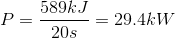
Power is the rate of energy transfer. To raise a
← Didn't Know|Knew It →
How far can a person jump while running at  and a vertical velocity of
  ?
?
How far can a person jump while running at
Tap to reveal answer
We know that:
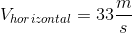

and we are looking for the maximum height (vertical displacement) this person can obtain, so we aren't concerned with  .
.
We can apply the conservation of energy:


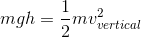
Masses cancel, so
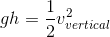
Solve for  :
:
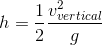
 (rounded to simplify our calculations)
so let's plug in what we know
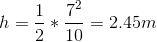 . This is our final answer.
We know that:
and we are looking for the maximum height (vertical displacement) this person can obtain, so we aren't concerned with
We can apply the conservation of energy:
Masses cancel, so
Solve for
so let's plug in what we know
← Didn't Know|Knew It →
If a  object has a kinetic energy of
  right after it is launched in the air, and it has
  KE at its max height, what is its max height?
If a
Tap to reveal answer
Let's first write down the information we are given:



In order to solve this problem we must apply the conservation of energy, which states  since no friction.
This means that as the project reaches its max height energy is converted from Kinetic Energy (energy of motion) to potential gravitational energy (based off of height).
We can subtract  from
from  to get the
  at its max height
 =
=


so we can solve for the height


where 
therefore 
Let's first write down the information we are given:
In order to solve this problem we must apply the conservation of energy, which states
This means that as the project reaches its max height energy is converted from Kinetic Energy (energy of motion) to potential gravitational energy (based off of height).
We can subtract
so we can solve for the height
where
therefore
← Didn't Know|Knew It →
If an object has a kinetic energy of  right after it is launched in the air, and it has
  KE at its max height of
  , what is the object's mass?
If an object has a kinetic energy of
Tap to reveal answer
Let's first write down the information we are given:



In order to solve this problem we must apply the conservation of energy, which states since no friction.
This means that as the project reaches its max height energy is converted from Kinetic energy (energy of motion) to potential gravitational energy (based off of height).
We can subtract from to get the at its max height
=
so we can solve for the mass


where 
therefore 
Let's first write down the information we are given:
In order to solve this problem we must apply the conservation of energy, which states
This means that as the project reaches its max height energy is converted from Kinetic energy (energy of motion) to potential gravitational energy (based off of height).
We can subtract
so we can solve for the mass
where
therefore
← Didn't Know|Knew It →
An hourglass is placed on a scale with all its sand in the upper chamber. A short time later, the sand begins to fall into the lower chamber. Which of the following best describes the reading on the scale as a function of time before any sand has accumulated in the bottom chamber?
An hourglass is placed on a scale with all its sand in the upper chamber. A short time later, the sand begins to fall into the lower chamber. Which of the following best describes the reading on the scale as a function of time before any sand has accumulated in the bottom chamber?
Tap to reveal answer
Initially, when all the sand is in the upper chamber, the reading on the scale is constant and corresponds to the weight of the hourglass and the sand within. As some sand falls, there is no normal force on it so the scale can not register its weight. The fraction of sand that is falling is small, so there is only a small decrease in the apparent weight of the hourglass.
Initially, when all the sand is in the upper chamber, the reading on the scale is constant and corresponds to the weight of the hourglass and the sand within. As some sand falls, there is no normal force on it so the scale can not register its weight. The fraction of sand that is falling is small, so there is only a small decrease in the apparent weight of the hourglass.
← Didn't Know|Knew It →
A juggler throws a ball straight up into the air, which exerts air resistance on the ball. Which of the following best describes the speed of the ball after it falls and just reaches the juggler's hand?
A juggler throws a ball straight up into the air, which exerts air resistance on the ball. Which of the following best describes the speed of the ball after it falls and just reaches the juggler's hand?
Tap to reveal answer
Air resistance is like a friction force that takes energy away from the ball. Because the ball has energy taken from it on the way up and the way down, there is net negative work done on the ball. The energy of the ball is not conserved and it slows down slightly compared to when it was released.
Air resistance is like a friction force that takes energy away from the ball. Because the ball has energy taken from it on the way up and the way down, there is net negative work done on the ball. The energy of the ball is not conserved and it slows down slightly compared to when it was released.
← Didn't Know|Knew It →
A  cinder block sitting on a frictionless surface is attached to a rope. If the rope is pulled parallel to the surface such that the block accelerates at a rate of
  , what is the minimum amount of tension the rope must be able to support without breaking?
A
Tap to reveal answer
This is a simple case of  . In this instance,
  is
is  and
and  is
is  . Substituting, we find
  .
.
This is a simple case of
← Didn't Know|Knew It →
A  cinder block sitting on the ground is attached to a rope. If the rope is pulled such that the block accelerates directly upwards at a rate of
  , what is the minimum amount of tension the rope must be able to support without breaking?
A
Tap to reveal answer
In this case, the rope must be able to support both the force of gravity and the force required to accelerate the block. Both are given by  :
:


In this case, the rope must be able to support both the force of gravity and the force required to accelerate the block. Both are given by
← Didn't Know|Knew It →
A block which weighs  experiences a resultant force of
  that increases its velocity by
  . How long did this force act on the block?
A block which weighs 
Tap to reveal answer
Let's first write down the information we are given:


We know that  . This equation can simplified to
  since acceleration is equal to velocity over time so
  .
.
Let's manipulate the equation by solving for time so we can simply plug in the numbers we are given:

so: 

 =
= which is our final answer.
Let's first write down the information we are given:

We know that
Let's manipulate the equation by solving for time so we can simply plug in the numbers we are given:
so:
← Didn't Know|Knew It →
A  object experiences a force of
  in its direction of motion for
  . What is the change in the velocity the object moved at during this time?
A
Tap to reveal answer
Let's first write down the information we are given:


We know that  . This equation can simplified to
  since acceleration is equal to velocity over time so
  .
.
Let's manipulate the equation by solving for velocity so we can simply plug in the numbers we are given:

so: 

 which is our final answer.
Let's first write down the information we are given:
We know that
Let's manipulate the equation by solving for velocity so we can simply plug in the numbers we are given:
so:
← Didn't Know|Knew It →
A  experiences a net force that increases its velocity by
  from rest for
  . What is the magnitude of this force?
A
Tap to reveal answer
Let's write down the information we are given:


We know that  . This equation can simplified to
  since acceleration is equal to velocity over time so
  .
.
So we can just plug in the information we are given to solve for the Force:

 , which is our final answer.
Let's write down the information we are given:
We know that
So we can just plug in the information we are given to solve for the Force:
← Didn't Know|Knew It →
An object is pushed from rest with a force of  that increases its velocity by
  for
for  . What is the mass of this object?
An object is pushed from rest with a force of
Tap to reveal answer
Let's write down the information we are given:


We know that  . This equation can simplified to
  since acceleration is equal to velocity over time so
  .
.
So we can solve for  in this equation:

 , which is our final answer.
Let's write down the information we are given:
We know that
So we can solve for
← Didn't Know|Knew It →
A cinder block sitting on a frictionless surface is attached to a rope. If the rope is pulled parallel to the surface such that the block accelerates at a rate of , what is the minimum amount of tension the rope must be able to support without breaking?
A
Tap to reveal answer
This is a simple case of . In this instance, is and is . Substituting, we find .
This is a simple case of
← Didn't Know|Knew It →
A cinder block sitting on the ground is attached to a rope. If the rope is pulled such that the block accelerates directly upwards at a rate of , what is the minimum amount of tension the rope must be able to support without breaking?
A
Tap to reveal answer
In this case, the rope must be able to support both the force of gravity and the force required to accelerate the block. Both are given by :
In this case, the rope must be able to support both the force of gravity and the force required to accelerate the block. Both are given by
← Didn't Know|Knew It →
An hourglass is placed on a scale with all its sand in the upper chamber. A short time later, the sand begins to fall into the lower chamber. Which of the following best describes the reading on the scale as a function of time before any sand has accumulated in the bottom chamber?
An hourglass is placed on a scale with all its sand in the upper chamber. A short time later, the sand begins to fall into the lower chamber. Which of the following best describes the reading on the scale as a function of time before any sand has accumulated in the bottom chamber?
Tap to reveal answer
Initially, when all the sand is in the upper chamber, the reading on the scale is constant and corresponds to the weight of the hourglass and the sand within. As some sand falls, there is no normal force on it so the scale can not register its weight. The fraction of sand that is falling is small, so there is only a small decrease in the apparent weight of the hourglass.
Initially, when all the sand is in the upper chamber, the reading on the scale is constant and corresponds to the weight of the hourglass and the sand within. As some sand falls, there is no normal force on it so the scale can not register its weight. The fraction of sand that is falling is small, so there is only a small decrease in the apparent weight of the hourglass.
← Didn't Know|Knew It →
A juggler throws a ball straight up into the air, which exerts air resistance on the ball. Which of the following best describes the speed of the ball after it falls and just reaches the juggler's hand?
A juggler throws a ball straight up into the air, which exerts air resistance on the ball. Which of the following best describes the speed of the ball after it falls and just reaches the juggler's hand?
Tap to reveal answer
Air resistance is like a friction force that takes energy away from the ball. Because the ball has energy taken from it on the way up and the way down, there is net negative work done on the ball. The energy of the ball is not conserved and it slows down slightly compared to when it was released.
Air resistance is like a friction force that takes energy away from the ball. Because the ball has energy taken from it on the way up and the way down, there is net negative work done on the ball. The energy of the ball is not conserved and it slows down slightly compared to when it was released.
← Didn't Know|Knew It →
A block which weighs experiences a resultant force of that increases its velocity by . How long did this force act on the block?
A block which weighs
Tap to reveal answer
Let's first write down the information we are given:
We know that . This equation can simplified to since acceleration is equal to velocity over time so .
Let's manipulate the equation by solving for time so we can simply plug in the numbers we are given:
so:
= which is our final answer.
Let's first write down the information we are given:
We know that
Let's manipulate the equation by solving for time so we can simply plug in the numbers we are given:
so:
← Didn't Know|Knew It →
A object experiences a force of in its direction of motion for . What is the change in the velocity the object moved at during this time?
A
Tap to reveal answer
Let's first write down the information we are given:
We know that . This equation can simplified to since acceleration is equal to velocity over time so .
Let's manipulate the equation by solving for velocity so we can simply plug in the numbers we are given:
so:
which is our final answer.
Let's first write down the information we are given:
We know that
Let's manipulate the equation by solving for velocity so we can simply plug in the numbers we are given:
so:
← Didn't Know|Knew It →
A experiences a net force that increases its velocity by from rest for . What is the magnitude of this force?
A
Tap to reveal answer
Let's write down the information we are given:
We know that . This equation can simplified to since acceleration is equal to velocity over time so .
So we can just plug in the information we are given to solve for the Force:
, which is our final answer.
Let's write down the information we are given:
We know that
So we can just plug in the information we are given to solve for the Force:
← Didn't Know|Knew It →