Graph Logarithms - Pre-Calculus
Card 1 of 72
Find  .
.
Find
Tap to reveal answer
Using the Change of Base formula we can rewrite the log as follows.
 .
.
Or,
 , then find that
  .
.
Therefore,
 .
.
Using the Change of Base formula we can rewrite the log as follows.
Or,
Therefore,
← Didn't Know|Knew It →
Evaluate the following logarithm: 
Evaluate the following logarithm:
Tap to reveal answer
The problem asks us to evaluate the following logarithm:

According to the definition of a logarithm, what this equation is asking us is "5 to what power equals 7?":

Using the properties of logarithms, if we take the log of both sides we get the following equation and simplification:


The problem asks us to evaluate the following logarithm:
According to the definition of a logarithm, what this equation is asking us is "5 to what power equals 7?":
Using the properties of logarithms, if we take the log of both sides we get the following equation and simplification:
← Didn't Know|Knew It →
Evaluate the following logarithmic expression:

Evaluate the following logarithmic expression:
Tap to reveal answer
In order to evaluate the logarithmic expression, we have to remember the notation of a logarithm and what it means:

Any logarithm expressed in the form above is simply asking "a to what power equals b?" So we're trying to find what power the base must be raised to in order to obtain the value in parentheses. If we look at our expression in particular:

The first term is asking "5 to what power equals 1/25?" while the second is asking "7 to what power equals 49?" Setting these questions up mathematically, we can find the values of each logarithm:


So the value of the first term is -2, and the value of the second term is 2, which gives us:

In order to evaluate the logarithmic expression, we have to remember the notation of a logarithm and what it means:
Any logarithm expressed in the form above is simply asking "a to what power equals b?" So we're trying to find what power the base must be raised to in order to obtain the value in parentheses. If we look at our expression in particular:
The first term is asking "5 to what power equals 1/25?" while the second is asking "7 to what power equals 49?" Setting these questions up mathematically, we can find the values of each logarithm:
So the value of the first term is -2, and the value of the second term is 2, which gives us:
← Didn't Know|Knew It →
Evaluate the following logarithm:

Evaluate the following logarithm:
Tap to reveal answer
The notation of this logarithm is asking "5 to what power equals 125?" If we set this up mathematically, we can simplify either side until it is readily apparent what the value of x is, which is the value of the logarithm:


So to answer our question, 5 to the power of 3 is 125, so the answer is 3.
The notation of this logarithm is asking "5 to what power equals 125?" If we set this up mathematically, we can simplify either side until it is readily apparent what the value of x is, which is the value of the logarithm:
So to answer our question, 5 to the power of 3 is 125, so the answer is 3.
← Didn't Know|Knew It →
Evaluate:

Evaluate:
Tap to reveal answer
To evaluate, you must convert 256 to a power of 2. Then the log and 2 will cancel to leave you with your answer.


To evaluate, you must convert 256 to a power of 2. Then the log and 2 will cancel to leave you with your answer.
← Didn't Know|Knew It →
What is the domain of the function 
What is the domain of the function
Tap to reveal answer
The function  is undefined unless
  . Thus
  is undefined unless
  because the function has been shifted left.
The function
← Didn't Know|Knew It →
What is the range of the function 
What is the range of the function
Tap to reveal answer
To find the range of this particular function we need to first identify the domain. Since  we know that
  is a bound on our function.
From here we want to find the function value as  approaches
  .
.
To find this approximate value we will plug in  into our original function.




This is our lowest value we will obtain. As we plug in large values we get large function values.
Therefore our range is:

To find the range of this particular function we need to first identify the domain. Since
From here we want to find the function value as
To find this approximate value we will plug in
This is our lowest value we will obtain. As we plug in large values we get large function values.
Therefore our range is:
← Didn't Know|Knew It →
Which of these is a correct method for evaluating  ?
?
Which of these is a correct method for evaluating
Tap to reveal answer
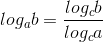
When evaluating a log you are asking what power your base must be raised by to get your argument.
If you cannot directly figure that out you can use a change of base formula instead.
When evaluating a log you are asking what power your base must be raised by to get your argument.
If you cannot directly figure that out you can use a change of base formula instead.
← Didn't Know|Knew It →
Which of the following diagrams represents the graph of the following logarithmic function?

Which of the following diagrams represents the graph of the following logarithmic function?
Tap to reveal answer
For  ,
,  is the exponent of base 5 and
  is the product. Therefore, when
  ,
,  and when
  ,
,  . As a result, the correct graph will have
  values of 5 and 125 at
  and
and  , respectively.
For
← Didn't Know|Knew It →
Which of the following logarithmic functions match the provided diagram?
Which of the following logarithmic functions match the provided diagram?
Tap to reveal answer
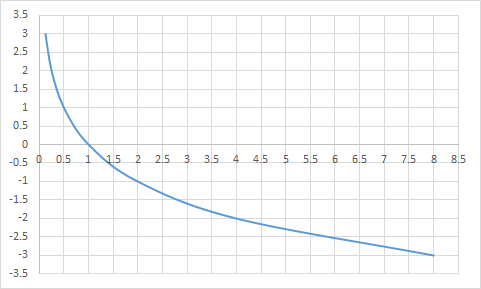
Looking at the diagram, we can see that when  ,
,  . Since
  represents the exponent and
  represents the product, and any base with an exponent of 1 equals the base, we can determine the base to be 0.5.
Looking at the diagram, we can see that when
← Didn't Know|Knew It →
Which of the following diagrams matches the given logarithmic function:

Which of the following diagrams matches the given logarithmic function:
Tap to reveal answer
For this function,  represents the exponent and y represents the product of the base 2 and its exponent. On the diagram, it is clear that as the
  value increases, the
  value increases exponentially and at
  ,
,  . Those two characteristics of the graph indicate that x is the exponent value and the base is equal to 2.
For this function,
← Didn't Know|Knew It →
Which of the following logarithmic functions match the given diagram?
Which of the following logarithmic functions match the given diagram?
Tap to reveal answer
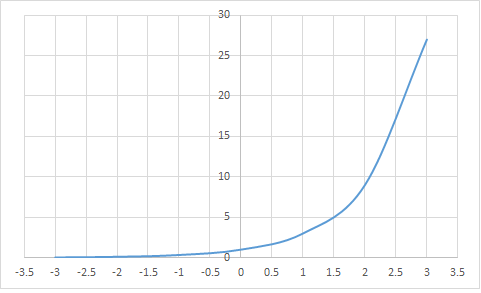
Looking at the graph, the y-value diminishes exponentially as  decreases and increases rapidly as the x-value increases, which indicates that
  is the exponent value for the equation.
Also,  when
when  and
and  when
when  , which can be expressed as
  and
and  , respectively.
This indicates that the diagram is consistent with the function  .
.
Looking at the graph, the y-value diminishes exponentially as
Also,
This indicates that the diagram is consistent with the function
← Didn't Know|Knew It →
Evaluate this logarithm:
Evaluate this logarithm:
Tap to reveal answer
It is important to remember a logarithm is really just an exponent. In fact when you see  remember that the expression is only asking what exponent must "a" be raised to in order to obtain "x"!

Now that we have substituted the value of x reread the problem by the rule above. What power must 3 be raised to in order to obtain 243?


5 is the power to which 3 must be raised to obtain 243.
It is important to remember a logarithm is really just an exponent. In fact when you see
Now that we have substituted the value of x reread the problem by the rule above. What power must 3 be raised to in order to obtain 243?
5 is the power to which 3 must be raised to obtain 243.
← Didn't Know|Knew It →
Evaluate the logarithm

Evaluate the logarithm
Tap to reveal answer
Given the property

and because

we obtain that

Given the property
and because
we obtain that
← Didn't Know|Knew It →
Evaluate to four decimal places: 
Evaluate to four decimal places:
Tap to reveal answer
Using a calculator, evaluate 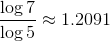
Using a calculator, evaluate
← Didn't Know|Knew It →
Evaluate to 4 decimal places: 
Evaluate to 4 decimal places:
Tap to reveal answer
To evaluate, use a calculator to find 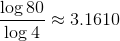
To evaluate, use a calculator to find
← Didn't Know|Knew It →
Evaluate the following:

Evaluate the following:
Tap to reveal answer
To solve, simply find the matching base and use properties of logs to simplify.
Some properties of logs include the following:
-

-

-

Thus,
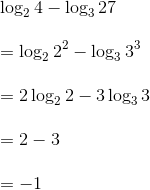
To solve, simply find the matching base and use properties of logs to simplify.
Some properties of logs include the following:
Thus,
← Didn't Know|Knew It →
Evaluate the following:
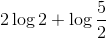
Evaluate the following:
Tap to reveal answer
To solve, remember the following rules for logarithms.


Thus,

Remember, if a base isn't specified, it is 10.
To solve, remember the following rules for logarithms.
Thus,
Remember, if a base isn't specified, it is 10.
← Didn't Know|Knew It →
Find .
Find
Tap to reveal answer
Using the Change of Base formula we can rewrite the log as follows.
.
Or,
, then find that .
Therefore,
.
Using the Change of Base formula we can rewrite the log as follows.
Or,
Therefore,
← Didn't Know|Knew It →
Evaluate the following logarithm:
Evaluate the following logarithm:
Tap to reveal answer
The problem asks us to evaluate the following logarithm:
According to the definition of a logarithm, what this equation is asking us is "5 to what power equals 7?":
Using the properties of logarithms, if we take the log of both sides we get the following equation and simplification:
The problem asks us to evaluate the following logarithm:
According to the definition of a logarithm, what this equation is asking us is "5 to what power equals 7?":
Using the properties of logarithms, if we take the log of both sides we get the following equation and simplification:
← Didn't Know|Knew It →