Simplify Expressions With Rational Exponents - Pre-Calculus
Card 1 of 76
Simplify the function:

Simplify the function:
Tap to reveal answer
When an exponent is raised to the power of another exponent, just multiply the exponents together.


When an exponent is raised to the power of another exponent, just multiply the exponents together.
← Didn't Know|Knew It →
Simplify the function:

Simplify the function:
Tap to reveal answer
When an exponent is raised to the power of another exponent, just multiply the exponents together.


When an exponent is raised to the power of another exponent, just multiply the exponents together.
← Didn't Know|Knew It →
Simplify

Simplify
Tap to reveal answer

 .
.
← Didn't Know|Knew It →
Simplify the expression:
 .
.
Simplify the expression:
Tap to reveal answer
First, you can begin to simplfy the numerator by converting all 3 expressions into base 2.
 , which simplifies to

For the denominator, the same method applies. Convert the 25 into base 5, and when simplified becomes simply 5.


The final simplified answer becomes:
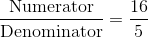
First, you can begin to simplfy the numerator by converting all 3 expressions into base 2.
For the denominator, the same method applies. Convert the 25 into base 5, and when simplified becomes simply 5.
The final simplified answer becomes:
← Didn't Know|Knew It →
Evaluate the following expression using knowledge of the properties of exponents:

Evaluate the following expression using knowledge of the properties of exponents:
Tap to reveal answer
Let's work through this equation involving exponents one term at a time. The first term we see is  , for which we can apply the following property:

So if we plug our values into the formula for the property, we get:

Because  . Our next term is
  , for which we'll need the property:

Using the values for our term, we have:

The third term of the equation is  , for which the quickest way to evaluate would be using the following property:

Using the values from our term, this gives us:

The next property we will need to consider for our fourth term is given below:

If we plug in the corresponding values from our term, we get:
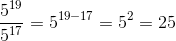
Finally, our last term requires knowledge of the following simple property: Any number raised to the power of zero is 1. With this in mind, our last term becomes:

Rewriting the equation with all of the values we've just evaluated, we obtain our final answer:

Let's work through this equation involving exponents one term at a time. The first term we see is
So if we plug our values into the formula for the property, we get:
Because
Using the values for our term, we have:
The third term of the equation is
Using the values from our term, this gives us:
The next property we will need to consider for our fourth term is given below:
If we plug in the corresponding values from our term, we get:
Finally, our last term requires knowledge of the following simple property: Any number raised to the power of zero is 1. With this in mind, our last term becomes:
Rewriting the equation with all of the values we've just evaluated, we obtain our final answer:
← Didn't Know|Knew It →
Simplify the expression.

Simplify the expression.
Tap to reveal answer
Using the properties of exponents, we can either choose to subtract the exponents of the corresponding bases or rewrite the expression using negative exponents as such:

Here, we combine the terms with corresponding bases by adding the exponents together to get

Placing the x term (since it has a negative exponent) in the denominator will result in the correct answer. It can be shown that simply subtracting the exponents of corresponding bases will result in the same answer.

Using the properties of exponents, we can either choose to subtract the exponents of the corresponding bases or rewrite the expression using negative exponents as such:
Here, we combine the terms with corresponding bases by adding the exponents together to get
Placing the x term (since it has a negative exponent) in the denominator will result in the correct answer. It can be shown that simply subtracting the exponents of corresponding bases will result in the same answer.
← Didn't Know|Knew It →
Solve:

Solve:
Tap to reveal answer
To remove the fractional exponents, raise both sides to the second power and simplify:


Now solve for  :
:


To remove the fractional exponents, raise both sides to the second power and simplify:
Now solve for
← Didn't Know|Knew It →
Solve:

Solve:
Tap to reveal answer
To remove the rational exponent, cube both sides of the equation:

Now simplify both sides of the equation:


To remove the rational exponent, cube both sides of the equation:
Now simplify both sides of the equation:
← Didn't Know|Knew It →
Evaluate the following expression and solve for  .
.

Evaluate the following expression and solve for
Tap to reveal answer
To solve this problem, recall that you can set exponents equal to eachother if they have the same base.
See below:

So, we have

Because both sides of this equation have a base of seven, we can set the exponents equal to eachother and solve for t.


To solve this problem, recall that you can set exponents equal to eachother if they have the same base.
See below:
So, we have
Because both sides of this equation have a base of seven, we can set the exponents equal to eachother and solve for t.
← Didn't Know|Knew It →
Simplify the expression  .
.
Simplify the expression
Tap to reveal answer
We proceed as follows

Write  as a fraction

The denominator of the fraction is a  , so it becomes a square root.

Take the square root.

Raise to the  power.

We proceed as follows
Write
The denominator of the fraction is a
Take the square root.
Raise to the
← Didn't Know|Knew It →
Solve for  .
.

Solve for
Tap to reveal answer
We begin by taking the natural log of the equation:

Simplifying the left side of the equation using the rules of logarithms gives:

We group the x terms to get:

We reincorporate the exponents into the logarithms and use the identity property of the natural log to obtain:

We combine the logarithms using the multiplication/sum rule to get:

We then solve for x:

We begin by taking the natural log of the equation:
Simplifying the left side of the equation using the rules of logarithms gives:
We group the x terms to get:
We reincorporate the exponents into the logarithms and use the identity property of the natural log to obtain:
We combine the logarithms using the multiplication/sum rule to get:
We then solve for x:
← Didn't Know|Knew It →
Solve for  .
.

Solve for
Tap to reveal answer
We begin by factoring out the term  to get:

This equation gives our first solution:

Then we check for more solutions:
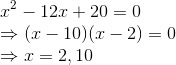
Therefore our solution is

We begin by factoring out the term
This equation gives our first solution:
Then we check for more solutions:
Therefore our solution is
← Didn't Know|Knew It →
Evaluate  when
when 
Evaluate
Tap to reveal answer
Remember the denominator of a rational exponent is equivalent to the index of a root.
This should simplify quite nicely.

When it gives us,

Remember the denominator of a rational exponent is equivalent to the index of a root.
This should simplify quite nicely.
When
← Didn't Know|Knew It →
What is the value of  ?
?
What is the value of
Tap to reveal answer
Recall that when considering rational exponents, the denominator of the fraction tells us the "root" of the expression.
Thus in this case we are taking the fifth root of  .
.
The fifth root of  is
is  , because
  .
.
Thus, we have reduced our expression to  .
.
Recall that when considering rational exponents, the denominator of the fraction tells us the "root" of the expression.
Thus in this case we are taking the fifth root of
The fifth root of
Thus, we have reduced our expression to
← Didn't Know|Knew It →
What is the value of  ?
?
What is the value of
Tap to reveal answer
What does an exponent of one-third mean? Consider our expression and raise it to the third power.

Simplifying, we get:

Thus, we are looking for a number that when cubed, we get  . Thus, we are discussing the cube root of
  , or
, or  .
.
What does an exponent of one-third mean? Consider our expression and raise it to the third power.
Simplifying, we get:
Thus, we are looking for a number that when cubed, we get
← Didn't Know|Knew It →
Simplify the expression: 
Simplify the expression:
Tap to reveal answer

Simplify the constants:

Subtract the "x" exponents:

 This is how the x moves to the denominator.
Finally subtract the "y" exponents:

Simplify the constants:
Subtract the "x" exponents:
Finally subtract the "y" exponents:
← Didn't Know|Knew It →
Simplify and rewrite with positive exponents:

Simplify and rewrite with positive exponents:
Tap to reveal answer

When dividing two exponents with the same base we subtract the exponents:

Negative exponents are dealt with based on the rule
 :
:

When dividing two exponents with the same base we subtract the exponents:
Negative exponents are dealt with based on the rule
← Didn't Know|Knew It →
Simplify:

Simplify:
Tap to reveal answer
Subtract the "x" exponents and the "y" exponents vertically. Then add the exponents horizontally if they have the same base (subtract the "x" and subtract the "y" ones). Finally move the negative exponent to the denominator.

Subtract the "x" exponents and the "y" exponents vertically. Then add the exponents horizontally if they have the same base (subtract the "x" and subtract the "y" ones). Finally move the negative exponent to the denominator.
← Didn't Know|Knew It →
Simplify the function:

Simplify the function:
Tap to reveal answer
When an exponent is raised to the power of another exponent, just multiply the exponents together.


When an exponent is raised to the power of another exponent, just multiply the exponents together.
← Didn't Know|Knew It →
Simplify
Simplify
Tap to reveal answer
.
← Didn't Know|Knew It →