How to factor a common factor out of squares - PSAT Math
Card 1 of 28
x2 = 36
Quantity A: x
Quantity B: 6
x2 = 36
Quantity A: x
Quantity B: 6
Tap to reveal answer
x2 = 36 -> it is important to remember that this leads to two answers.
x = 6 or x = -6.
If x = 6: A = B.
If x = -6: A < B.
Thus the relationship cannot be determined from the information given.
x2 = 36 -> it is important to remember that this leads to two answers.
x = 6 or x = -6.
If x = 6: A = B.
If x = -6: A < B.
Thus the relationship cannot be determined from the information given.
← Didn't Know|Knew It →
According to Heron's Formula, the area of a triangle with side lengths of a, b, and c is given by the following:

where s is one-half of the triangle's perimeter.
What is the area of a triangle with side lengths of 6, 10, and 12 units?
According to Heron's Formula, the area of a triangle with side lengths of a, b, and c is given by the following:
where s is one-half of the triangle's perimeter.
What is the area of a triangle with side lengths of 6, 10, and 12 units?
Tap to reveal answer
We can use Heron's formula to find the area of the triangle. We can let a = 6, b = 10, and c = 12.
In order to find s, we need to find one half of the perimeter. The perimeter is the sum of the lengths of the sides of the triangle.
Perimeter = a + b + c = 6 + 10 + 12 = 28
In order to find s, we must multiply the perimeter by one-half, which would give us (1/2)(28), or 14.
Now that we have a, b, c, and s, we can calculate the area using Heron's formula.
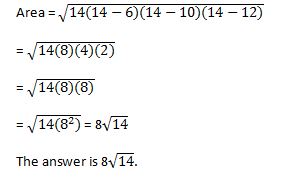
We can use Heron's formula to find the area of the triangle. We can let a = 6, b = 10, and c = 12.
In order to find s, we need to find one half of the perimeter. The perimeter is the sum of the lengths of the sides of the triangle.
Perimeter = a + b + c = 6 + 10 + 12 = 28
In order to find s, we must multiply the perimeter by one-half, which would give us (1/2)(28), or 14.
Now that we have a, b, c, and s, we can calculate the area using Heron's formula.
← Didn't Know|Knew It →
Simplify the expression.

Simplify the expression.
Tap to reveal answer
Use the distributive property for radicals.

Multiply all terms by  .
.

Combine terms under radicals.


Look for perfect square factors under each radical.  has a perfect square of
  . The can be factored out.


Since both radicals are the same, we can add them.

Use the distributive property for radicals.
Multiply all terms by
Combine terms under radicals.
Look for perfect square factors under each radical.
Since both radicals are the same, we can add them.
← Didn't Know|Knew It →
Simplify the radical expression.

Simplify the radical expression.
Tap to reveal answer
Look for perfect cubes within each term. This will allow us to factor out of the radical.


Simplify.

Look for perfect cubes within each term. This will allow us to factor out of the radical.
Simplify.
← Didn't Know|Knew It →
x2 = 36
Quantity A: x
Quantity B: 6
x2 = 36
Quantity A: x
Quantity B: 6
Tap to reveal answer
x2 = 36 -> it is important to remember that this leads to two answers.
x = 6 or x = -6.
If x = 6: A = B.
If x = -6: A < B.
Thus the relationship cannot be determined from the information given.
x2 = 36 -> it is important to remember that this leads to two answers.
x = 6 or x = -6.
If x = 6: A = B.
If x = -6: A < B.
Thus the relationship cannot be determined from the information given.
← Didn't Know|Knew It →
According to Heron's Formula, the area of a triangle with side lengths of a, b, and c is given by the following:
where s is one-half of the triangle's perimeter.
What is the area of a triangle with side lengths of 6, 10, and 12 units?
According to Heron's Formula, the area of a triangle with side lengths of a, b, and c is given by the following:
where s is one-half of the triangle's perimeter.
What is the area of a triangle with side lengths of 6, 10, and 12 units?
Tap to reveal answer
We can use Heron's formula to find the area of the triangle. We can let a = 6, b = 10, and c = 12.
In order to find s, we need to find one half of the perimeter. The perimeter is the sum of the lengths of the sides of the triangle.
Perimeter = a + b + c = 6 + 10 + 12 = 28
In order to find s, we must multiply the perimeter by one-half, which would give us (1/2)(28), or 14.
Now that we have a, b, c, and s, we can calculate the area using Heron's formula.
We can use Heron's formula to find the area of the triangle. We can let a = 6, b = 10, and c = 12.
In order to find s, we need to find one half of the perimeter. The perimeter is the sum of the lengths of the sides of the triangle.
Perimeter = a + b + c = 6 + 10 + 12 = 28
In order to find s, we must multiply the perimeter by one-half, which would give us (1/2)(28), or 14.
Now that we have a, b, c, and s, we can calculate the area using Heron's formula.
← Didn't Know|Knew It →
Simplify the expression.
Simplify the expression.
Tap to reveal answer
Use the distributive property for radicals.
Multiply all terms by .
Combine terms under radicals.
Look for perfect square factors under each radical. has a perfect square of . The can be factored out.
Since both radicals are the same, we can add them.
Use the distributive property for radicals.
Multiply all terms by
Combine terms under radicals.
Look for perfect square factors under each radical.
Since both radicals are the same, we can add them.
← Didn't Know|Knew It →
Simplify the radical expression.
Simplify the radical expression.
Tap to reveal answer
Look for perfect cubes within each term. This will allow us to factor out of the radical.
Simplify.
Look for perfect cubes within each term. This will allow us to factor out of the radical.
Simplify.
← Didn't Know|Knew It →
x2 = 36
Quantity A: x
Quantity B: 6
x2 = 36
Quantity A: x
Quantity B: 6
Tap to reveal answer
x2 = 36 -> it is important to remember that this leads to two answers.
x = 6 or x = -6.
If x = 6: A = B.
If x = -6: A < B.
Thus the relationship cannot be determined from the information given.
x2 = 36 -> it is important to remember that this leads to two answers.
x = 6 or x = -6.
If x = 6: A = B.
If x = -6: A < B.
Thus the relationship cannot be determined from the information given.
← Didn't Know|Knew It →
According to Heron's Formula, the area of a triangle with side lengths of a, b, and c is given by the following:
where s is one-half of the triangle's perimeter.
What is the area of a triangle with side lengths of 6, 10, and 12 units?
According to Heron's Formula, the area of a triangle with side lengths of a, b, and c is given by the following:
where s is one-half of the triangle's perimeter.
What is the area of a triangle with side lengths of 6, 10, and 12 units?
Tap to reveal answer
We can use Heron's formula to find the area of the triangle. We can let a = 6, b = 10, and c = 12.
In order to find s, we need to find one half of the perimeter. The perimeter is the sum of the lengths of the sides of the triangle.
Perimeter = a + b + c = 6 + 10 + 12 = 28
In order to find s, we must multiply the perimeter by one-half, which would give us (1/2)(28), or 14.
Now that we have a, b, c, and s, we can calculate the area using Heron's formula.
We can use Heron's formula to find the area of the triangle. We can let a = 6, b = 10, and c = 12.
In order to find s, we need to find one half of the perimeter. The perimeter is the sum of the lengths of the sides of the triangle.
Perimeter = a + b + c = 6 + 10 + 12 = 28
In order to find s, we must multiply the perimeter by one-half, which would give us (1/2)(28), or 14.
Now that we have a, b, c, and s, we can calculate the area using Heron's formula.
← Didn't Know|Knew It →
Simplify the expression.
Simplify the expression.
Tap to reveal answer
Use the distributive property for radicals.
Multiply all terms by .
Combine terms under radicals.
Look for perfect square factors under each radical. has a perfect square of . The can be factored out.
Since both radicals are the same, we can add them.
Use the distributive property for radicals.
Multiply all terms by
Combine terms under radicals.
Look for perfect square factors under each radical.
Since both radicals are the same, we can add them.
← Didn't Know|Knew It →
Simplify the radical expression.
Simplify the radical expression.
Tap to reveal answer
Look for perfect cubes within each term. This will allow us to factor out of the radical.
Simplify.
Look for perfect cubes within each term. This will allow us to factor out of the radical.
Simplify.
← Didn't Know|Knew It →
x2 = 36
Quantity A: x
Quantity B: 6
x2 = 36
Quantity A: x
Quantity B: 6
Tap to reveal answer
x2 = 36 -> it is important to remember that this leads to two answers.
x = 6 or x = -6.
If x = 6: A = B.
If x = -6: A < B.
Thus the relationship cannot be determined from the information given.
x2 = 36 -> it is important to remember that this leads to two answers.
x = 6 or x = -6.
If x = 6: A = B.
If x = -6: A < B.
Thus the relationship cannot be determined from the information given.
← Didn't Know|Knew It →
According to Heron's Formula, the area of a triangle with side lengths of a, b, and c is given by the following:
where s is one-half of the triangle's perimeter.
What is the area of a triangle with side lengths of 6, 10, and 12 units?
According to Heron's Formula, the area of a triangle with side lengths of a, b, and c is given by the following:
where s is one-half of the triangle's perimeter.
What is the area of a triangle with side lengths of 6, 10, and 12 units?
Tap to reveal answer
We can use Heron's formula to find the area of the triangle. We can let a = 6, b = 10, and c = 12.
In order to find s, we need to find one half of the perimeter. The perimeter is the sum of the lengths of the sides of the triangle.
Perimeter = a + b + c = 6 + 10 + 12 = 28
In order to find s, we must multiply the perimeter by one-half, which would give us (1/2)(28), or 14.
Now that we have a, b, c, and s, we can calculate the area using Heron's formula.
We can use Heron's formula to find the area of the triangle. We can let a = 6, b = 10, and c = 12.
In order to find s, we need to find one half of the perimeter. The perimeter is the sum of the lengths of the sides of the triangle.
Perimeter = a + b + c = 6 + 10 + 12 = 28
In order to find s, we must multiply the perimeter by one-half, which would give us (1/2)(28), or 14.
Now that we have a, b, c, and s, we can calculate the area using Heron's formula.
← Didn't Know|Knew It →
Simplify the expression.
Simplify the expression.
Tap to reveal answer
Use the distributive property for radicals.
Multiply all terms by .
Combine terms under radicals.
Look for perfect square factors under each radical. has a perfect square of . The can be factored out.
Since both radicals are the same, we can add them.
Use the distributive property for radicals.
Multiply all terms by
Combine terms under radicals.
Look for perfect square factors under each radical.
Since both radicals are the same, we can add them.
← Didn't Know|Knew It →
Simplify the radical expression.
Simplify the radical expression.
Tap to reveal answer
Look for perfect cubes within each term. This will allow us to factor out of the radical.
Simplify.
Look for perfect cubes within each term. This will allow us to factor out of the radical.
Simplify.
← Didn't Know|Knew It →
x2 = 36
Quantity A: x
Quantity B: 6
x2 = 36
Quantity A: x
Quantity B: 6
Tap to reveal answer
x2 = 36 -> it is important to remember that this leads to two answers.
x = 6 or x = -6.
If x = 6: A = B.
If x = -6: A < B.
Thus the relationship cannot be determined from the information given.
x2 = 36 -> it is important to remember that this leads to two answers.
x = 6 or x = -6.
If x = 6: A = B.
If x = -6: A < B.
Thus the relationship cannot be determined from the information given.
← Didn't Know|Knew It →
According to Heron's Formula, the area of a triangle with side lengths of a, b, and c is given by the following:
where s is one-half of the triangle's perimeter.
What is the area of a triangle with side lengths of 6, 10, and 12 units?
According to Heron's Formula, the area of a triangle with side lengths of a, b, and c is given by the following:
where s is one-half of the triangle's perimeter.
What is the area of a triangle with side lengths of 6, 10, and 12 units?
Tap to reveal answer
We can use Heron's formula to find the area of the triangle. We can let a = 6, b = 10, and c = 12.
In order to find s, we need to find one half of the perimeter. The perimeter is the sum of the lengths of the sides of the triangle.
Perimeter = a + b + c = 6 + 10 + 12 = 28
In order to find s, we must multiply the perimeter by one-half, which would give us (1/2)(28), or 14.
Now that we have a, b, c, and s, we can calculate the area using Heron's formula.
We can use Heron's formula to find the area of the triangle. We can let a = 6, b = 10, and c = 12.
In order to find s, we need to find one half of the perimeter. The perimeter is the sum of the lengths of the sides of the triangle.
Perimeter = a + b + c = 6 + 10 + 12 = 28
In order to find s, we must multiply the perimeter by one-half, which would give us (1/2)(28), or 14.
Now that we have a, b, c, and s, we can calculate the area using Heron's formula.
← Didn't Know|Knew It →
Simplify the expression.
Simplify the expression.
Tap to reveal answer
Use the distributive property for radicals.
Multiply all terms by .
Combine terms under radicals.
Look for perfect square factors under each radical. has a perfect square of . The can be factored out.
Since both radicals are the same, we can add them.
Use the distributive property for radicals.
Multiply all terms by
Combine terms under radicals.
Look for perfect square factors under each radical.
Since both radicals are the same, we can add them.
← Didn't Know|Knew It →
Simplify the radical expression.
Simplify the radical expression.
Tap to reveal answer
Look for perfect cubes within each term. This will allow us to factor out of the radical.
Simplify.
Look for perfect cubes within each term. This will allow us to factor out of the radical.
Simplify.
← Didn't Know|Knew It →