How to find domain and range of the inverse of a relation - PSAT Math
Card 1 of 56
Which of the following values of x is not in the domain of the function y = (2_x –_ 1) / (x_2 – 6_x + 9) ?
Which of the following values of x is not in the domain of the function y = (2_x –_ 1) / (x_2 – 6_x + 9) ?
Tap to reveal answer
Values of x that make the denominator equal zero are not included in the domain. The denominator can be simplified to (x – 3)2, so the value that makes it zero is 3.
Values of x that make the denominator equal zero are not included in the domain. The denominator can be simplified to (x – 3)2, so the value that makes it zero is 3.
← Didn't Know|Knew It →
Given the relation below:
{(1, 2), (3, 4), (5, 6), (7, 8)}
Find the range of the inverse of the relation.
Given the relation below:
{(1, 2), (3, 4), (5, 6), (7, 8)}
Find the range of the inverse of the relation.
Tap to reveal answer
The domain of a relation is the same as the range of the inverse of the relation. In other words, the x-values of the relation are the y-values of the inverse.
The domain of a relation is the same as the range of the inverse of the relation. In other words, the x-values of the relation are the y-values of the inverse.
← Didn't Know|Knew It →
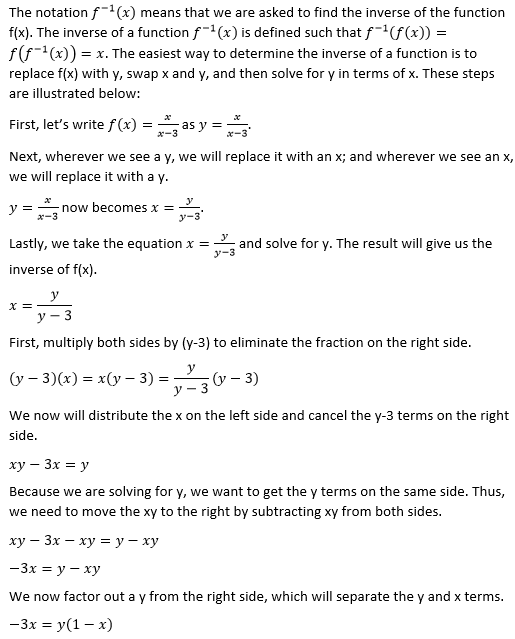
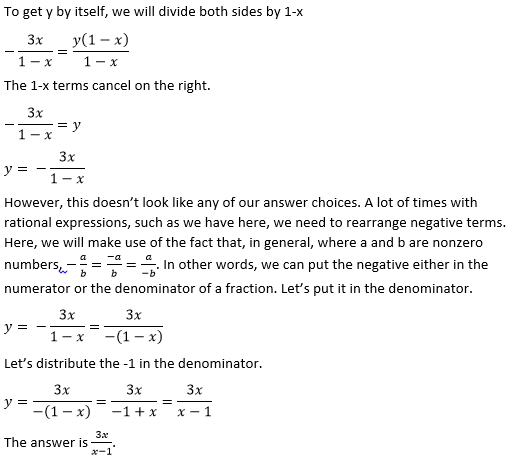
If 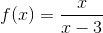 , then which of the following is equal to
  ?
?
If
Tap to reveal answer
← Didn't Know|Knew It →
What is the range of the function y = _x_2 + 2?
What is the range of the function y = _x_2 + 2?
Tap to reveal answer
The range of a function is the set of y-values that a function can take. First let's find the domain. The domain is the set of x-values that the function can take. Here the domain is all real numbers because no x-value will make this function undefined. (Dividing by 0 is an example of an operation that would make the function undefined.)
So if any value of x can be plugged into y = _x_2 + 2, can y take any value also? Not quite! The smallest value that y can ever be is 2. No matter what value of x is plugged in, y = _x_2 + 2 will never produce a number less than 2. Therefore the range is y ≥ 2.
The range of a function is the set of y-values that a function can take. First let's find the domain. The domain is the set of x-values that the function can take. Here the domain is all real numbers because no x-value will make this function undefined. (Dividing by 0 is an example of an operation that would make the function undefined.)
So if any value of x can be plugged into y = _x_2 + 2, can y take any value also? Not quite! The smallest value that y can ever be is 2. No matter what value of x is plugged in, y = _x_2 + 2 will never produce a number less than 2. Therefore the range is y ≥ 2.
← Didn't Know|Knew It →
What is the smallest value that belongs to the range of the function f(x)=2|4-x|-2 ?
What is the smallest value that belongs to the range of the function f(x)=2|4-x|-2 ?
Tap to reveal answer
We need to be careful here not to confuse the domain and range of a function. The problem specifically concerns the range of the function, which is the set of possible numbers of f(x). It can be helpful to think of the range as all the possible y-values we could have on the points on the graph of f(x).
Notice that f(x) has |4-x| in its equation. Whenever we have an absolute value of some quantity, the result will always be equal to or greater than zero. In other words, |4-x| geq 0. We are asked to find the smallest value in the range of f(x), so let's consider the smallest value of |4-x|, which would have to be zero. Let's see what would happen to f(x) if |4-x|=0.
f(x)=2(0)-2=0-2=-2
This means that when |4-x|=0, f(x)=-2. Let's see what happens when |4-x| gets larger. For example, let's let |4-x|=3.
f(x)=2(3)-2=4
As we can see, as |4-x| gets larger, so does f(x). We want f(x) to be as small as possible, so we are going to want |4-x| to be equal to zero. And, as we already determiend, f(x) equals -2 when |4-x|=0.
The answer is -2.
We need to be careful here not to confuse the domain and range of a function. The problem specifically concerns the range of the function, which is the set of possible numbers of f(x). It can be helpful to think of the range as all the possible y-values we could have on the points on the graph of f(x).
Notice that f(x) has |4-x| in its equation. Whenever we have an absolute value of some quantity, the result will always be equal to or greater than zero. In other words, |4-x| geq 0. We are asked to find the smallest value in the range of f(x), so let's consider the smallest value of |4-x|, which would have to be zero. Let's see what would happen to f(x) if |4-x|=0.
f(x)=2(0)-2=0-2=-2
This means that when |4-x|=0, f(x)=-2. Let's see what happens when |4-x| gets larger. For example, let's let |4-x|=3.
f(x)=2(3)-2=4
As we can see, as |4-x| gets larger, so does f(x). We want f(x) to be as small as possible, so we are going to want |4-x| to be equal to zero. And, as we already determiend, f(x) equals -2 when |4-x|=0.
The answer is -2.
← Didn't Know|Knew It →
If f(x) = x - 3, then find $f^{-1}$(x)
If f(x) = x - 3, then find $f^{-1}$(x)
Tap to reveal answer
f(x) = x - 3 is the same as y= x - 3.
To find the inverse simply exchange x and y and solve for y.
So we get x=y-3 which leads to y=x+3.
f(x) = x - 3 is the same as y= x - 3.
To find the inverse simply exchange x and y and solve for y.
So we get x=y-3 which leads to y=x+3.
← Didn't Know|Knew It →
What is the range of the function y = _x_2 + 2?
What is the range of the function y = _x_2 + 2?
Tap to reveal answer
The range of a function is the set of y-values that a function can take. First let's find the domain. The domain is the set of x-values that the function can take. Here the domain is all real numbers because no x-value will make this function undefined. (Dividing by 0 is an example of an operation that would make the function undefined.)
So if any value of x can be plugged into y = _x_2 + 2, can y take any value also? Not quite! The smallest value that y can ever be is 2. No matter what value of x is plugged in, y = _x_2 + 2 will never produce a number less than 2. Therefore the range is y ≥ 2.
The range of a function is the set of y-values that a function can take. First let's find the domain. The domain is the set of x-values that the function can take. Here the domain is all real numbers because no x-value will make this function undefined. (Dividing by 0 is an example of an operation that would make the function undefined.)
So if any value of x can be plugged into y = _x_2 + 2, can y take any value also? Not quite! The smallest value that y can ever be is 2. No matter what value of x is plugged in, y = _x_2 + 2 will never produce a number less than 2. Therefore the range is y ≥ 2.
← Didn't Know|Knew It →
Given the relation below, identify the domain of the inverse of the relation.

Given the relation below, identify the domain of the inverse of the relation.
Tap to reveal answer

The domain of the inverse of a relation is the same as the range of the original relation. In other words, the y-values of the relation are the x-values of the inverse.
For the original relation, the range is:  .
.
Thus, the domain for the inverse relation will also be  .
.
The domain of the inverse of a relation is the same as the range of the original relation. In other words, the y-values of the relation are the x-values of the inverse.
For the original relation, the range is:
Thus, the domain for the inverse relation will also be
← Didn't Know|Knew It →
Which of the following values of x is not in the domain of the function y = (2_x –_ 1) / (x_2 – 6_x + 9) ?
Which of the following values of x is not in the domain of the function y = (2_x –_ 1) / (x_2 – 6_x + 9) ?
Tap to reveal answer
Values of x that make the denominator equal zero are not included in the domain. The denominator can be simplified to (x – 3)2, so the value that makes it zero is 3.
Values of x that make the denominator equal zero are not included in the domain. The denominator can be simplified to (x – 3)2, so the value that makes it zero is 3.
← Didn't Know|Knew It →
Given the relation below:
{(1, 2), (3, 4), (5, 6), (7, 8)}
Find the range of the inverse of the relation.
Given the relation below:
{(1, 2), (3, 4), (5, 6), (7, 8)}
Find the range of the inverse of the relation.
Tap to reveal answer
The domain of a relation is the same as the range of the inverse of the relation. In other words, the x-values of the relation are the y-values of the inverse.
The domain of a relation is the same as the range of the inverse of the relation. In other words, the x-values of the relation are the y-values of the inverse.
← Didn't Know|Knew It →
If , then which of the following is equal to ?
If
Tap to reveal answer
← Didn't Know|Knew It →
What is the range of the function y = _x_2 + 2?
What is the range of the function y = _x_2 + 2?
Tap to reveal answer
The range of a function is the set of y-values that a function can take. First let's find the domain. The domain is the set of x-values that the function can take. Here the domain is all real numbers because no x-value will make this function undefined. (Dividing by 0 is an example of an operation that would make the function undefined.)
So if any value of x can be plugged into y = _x_2 + 2, can y take any value also? Not quite! The smallest value that y can ever be is 2. No matter what value of x is plugged in, y = _x_2 + 2 will never produce a number less than 2. Therefore the range is y ≥ 2.
The range of a function is the set of y-values that a function can take. First let's find the domain. The domain is the set of x-values that the function can take. Here the domain is all real numbers because no x-value will make this function undefined. (Dividing by 0 is an example of an operation that would make the function undefined.)
So if any value of x can be plugged into y = _x_2 + 2, can y take any value also? Not quite! The smallest value that y can ever be is 2. No matter what value of x is plugged in, y = _x_2 + 2 will never produce a number less than 2. Therefore the range is y ≥ 2.
← Didn't Know|Knew It →
What is the smallest value that belongs to the range of the function f(x)=2|4-x|-2 ?
What is the smallest value that belongs to the range of the function f(x)=2|4-x|-2 ?
Tap to reveal answer
We need to be careful here not to confuse the domain and range of a function. The problem specifically concerns the range of the function, which is the set of possible numbers of f(x). It can be helpful to think of the range as all the possible y-values we could have on the points on the graph of f(x).
Notice that f(x) has |4-x| in its equation. Whenever we have an absolute value of some quantity, the result will always be equal to or greater than zero. In other words, |4-x| geq 0. We are asked to find the smallest value in the range of f(x), so let's consider the smallest value of |4-x|, which would have to be zero. Let's see what would happen to f(x) if |4-x|=0.
f(x)=2(0)-2=0-2=-2
This means that when |4-x|=0, f(x)=-2. Let's see what happens when |4-x| gets larger. For example, let's let |4-x|=3.
f(x)=2(3)-2=4
As we can see, as |4-x| gets larger, so does f(x). We want f(x) to be as small as possible, so we are going to want |4-x| to be equal to zero. And, as we already determiend, f(x) equals -2 when |4-x|=0.
The answer is -2.
We need to be careful here not to confuse the domain and range of a function. The problem specifically concerns the range of the function, which is the set of possible numbers of f(x). It can be helpful to think of the range as all the possible y-values we could have on the points on the graph of f(x).
Notice that f(x) has |4-x| in its equation. Whenever we have an absolute value of some quantity, the result will always be equal to or greater than zero. In other words, |4-x| geq 0. We are asked to find the smallest value in the range of f(x), so let's consider the smallest value of |4-x|, which would have to be zero. Let's see what would happen to f(x) if |4-x|=0.
f(x)=2(0)-2=0-2=-2
This means that when |4-x|=0, f(x)=-2. Let's see what happens when |4-x| gets larger. For example, let's let |4-x|=3.
f(x)=2(3)-2=4
As we can see, as |4-x| gets larger, so does f(x). We want f(x) to be as small as possible, so we are going to want |4-x| to be equal to zero. And, as we already determiend, f(x) equals -2 when |4-x|=0.
The answer is -2.
← Didn't Know|Knew It →
If f(x) = x - 3, then find $f^{-1}$(x)
If f(x) = x - 3, then find $f^{-1}$(x)
Tap to reveal answer
f(x) = x - 3 is the same as y= x - 3.
To find the inverse simply exchange x and y and solve for y.
So we get x=y-3 which leads to y=x+3.
f(x) = x - 3 is the same as y= x - 3.
To find the inverse simply exchange x and y and solve for y.
So we get x=y-3 which leads to y=x+3.
← Didn't Know|Knew It →
What is the range of the function y = _x_2 + 2?
What is the range of the function y = _x_2 + 2?
Tap to reveal answer
The range of a function is the set of y-values that a function can take. First let's find the domain. The domain is the set of x-values that the function can take. Here the domain is all real numbers because no x-value will make this function undefined. (Dividing by 0 is an example of an operation that would make the function undefined.)
So if any value of x can be plugged into y = _x_2 + 2, can y take any value also? Not quite! The smallest value that y can ever be is 2. No matter what value of x is plugged in, y = _x_2 + 2 will never produce a number less than 2. Therefore the range is y ≥ 2.
The range of a function is the set of y-values that a function can take. First let's find the domain. The domain is the set of x-values that the function can take. Here the domain is all real numbers because no x-value will make this function undefined. (Dividing by 0 is an example of an operation that would make the function undefined.)
So if any value of x can be plugged into y = _x_2 + 2, can y take any value also? Not quite! The smallest value that y can ever be is 2. No matter what value of x is plugged in, y = _x_2 + 2 will never produce a number less than 2. Therefore the range is y ≥ 2.
← Didn't Know|Knew It →
Given the relation below, identify the domain of the inverse of the relation.
Given the relation below, identify the domain of the inverse of the relation.
Tap to reveal answer
The domain of the inverse of a relation is the same as the range of the original relation. In other words, the y-values of the relation are the x-values of the inverse.
For the original relation, the range is: .
Thus, the domain for the inverse relation will also be .
The domain of the inverse of a relation is the same as the range of the original relation. In other words, the y-values of the relation are the x-values of the inverse.
For the original relation, the range is:
Thus, the domain for the inverse relation will also be
← Didn't Know|Knew It →
Which of the following values of x is not in the domain of the function y = (2_x –_ 1) / (x_2 – 6_x + 9) ?
Which of the following values of x is not in the domain of the function y = (2_x –_ 1) / (x_2 – 6_x + 9) ?
Tap to reveal answer
Values of x that make the denominator equal zero are not included in the domain. The denominator can be simplified to (x – 3)2, so the value that makes it zero is 3.
Values of x that make the denominator equal zero are not included in the domain. The denominator can be simplified to (x – 3)2, so the value that makes it zero is 3.
← Didn't Know|Knew It →
Given the relation below:
{(1, 2), (3, 4), (5, 6), (7, 8)}
Find the range of the inverse of the relation.
Given the relation below:
{(1, 2), (3, 4), (5, 6), (7, 8)}
Find the range of the inverse of the relation.
Tap to reveal answer
The domain of a relation is the same as the range of the inverse of the relation. In other words, the x-values of the relation are the y-values of the inverse.
The domain of a relation is the same as the range of the inverse of the relation. In other words, the x-values of the relation are the y-values of the inverse.
← Didn't Know|Knew It →
If , then which of the following is equal to ?
If
Tap to reveal answer
← Didn't Know|Knew It →
What is the range of the function y = _x_2 + 2?
What is the range of the function y = _x_2 + 2?
Tap to reveal answer
The range of a function is the set of y-values that a function can take. First let's find the domain. The domain is the set of x-values that the function can take. Here the domain is all real numbers because no x-value will make this function undefined. (Dividing by 0 is an example of an operation that would make the function undefined.)
So if any value of x can be plugged into y = _x_2 + 2, can y take any value also? Not quite! The smallest value that y can ever be is 2. No matter what value of x is plugged in, y = _x_2 + 2 will never produce a number less than 2. Therefore the range is y ≥ 2.
The range of a function is the set of y-values that a function can take. First let's find the domain. The domain is the set of x-values that the function can take. Here the domain is all real numbers because no x-value will make this function undefined. (Dividing by 0 is an example of an operation that would make the function undefined.)
So if any value of x can be plugged into y = _x_2 + 2, can y take any value also? Not quite! The smallest value that y can ever be is 2. No matter what value of x is plugged in, y = _x_2 + 2 will never produce a number less than 2. Therefore the range is y ≥ 2.
← Didn't Know|Knew It →