How to order fractions from least to greatest or from greatest to least - PSAT Math
Card 1 of 63
Which of the following is greater than 1/2 ?
Which of the following is greater than 1/2 ?
Tap to reveal answer
There are two ways to deal with fractions. One way is to convert them all to decimals. (By using your calculator, divide the numerator by the denominator). Using this method all you would need to do is to see which is greater than 0.5. Otherwise to see which is greater than 1/2, double the numerator and see if the result is greater than the denominator. In B, the correct answer, doubling the numerator gives us 12, which is bigger than 11.
There are two ways to deal with fractions. One way is to convert them all to decimals. (By using your calculator, divide the numerator by the denominator). Using this method all you would need to do is to see which is greater than 0.5. Otherwise to see which is greater than 1/2, double the numerator and see if the result is greater than the denominator. In B, the correct answer, doubling the numerator gives us 12, which is bigger than 11.
← Didn't Know|Knew It →
Which of the following has the greatest value?
Which of the following has the greatest value?
Tap to reveal answer
If all are converted to decimals, 0.65 is the biggest.
If all are converted to decimals, 0.65 is the biggest.
← Didn't Know|Knew It →
Which fraction falls between ½ and 3/4?
Which fraction falls between ½ and 3/4?
Tap to reveal answer
The easiest method is to put each of these fractions into a calculator, and then place them in order on a number line to see which value falls in between 1/2 = 0.5 and ¾ = 0.75. Without a calculator you must do long division to find the value of the numerator (top number) divided by the denominator (bottom number) for each fraction. You can actually eliminate answers b. and d. because they are equal to 1/2 and ¾ respectively. 4/5= 0.80, 3/6 = 0.5, 5/8= 0.625, 6/8 = 0.75.
The easiest method is to put each of these fractions into a calculator, and then place them in order on a number line to see which value falls in between 1/2 = 0.5 and ¾ = 0.75. Without a calculator you must do long division to find the value of the numerator (top number) divided by the denominator (bottom number) for each fraction. You can actually eliminate answers b. and d. because they are equal to 1/2 and ¾ respectively. 4/5= 0.80, 3/6 = 0.5, 5/8= 0.625, 6/8 = 0.75.
← Didn't Know|Knew It →
If Ben is taller than Jaime, Mary is taller than Ben, and Chris is taller than Mary. Who is the second tallest?
If Ben is taller than Jaime, Mary is taller than Ben, and Chris is taller than Mary. Who is the second tallest?
Tap to reveal answer
Using math symbols to dictate height we find that Ben>Jaime, Mary>Ben, Chris>Mary. Putting these in order we have Chris>Mary, Mary>Ben, Ben>Jaime. This shows that Mary is the second tallest.
Using math symbols to dictate height we find that Ben>Jaime, Mary>Ben, Chris>Mary. Putting these in order we have Chris>Mary, Mary>Ben, Ben>Jaime. This shows that Mary is the second tallest.
← Didn't Know|Knew It →
Order the following fractions in descending order.
1/2, 2/3, 2/5, 3/4, 4/7
Order the following fractions in descending order.
1/2, 2/3, 2/5, 3/4, 4/7
Tap to reveal answer
Method 1:
Find the common denominator (420) and convert each fraction to this denominator:
1/2 = 210/420
2/3 = 280/420
2/5 = 168/420
3/4 = 315/420
4/7 = 240/420
Now sort by numerator, largest to smallest.
Method 2:
Divide each fraction to obtain a decimal. Sort the decimals, largest to smallest.
Method 1:
Find the common denominator (420) and convert each fraction to this denominator:
1/2 = 210/420
2/3 = 280/420
2/5 = 168/420
3/4 = 315/420
4/7 = 240/420
Now sort by numerator, largest to smallest.
Method 2:
Divide each fraction to obtain a decimal. Sort the decimals, largest to smallest.
← Didn't Know|Knew It →
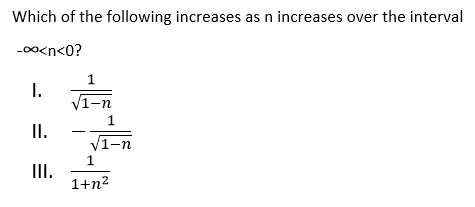
Tap to reveal answer
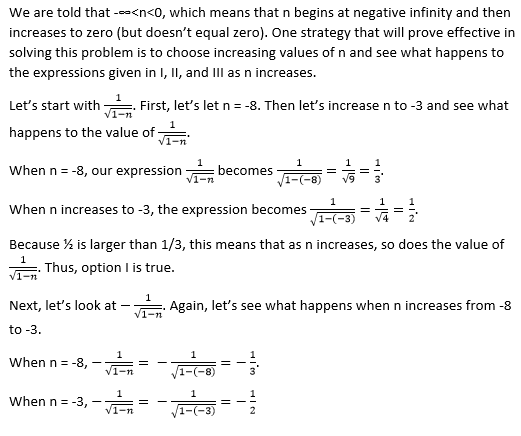
← Didn't Know|Knew It →
Which of the following fractions is between 0.2 and 0.3?
Which of the following fractions is between 0.2 and 0.3?
Tap to reveal answer
$\frac{1}{4}$=0.25
0.2<0.25<0.3
$\frac{1}{6}$approx 0.167<0.2
The other three choices are larger than 0.3.
$\frac{1}{4}$=0.25
0.2<0.25<0.3
$\frac{1}{6}$approx 0.167<0.2
The other three choices are larger than 0.3.
← Didn't Know|Knew It →
Which of the following fractions is the greatest?
Which of the following fractions is the greatest?
Tap to reveal answer
The trick to this problem is to see that three of the choices have the numerator and denominator 3 units apart. The other two choices can be made three units apart as well- multiply both  and
and  by
by  to get them to be
  and
and  , respectively.
The trick is that once all fractions are the same units apart in denominator and numerator, the biggest number is the largest fraction.
The trick to this problem is to see that three of the choices have the numerator and denominator 3 units apart. The other two choices can be made three units apart as well- multiply both
The trick is that once all fractions are the same units apart in denominator and numerator, the biggest number is the largest fraction.
← Didn't Know|Knew It →
Order the following from least to greatest: three-fifths, seven-eighths, 0.5, sixteen-eighteenths, 97%, 17-fifths.
Order the following from least to greatest: three-fifths, seven-eighths, 0.5, sixteen-eighteenths, 97%, 17-fifths.
Tap to reveal answer
We need to order: three fifths, seven eights, 0.5, sixteen eighteenths, 97%, seventeen fifths.
Let us re-write each as a fraction:  ,
,  ,
,  ,
,  ,
,  , and
, and  . We can now easily order these:
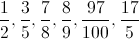
We need to order: three fifths, seven eights, 0.5, sixteen eighteenths, 97%, seventeen fifths.
Let us re-write each as a fraction:
← Didn't Know|Knew It →
Which of the following is greater than 1/2 ?
Which of the following is greater than 1/2 ?
Tap to reveal answer
There are two ways to deal with fractions. One way is to convert them all to decimals. (By using your calculator, divide the numerator by the denominator). Using this method all you would need to do is to see which is greater than 0.5. Otherwise to see which is greater than 1/2, double the numerator and see if the result is greater than the denominator. In B, the correct answer, doubling the numerator gives us 12, which is bigger than 11.
There are two ways to deal with fractions. One way is to convert them all to decimals. (By using your calculator, divide the numerator by the denominator). Using this method all you would need to do is to see which is greater than 0.5. Otherwise to see which is greater than 1/2, double the numerator and see if the result is greater than the denominator. In B, the correct answer, doubling the numerator gives us 12, which is bigger than 11.
← Didn't Know|Knew It →
Which of the following has the greatest value?
Which of the following has the greatest value?
Tap to reveal answer
If all are converted to decimals, 0.65 is the biggest.
If all are converted to decimals, 0.65 is the biggest.
← Didn't Know|Knew It →
Which fraction falls between ½ and 3/4?
Which fraction falls between ½ and 3/4?
Tap to reveal answer
The easiest method is to put each of these fractions into a calculator, and then place them in order on a number line to see which value falls in between 1/2 = 0.5 and ¾ = 0.75. Without a calculator you must do long division to find the value of the numerator (top number) divided by the denominator (bottom number) for each fraction. You can actually eliminate answers b. and d. because they are equal to 1/2 and ¾ respectively. 4/5= 0.80, 3/6 = 0.5, 5/8= 0.625, 6/8 = 0.75.
The easiest method is to put each of these fractions into a calculator, and then place them in order on a number line to see which value falls in between 1/2 = 0.5 and ¾ = 0.75. Without a calculator you must do long division to find the value of the numerator (top number) divided by the denominator (bottom number) for each fraction. You can actually eliminate answers b. and d. because they are equal to 1/2 and ¾ respectively. 4/5= 0.80, 3/6 = 0.5, 5/8= 0.625, 6/8 = 0.75.
← Didn't Know|Knew It →
If Ben is taller than Jaime, Mary is taller than Ben, and Chris is taller than Mary. Who is the second tallest?
If Ben is taller than Jaime, Mary is taller than Ben, and Chris is taller than Mary. Who is the second tallest?
Tap to reveal answer
Using math symbols to dictate height we find that Ben>Jaime, Mary>Ben, Chris>Mary. Putting these in order we have Chris>Mary, Mary>Ben, Ben>Jaime. This shows that Mary is the second tallest.
Using math symbols to dictate height we find that Ben>Jaime, Mary>Ben, Chris>Mary. Putting these in order we have Chris>Mary, Mary>Ben, Ben>Jaime. This shows that Mary is the second tallest.
← Didn't Know|Knew It →
Order the following fractions in descending order.
1/2, 2/3, 2/5, 3/4, 4/7
Order the following fractions in descending order.
1/2, 2/3, 2/5, 3/4, 4/7
Tap to reveal answer
Method 1:
Find the common denominator (420) and convert each fraction to this denominator:
1/2 = 210/420
2/3 = 280/420
2/5 = 168/420
3/4 = 315/420
4/7 = 240/420
Now sort by numerator, largest to smallest.
Method 2:
Divide each fraction to obtain a decimal. Sort the decimals, largest to smallest.
Method 1:
Find the common denominator (420) and convert each fraction to this denominator:
1/2 = 210/420
2/3 = 280/420
2/5 = 168/420
3/4 = 315/420
4/7 = 240/420
Now sort by numerator, largest to smallest.
Method 2:
Divide each fraction to obtain a decimal. Sort the decimals, largest to smallest.
← Didn't Know|Knew It →
Tap to reveal answer
← Didn't Know|Knew It →
Which of the following fractions is between 0.2 and 0.3?
Which of the following fractions is between 0.2 and 0.3?
Tap to reveal answer
$\frac{1}{4}$=0.25
0.2<0.25<0.3
$\frac{1}{6}$approx 0.167<0.2
The other three choices are larger than 0.3.
$\frac{1}{4}$=0.25
0.2<0.25<0.3
$\frac{1}{6}$approx 0.167<0.2
The other three choices are larger than 0.3.
← Didn't Know|Knew It →
Which of the following fractions is the greatest?
Which of the following fractions is the greatest?
Tap to reveal answer
The trick to this problem is to see that three of the choices have the numerator and denominator 3 units apart. The other two choices can be made three units apart as well- multiply both and by to get them to be and , respectively.
The trick is that once all fractions are the same units apart in denominator and numerator, the biggest number is the largest fraction.
The trick to this problem is to see that three of the choices have the numerator and denominator 3 units apart. The other two choices can be made three units apart as well- multiply both
The trick is that once all fractions are the same units apart in denominator and numerator, the biggest number is the largest fraction.
← Didn't Know|Knew It →
Order the following from least to greatest: three-fifths, seven-eighths, 0.5, sixteen-eighteenths, 97%, 17-fifths.
Order the following from least to greatest: three-fifths, seven-eighths, 0.5, sixteen-eighteenths, 97%, 17-fifths.
Tap to reveal answer
We need to order: three fifths, seven eights, 0.5, sixteen eighteenths, 97%, seventeen fifths.
Let us re-write each as a fraction: , , , , , and . We can now easily order these:
We need to order: three fifths, seven eights, 0.5, sixteen eighteenths, 97%, seventeen fifths.
Let us re-write each as a fraction:
← Didn't Know|Knew It →
Which of the following is greater than 1/2 ?
Which of the following is greater than 1/2 ?
Tap to reveal answer
There are two ways to deal with fractions. One way is to convert them all to decimals. (By using your calculator, divide the numerator by the denominator). Using this method all you would need to do is to see which is greater than 0.5. Otherwise to see which is greater than 1/2, double the numerator and see if the result is greater than the denominator. In B, the correct answer, doubling the numerator gives us 12, which is bigger than 11.
There are two ways to deal with fractions. One way is to convert them all to decimals. (By using your calculator, divide the numerator by the denominator). Using this method all you would need to do is to see which is greater than 0.5. Otherwise to see which is greater than 1/2, double the numerator and see if the result is greater than the denominator. In B, the correct answer, doubling the numerator gives us 12, which is bigger than 11.
← Didn't Know|Knew It →
Which of the following has the greatest value?
Which of the following has the greatest value?
Tap to reveal answer
If all are converted to decimals, 0.65 is the biggest.
If all are converted to decimals, 0.65 is the biggest.
← Didn't Know|Knew It →