How to subtract exponents - PSAT Math
Card 1 of 28
If m and n are integers such that m < n < 0 and _m_2 – _n_2 = 7, which of the following can be the value of m + n?
I. –5
II. –7
III. –9
If m and n are integers such that m < n < 0 and _m_2 – _n_2 = 7, which of the following can be the value of m + n?
I. –5
II. –7
III. –9
Tap to reveal answer
m and n are both less than zero and thus negative integers, giving us _m_2 and _n_2 as perfect squares. The only perfect squares with a difference of 7 is 16 – 9, therefore m = –4 and n = –3.
m and n are both less than zero and thus negative integers, giving us _m_2 and _n_2 as perfect squares. The only perfect squares with a difference of 7 is 16 – 9, therefore m = –4 and n = –3.
← Didn't Know|Knew It →
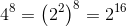
If  , then what is
  ?
?
If
Tap to reveal answer

Follow the order of operations by solving the expression within the parentheses first.



Return to solve the original expression.





Follow the order of operations by solving the expression within the parentheses first.
Return to solve the original expression.
← Didn't Know|Knew It →
Solve:

Solve:
Tap to reveal answer
Subtract the denominator exponent from the numerator's exponent, since they have the same base.
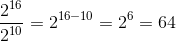
Subtract the denominator exponent from the numerator's exponent, since they have the same base.
← Didn't Know|Knew It →

Tap to reveal answer
To simplify, we can rewrite the numerator using a common exponential base.
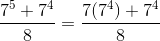
Now, we can factor out the numerator.

The eights cancel to give us our final answer.

To simplify, we can rewrite the numerator using a common exponential base.
Now, we can factor out the numerator.
The eights cancel to give us our final answer.
← Didn't Know|Knew It →
If m and n are integers such that m < n < 0 and _m_2 – _n_2 = 7, which of the following can be the value of m + n?
I. –5
II. –7
III. –9
If m and n are integers such that m < n < 0 and _m_2 – _n_2 = 7, which of the following can be the value of m + n?
I. –5
II. –7
III. –9
Tap to reveal answer
m and n are both less than zero and thus negative integers, giving us _m_2 and _n_2 as perfect squares. The only perfect squares with a difference of 7 is 16 – 9, therefore m = –4 and n = –3.
m and n are both less than zero and thus negative integers, giving us _m_2 and _n_2 as perfect squares. The only perfect squares with a difference of 7 is 16 – 9, therefore m = –4 and n = –3.
← Didn't Know|Knew It →
If , then what is ?
If
Tap to reveal answer
Follow the order of operations by solving the expression within the parentheses first.
Return to solve the original expression.
Follow the order of operations by solving the expression within the parentheses first.
Return to solve the original expression.
← Didn't Know|Knew It →
Solve:
Solve:
Tap to reveal answer
Subtract the denominator exponent from the numerator's exponent, since they have the same base.
Subtract the denominator exponent from the numerator's exponent, since they have the same base.
← Didn't Know|Knew It →
Tap to reveal answer
To simplify, we can rewrite the numerator using a common exponential base.
Now, we can factor out the numerator.
The eights cancel to give us our final answer.
To simplify, we can rewrite the numerator using a common exponential base.
Now, we can factor out the numerator.
The eights cancel to give us our final answer.
← Didn't Know|Knew It →
If m and n are integers such that m < n < 0 and _m_2 – _n_2 = 7, which of the following can be the value of m + n?
I. –5
II. –7
III. –9
If m and n are integers such that m < n < 0 and _m_2 – _n_2 = 7, which of the following can be the value of m + n?
I. –5
II. –7
III. –9
Tap to reveal answer
m and n are both less than zero and thus negative integers, giving us _m_2 and _n_2 as perfect squares. The only perfect squares with a difference of 7 is 16 – 9, therefore m = –4 and n = –3.
m and n are both less than zero and thus negative integers, giving us _m_2 and _n_2 as perfect squares. The only perfect squares with a difference of 7 is 16 – 9, therefore m = –4 and n = –3.
← Didn't Know|Knew It →
If , then what is ?
If
Tap to reveal answer
Follow the order of operations by solving the expression within the parentheses first.
Return to solve the original expression.
Follow the order of operations by solving the expression within the parentheses first.
Return to solve the original expression.
← Didn't Know|Knew It →
Solve:
Solve:
Tap to reveal answer
Subtract the denominator exponent from the numerator's exponent, since they have the same base.
Subtract the denominator exponent from the numerator's exponent, since they have the same base.
← Didn't Know|Knew It →
Tap to reveal answer
To simplify, we can rewrite the numerator using a common exponential base.
Now, we can factor out the numerator.
The eights cancel to give us our final answer.
To simplify, we can rewrite the numerator using a common exponential base.
Now, we can factor out the numerator.
The eights cancel to give us our final answer.
← Didn't Know|Knew It →
If , then what is ?
If
Tap to reveal answer
Follow the order of operations by solving the expression within the parentheses first.
Return to solve the original expression.
Follow the order of operations by solving the expression within the parentheses first.
Return to solve the original expression.
← Didn't Know|Knew It →
If m and n are integers such that m < n < 0 and _m_2 – _n_2 = 7, which of the following can be the value of m + n?
I. –5
II. –7
III. –9
If m and n are integers such that m < n < 0 and _m_2 – _n_2 = 7, which of the following can be the value of m + n?
I. –5
II. –7
III. –9
Tap to reveal answer
m and n are both less than zero and thus negative integers, giving us _m_2 and _n_2 as perfect squares. The only perfect squares with a difference of 7 is 16 – 9, therefore m = –4 and n = –3.
m and n are both less than zero and thus negative integers, giving us _m_2 and _n_2 as perfect squares. The only perfect squares with a difference of 7 is 16 – 9, therefore m = –4 and n = –3.
← Didn't Know|Knew It →
Solve:
Solve:
Tap to reveal answer
Subtract the denominator exponent from the numerator's exponent, since they have the same base.
Subtract the denominator exponent from the numerator's exponent, since they have the same base.
← Didn't Know|Knew It →
Tap to reveal answer
To simplify, we can rewrite the numerator using a common exponential base.
Now, we can factor out the numerator.
The eights cancel to give us our final answer.
To simplify, we can rewrite the numerator using a common exponential base.
Now, we can factor out the numerator.
The eights cancel to give us our final answer.
← Didn't Know|Knew It →
If , then what is ?
If
Tap to reveal answer
Follow the order of operations by solving the expression within the parentheses first.
Return to solve the original expression.
Follow the order of operations by solving the expression within the parentheses first.
Return to solve the original expression.
← Didn't Know|Knew It →
If m and n are integers such that m < n < 0 and _m_2 – _n_2 = 7, which of the following can be the value of m + n?
I. –5
II. –7
III. –9
If m and n are integers such that m < n < 0 and _m_2 – _n_2 = 7, which of the following can be the value of m + n?
I. –5
II. –7
III. –9
Tap to reveal answer
m and n are both less than zero and thus negative integers, giving us _m_2 and _n_2 as perfect squares. The only perfect squares with a difference of 7 is 16 – 9, therefore m = –4 and n = –3.
m and n are both less than zero and thus negative integers, giving us _m_2 and _n_2 as perfect squares. The only perfect squares with a difference of 7 is 16 – 9, therefore m = –4 and n = –3.
← Didn't Know|Knew It →
Solve:
Solve:
Tap to reveal answer
Subtract the denominator exponent from the numerator's exponent, since they have the same base.
Subtract the denominator exponent from the numerator's exponent, since they have the same base.
← Didn't Know|Knew It →
Tap to reveal answer
To simplify, we can rewrite the numerator using a common exponential base.
Now, we can factor out the numerator.
The eights cancel to give us our final answer.
To simplify, we can rewrite the numerator using a common exponential base.
Now, we can factor out the numerator.
The eights cancel to give us our final answer.
← Didn't Know|Knew It →