How to use scientific notation - PSAT Math
Card 1 of 28
Express the square of  in scientific notation.
Express the square of
Tap to reveal answer
Take advantage of the exponent rules.

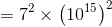





Take advantage of the exponent rules.
← Didn't Know|Knew It →
Express 0.000000076 in scientific notation.
Express 0.000000076 in scientific notation.
Tap to reveal answer
Write the number:

Counting the number of places, move the decimal point to the right until it is after the first nonzero digit:

The resulting number is 7.6; the number of places the decimal point moved to the right was 8. In scientific notation, this number is  .
.
Write the number:
Counting the number of places, move the decimal point to the right until it is after the first nonzero digit:
The resulting number is 7.6; the number of places the decimal point moved to the right was 8. In scientific notation, this number is
← Didn't Know|Knew It →
Put the following value in scientific notation:

Put the following value in scientific notation:
Tap to reveal answer
Our first value for scientific notation should be between  and
and  . We then multiply this value by
  raised to a power equal to the number of spaces our decimal has moved to the left.
Our first value for scientific notation should be between
← Didn't Know|Knew It →
The number  is equivalent to which of the following?
The number
Tap to reveal answer
Each of the answers to this question are in scientific notation. To determine the exponent on the 10, see how many places you need to move the decimal over to get from your original number to 2.79.
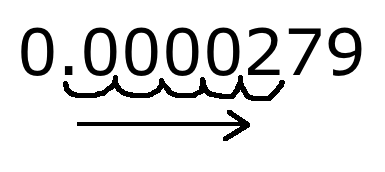
Because the decimal place moves 5 places, the exponent will be 5, and because the decimal moves to the RIGHT, the exponent is going to be negative.
So the answer to the quesiton is 
Each of the answers to this question are in scientific notation. To determine the exponent on the 10, see how many places you need to move the decimal over to get from your original number to 2.79.
Because the decimal place moves 5 places, the exponent will be 5, and because the decimal moves to the RIGHT, the exponent is going to be negative.
So the answer to the quesiton is
← Didn't Know|Knew It →
Express the square of in scientific notation.
Express the square of
Tap to reveal answer
Take advantage of the exponent rules.
Take advantage of the exponent rules.
← Didn't Know|Knew It →
Express 0.000000076 in scientific notation.
Express 0.000000076 in scientific notation.
Tap to reveal answer
Write the number:
Counting the number of places, move the decimal point to the right until it is after the first nonzero digit:
The resulting number is 7.6; the number of places the decimal point moved to the right was 8. In scientific notation, this number is .
Write the number:
Counting the number of places, move the decimal point to the right until it is after the first nonzero digit:
The resulting number is 7.6; the number of places the decimal point moved to the right was 8. In scientific notation, this number is
← Didn't Know|Knew It →
Put the following value in scientific notation:
Put the following value in scientific notation:
Tap to reveal answer
Our first value for scientific notation should be between and . We then multiply this value by raised to a power equal to the number of spaces our decimal has moved to the left.
Our first value for scientific notation should be between
← Didn't Know|Knew It →
The number is equivalent to which of the following?
The number
Tap to reveal answer
Each of the answers to this question are in scientific notation. To determine the exponent on the 10, see how many places you need to move the decimal over to get from your original number to 2.79.
Because the decimal place moves 5 places, the exponent will be 5, and because the decimal moves to the RIGHT, the exponent is going to be negative.
So the answer to the quesiton is
Each of the answers to this question are in scientific notation. To determine the exponent on the 10, see how many places you need to move the decimal over to get from your original number to 2.79.
Because the decimal place moves 5 places, the exponent will be 5, and because the decimal moves to the RIGHT, the exponent is going to be negative.
So the answer to the quesiton is
← Didn't Know|Knew It →
Express the square of in scientific notation.
Express the square of
Tap to reveal answer
Take advantage of the exponent rules.
Take advantage of the exponent rules.
← Didn't Know|Knew It →
Express 0.000000076 in scientific notation.
Express 0.000000076 in scientific notation.
Tap to reveal answer
Write the number:
Counting the number of places, move the decimal point to the right until it is after the first nonzero digit:
The resulting number is 7.6; the number of places the decimal point moved to the right was 8. In scientific notation, this number is .
Write the number:
Counting the number of places, move the decimal point to the right until it is after the first nonzero digit:
The resulting number is 7.6; the number of places the decimal point moved to the right was 8. In scientific notation, this number is
← Didn't Know|Knew It →
Put the following value in scientific notation:
Put the following value in scientific notation:
Tap to reveal answer
Our first value for scientific notation should be between and . We then multiply this value by raised to a power equal to the number of spaces our decimal has moved to the left.
Our first value for scientific notation should be between
← Didn't Know|Knew It →
The number is equivalent to which of the following?
The number
Tap to reveal answer
Each of the answers to this question are in scientific notation. To determine the exponent on the 10, see how many places you need to move the decimal over to get from your original number to 2.79.
Because the decimal place moves 5 places, the exponent will be 5, and because the decimal moves to the RIGHT, the exponent is going to be negative.
So the answer to the quesiton is
Each of the answers to this question are in scientific notation. To determine the exponent on the 10, see how many places you need to move the decimal over to get from your original number to 2.79.
Because the decimal place moves 5 places, the exponent will be 5, and because the decimal moves to the RIGHT, the exponent is going to be negative.
So the answer to the quesiton is
← Didn't Know|Knew It →
Express the square of in scientific notation.
Express the square of
Tap to reveal answer
Take advantage of the exponent rules.
Take advantage of the exponent rules.
← Didn't Know|Knew It →
Express 0.000000076 in scientific notation.
Express 0.000000076 in scientific notation.
Tap to reveal answer
Write the number:
Counting the number of places, move the decimal point to the right until it is after the first nonzero digit:
The resulting number is 7.6; the number of places the decimal point moved to the right was 8. In scientific notation, this number is .
Write the number:
Counting the number of places, move the decimal point to the right until it is after the first nonzero digit:
The resulting number is 7.6; the number of places the decimal point moved to the right was 8. In scientific notation, this number is
← Didn't Know|Knew It →
Put the following value in scientific notation:
Put the following value in scientific notation:
Tap to reveal answer
Our first value for scientific notation should be between and . We then multiply this value by raised to a power equal to the number of spaces our decimal has moved to the left.
Our first value for scientific notation should be between
← Didn't Know|Knew It →
The number is equivalent to which of the following?
The number
Tap to reveal answer
Each of the answers to this question are in scientific notation. To determine the exponent on the 10, see how many places you need to move the decimal over to get from your original number to 2.79.
Because the decimal place moves 5 places, the exponent will be 5, and because the decimal moves to the RIGHT, the exponent is going to be negative.
So the answer to the quesiton is
Each of the answers to this question are in scientific notation. To determine the exponent on the 10, see how many places you need to move the decimal over to get from your original number to 2.79.
Because the decimal place moves 5 places, the exponent will be 5, and because the decimal moves to the RIGHT, the exponent is going to be negative.
So the answer to the quesiton is
← Didn't Know|Knew It →
Express the square of in scientific notation.
Express the square of
Tap to reveal answer
Take advantage of the exponent rules.
Take advantage of the exponent rules.
← Didn't Know|Knew It →
Express 0.000000076 in scientific notation.
Express 0.000000076 in scientific notation.
Tap to reveal answer
Write the number:
Counting the number of places, move the decimal point to the right until it is after the first nonzero digit:
The resulting number is 7.6; the number of places the decimal point moved to the right was 8. In scientific notation, this number is .
Write the number:
Counting the number of places, move the decimal point to the right until it is after the first nonzero digit:
The resulting number is 7.6; the number of places the decimal point moved to the right was 8. In scientific notation, this number is
← Didn't Know|Knew It →
Put the following value in scientific notation:
Put the following value in scientific notation:
Tap to reveal answer
Our first value for scientific notation should be between and . We then multiply this value by raised to a power equal to the number of spaces our decimal has moved to the left.
Our first value for scientific notation should be between
← Didn't Know|Knew It →
The number is equivalent to which of the following?
The number
Tap to reveal answer
Each of the answers to this question are in scientific notation. To determine the exponent on the 10, see how many places you need to move the decimal over to get from your original number to 2.79.
Because the decimal place moves 5 places, the exponent will be 5, and because the decimal moves to the RIGHT, the exponent is going to be negative.
So the answer to the quesiton is
Each of the answers to this question are in scientific notation. To determine the exponent on the 10, see how many places you need to move the decimal over to get from your original number to 2.79.
Because the decimal place moves 5 places, the exponent will be 5, and because the decimal moves to the RIGHT, the exponent is going to be negative.
So the answer to the quesiton is
← Didn't Know|Knew It →