Operations with Fractions - SSAT Upper Level Quantitative
Card 1 of 256
Janice had  of a cup of milk. If she used
  cup to make some scrambled eggs, how much of a cup of milk does she have left?
Janice had
Tap to reveal answer
Subtract the two fractions. To subtract them, they must have a common denominator. Multiply the numerator and denominator of  by
by  to create a common denominator of
  , then subtract the numerators and reduce the resulting fraction.

Subtract the two fractions. To subtract them, they must have a common denominator. Multiply the numerator and denominator of
← Didn't Know|Knew It →
What is the result of this operation?

What is the result of this operation?
Tap to reveal answer
Since the denominators are exactly the same, we can just subtract the tops.
So

By reducing we get

Since the denominators are exactly the same, we can just subtract the tops.
So
By reducing we get
← Didn't Know|Knew It →
What is the result of this operation?

What is the result of this operation?
Tap to reveal answer
Since the denominators are the same, we can just subtract the numerators.
So

Since the denominators are the same, we can just subtract the numerators.
So
← Didn't Know|Knew It →
What is the result of this operation?

What is the result of this operation?
Tap to reveal answer
Since the denominators are the same, we can just subtract the numerators.

By reducing our result, we get

Since the denominators are the same, we can just subtract the numerators.
By reducing our result, we get
← Didn't Know|Knew It →
What is the result of this operation?

What is the result of this operation?
Tap to reveal answer
Since the denominators are the same, we can just subtract the numerators.

The result can just be reduced to

Since the denominators are the same, we can just subtract the numerators.
The result can just be reduced to
← Didn't Know|Knew It →
What is the result of this operation?

What is the result of this operation?
Tap to reveal answer
Since the denominators are different, we need to transform them into the same denominator.
So

becomes


Now subtract the numerators

Since the denominators are different, we need to transform them into the same denominator.
So
becomes
Now subtract the numerators
← Didn't Know|Knew It →
What is the result of the operation

What is the result of the operation
Tap to reveal answer
Since the denominators are the exact same, we can just subtract the numerators.

Since the denominators are the exact same, we can just subtract the numerators.
← Didn't Know|Knew It →
What is the result of this operation

What is the result of this operation
Tap to reveal answer
Since the denominators are the exact same, we can just subtract the numerators.
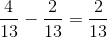
Since the denominators are the exact same, we can just subtract the numerators.
← Didn't Know|Knew It →
What is the result of this operation

What is the result of this operation
Tap to reveal answer
Since the denominators are the same, we can just subtract the numerators.

which we can reduce to

Since the denominators are the same, we can just subtract the numerators.
which we can reduce to
← Didn't Know|Knew It →
What is the result of this operation

What is the result of this operation
Tap to reveal answer
Since the denominators are the same, we can just subtract the numerators.

Since the denominators are the same, we can just subtract the numerators.
← Didn't Know|Knew It →
Multiply these fractions:

Multiply these fractions:
Tap to reveal answer
To multiply the fractions, simply multiply the numerators together and the denominators together.

Since this fraction is in its simplest form, that is the final answer.
To multiply the fractions, simply multiply the numerators together and the denominators together.
Since this fraction is in its simplest form, that is the final answer.
← Didn't Know|Knew It →
Simplify the expression.

Simplify the expression.
Tap to reveal answer

Start with the terms in parentheses, using the order of operations. Find the least common denominator.


Add the fractions in parentheses.

Multiply the fractions and simplify.

Start with the terms in parentheses, using the order of operations. Find the least common denominator.
Add the fractions in parentheses.
Multiply the fractions and simplify.
← Didn't Know|Knew It →
Simplify the expression  .
.
Simplify the expression
Tap to reveal answer
Beginning with  , we multiply across both numerators and denominators for both terms:


Reducing the fraction to its simplest form by dividing by the Greatest Common Factor:


Beginning with
Reducing the fraction to its simplest form by dividing by the Greatest Common Factor:
← Didn't Know|Knew It →
Simplify the expression  .
.
Simplify the expression
Tap to reveal answer
Multiplying across the numerators and denominators of both terms and simplifying:

Multiplying across the numerators and denominators of both terms and simplifying:
← Didn't Know|Knew It →
Simplify the expression  .
.
Simplify the expression
Tap to reveal answer

First, multiply straight across. Multiply the numerators together and then multiply the denominators together.


From here, simplify the expression by factoring out the Greatest Common Factor.
In this case the Greatest Common Factor is 20.


First, multiply straight across. Multiply the numerators together and then multiply the denominators together.
From here, simplify the expression by factoring out the Greatest Common Factor.
In this case the Greatest Common Factor is 20.
← Didn't Know|Knew It →
Steven runs a pizza shop. On Monday, he used  of a bag of flour. On Tuesday, he used
  the amount he used on Monday. How much of a bag of flour did he use on Tuesday?
Steven runs a pizza shop. On Monday, he used
Tap to reveal answer
To find how many bags of flour he used on Tuesday, multiply  by
by  .
.
To multiply fractions, multiply the numerators together, then multiply the denominators together.

To find how many bags of flour he used on Tuesday, multiply
To multiply fractions, multiply the numerators together, then multiply the denominators together.
← Didn't Know|Knew It →
In Mary's class,  of the class owns a dog, and of those in the class that own a dog,
  also owns a cat. What fraction of the class owns both a dog and a cat?
In Mary's class,
Tap to reveal answer
Multiply  by
by  to find out how much of the class have both a cat and a dog.

Multiply
← Didn't Know|Knew It →
In the morning, Tina ate  of a cake. For her afternoon snack she ate
  as much as she did in the morning. What fraction of the cake did Tina eat for her afternoon snack?
In the morning, Tina ate
Tap to reveal answer
Multiply  by
by  to find how much cake Tina ate in the afternoon.

Multiply
← Didn't Know|Knew It →
A certain recipe for a batch of chocolate cookies calls for  of a cup of sugar to be used. If Mike only wants to make
  of a batch, how much of a cup of sugar should he use?
A certain recipe for a batch of chocolate cookies calls for
Tap to reveal answer
Multiply  by
by  to find out how much sugar he needs to use.

Multiply
← Didn't Know|Knew It →
At an arcade,  of the games are fighting games. Of those games,
  are Japanese games. What fraction of the games at the arcade are Japanese fighting games?
At an arcade,
Tap to reveal answer
To find what fraction of the games are Japanese fighting ones, multiply  by
by  .
.

To find what fraction of the games are Japanese fighting ones, multiply
← Didn't Know|Knew It →