How to find the decimal equivalent of a fraction - SSAT Upper Level Quantitative
Card 1 of 64
Which of the following fractions is closest to 0.6?
Which of the following fractions is closest to 0.6?
Tap to reveal answer
For each fraction, divide each numerator by its denominator to get its decimal representation, then subtract to find its difference from 0.6.


 is the closest to 0.6 of the five.
For each fraction, divide each numerator by its denominator to get its decimal representation, then subtract to find its difference from 0.6.
← Didn't Know|Knew It →
Express  as a decimal.
Express
Tap to reveal answer
Divide 8 by 15:
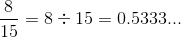
The 3 repeats, so the correct choice is  .
.
Divide 8 by 15:
The 3 repeats, so the correct choice is
← Didn't Know|Knew It →
Give the decimal equivalent of  .
.
Give the decimal equivalent of
Tap to reveal answer
Divide 11 by 18:

The 1 repeats infinitely, so this can be rewritten as  .
.
Divide 11 by 18:
The 1 repeats infinitely, so this can be rewritten as
← Didn't Know|Knew It →
Give the decimal equivalent of  .
.
Give the decimal equivalent of
Tap to reveal answer
Divide 5 by 27:

The group "185" repeats infinitely, so this can be written as  .
.
Divide 5 by 27:
The group "185" repeats infinitely, so this can be written as
← Didn't Know|Knew It →
Give the decimal equivalent of  .
.
Give the decimal equivalent of
Tap to reveal answer
Divide 7 by 36:

The 4 repeats infinitely, so this can be rewritten as  .
.
Divide 7 by 36:
The 4 repeats infinitely, so this can be rewritten as
← Didn't Know|Knew It →
Write the value of this expression as a decimal:

Write the value of this expression as a decimal:
Tap to reveal answer
Simplify the sum by taking the least common denominator, which is 12:


Divide 13 by 12:

Simplify the sum by taking the least common denominator, which is 12:
Divide 13 by 12:
← Didn't Know|Knew It →
Let  ,
,  ,
, 
Which of the following is closest to  ?
?
Let
Which of the following is closest to
Tap to reveal answer


The correct choice is 1.8.
The correct choice is 1.8.
← Didn't Know|Knew It →
Simplify and express as a decimal:

Simplify and express as a decimal:
Tap to reveal answer

 ,
,
so the correct response is  .
.
so the correct response is
← Didn't Know|Knew It →
Let  and
and 
Which of the following is closest to  ?
?
Let
Which of the following is closest to
Tap to reveal answer


The correct choice is 1.8.
The correct choice is 1.8.
← Didn't Know|Knew It →
Let  ,
,  , and
, and  .
.
Which of the following is closest to  ?
?
Let
Which of the following is closest to
Tap to reveal answer

The correct response is 1.
The correct response is 1.
← Didn't Know|Knew It →
Define an operation  as follows:
For all real numbers  :
:

Which of the following is equal to  ?
?
Define an operation
For all real numbers
Which of the following is equal to
Tap to reveal answer


 ,
,
is the correct response.
is the correct response.
← Didn't Know|Knew It →
Define an operation  as follows:
For all real numbers  :
:

Which of the following is closest to  ?
?
Define an operation
For all real numbers
Which of the following is closest to
Tap to reveal answer


The correct choice is 0.15.
The correct choice is 0.15.
← Didn't Know|Knew It →
Which of the following is a true statement?
Which of the following is a true statement?
Tap to reveal answer
Divide 7 by 13. The result is as follows:

The correct choice is that  .
.
Divide 7 by 13. The result is as follows:
The correct choice is that
← Didn't Know|Knew It →
Which of the following is closest to the sum of two thirds and four fifths?
Which of the following is closest to the sum of two thirds and four fifths?
Tap to reveal answer

Divide 22 by 15:

Of the five choices, the closest is 1.45.
Divide 22 by 15:
Of the five choices, the closest is 1.45.
← Didn't Know|Knew It →
Which of the following is a true statement?
Which of the following is a true statement?
Tap to reveal answer
Divide 19 by 27:

 ,
,
so
 .
.
Divide 19 by 27:
so
← Didn't Know|Knew It →
Which of the following falls between 0.32 and 0.33?
Which of the following falls between 0.32 and 0.33?
Tap to reveal answer
Since all of the fractions have 77 as a denominator, one way to solve this problem is to let  be the numerator of the correct fraction. Therefore, the equivalent problem is to find integer
  such that

Multiply each expression by  :
:


Therefore,  , making
  the correct choice.
Since all of the fractions have 77 as a denominator, one way to solve this problem is to let
Multiply each expression by
Therefore,
← Didn't Know|Knew It →
Which of the following fractions is closest to 0.6?
Which of the following fractions is closest to 0.6?
Tap to reveal answer
For each fraction, divide each numerator by its denominator to get its decimal representation, then subtract to find its difference from 0.6.
is the closest to 0.6 of the five.
For each fraction, divide each numerator by its denominator to get its decimal representation, then subtract to find its difference from 0.6.
← Didn't Know|Knew It →
Express as a decimal.
Express
Tap to reveal answer
Divide 8 by 15:
The 3 repeats, so the correct choice is .
Divide 8 by 15:
The 3 repeats, so the correct choice is
← Didn't Know|Knew It →
Give the decimal equivalent of .
Give the decimal equivalent of
Tap to reveal answer
Divide 11 by 18:
The 1 repeats infinitely, so this can be rewritten as .
Divide 11 by 18:
The 1 repeats infinitely, so this can be rewritten as
← Didn't Know|Knew It →
Give the decimal equivalent of .
Give the decimal equivalent of
Tap to reveal answer
Divide 5 by 27:
The group "185" repeats infinitely, so this can be written as .
Divide 5 by 27:
The group "185" repeats infinitely, so this can be written as
← Didn't Know|Knew It →