Inverse Trigonometric Functions
Help Questions
Pre-Calculus › Inverse Trigonometric Functions
Evaluate:


Explanation

Evaluate the following expression:


Explanation
This one seems complicated but becomes considerably easier once you implement the fact that the composite 


Given that 


Explanation
Given the value of the opposite and hypotenuse sides from the sine expression (3 and 4 respectively) we can use the Pythagorean Theorem to find the 3rd side (we’ll call it “t”): 
From here we can deduce the value of 

Evaluate the following:



Explanation
For this particular problem we need to recall that the inverse cosine cancels out the cosine therefore,

So the expression just becomes
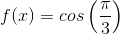
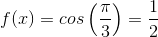
From here, recall the unit circle for specific angles such as 
Thus,
Approximate the following:


Explanation
This one is rather simple with knowledge of the unit circle: the value is extremely close to zero, of which 
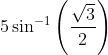
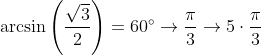
Evaluate:


Explanation

Evaluate the following:
Explanation
For this particular problem we need to recall that the inverse cosine cancels out the cosine therefore,
So the expression just becomes
From here, recall the unit circle for specific angles such as
Thus,
Given that
Explanation
Given the value of the opposite and hypotenuse sides from the sine expression (3 and 4 respectively) we can use the Pythagorean Theorem to find the 3rd side (we’ll call it “t”):
From here we can deduce the value of
Evaluate:
Explanation
Evaluate the following expression:
Explanation
This one seems complicated but becomes considerably easier once you implement the fact that the composite